







Question: PLEASE FIX the errors of the program it's not running import pandas as pd import numpy as np from sklearn.preprocessing import StandardScaler from sklearn.linear_model import
PLEASE FIX the errors of the program it's not running
import pandas as pd
import numpy as np
from sklearn.preprocessing import StandardScaler
from sklearn.linear_model import Perceptron
from sklearn.metrics import accuracy_score
import matplotlib.pyplot as plt
from matplotlib.colors import ListedColormap
from sklearn.model_selection import GridSearchCV
tr_data = pd.read_csv("http://venus.cs.qc.cuny.edu/~gan/cs371/hw/train.csv")
te_data = pd.read_csv("http://venus.cs.qc.cuny.edu/~gan/cs371/hw/test.csv")
tr_data = tr_data.as_matrix()
train_x = [[x[1], x[2]] for x in tr_data]
train_y = [x[0] for x in tr_data]
te_data = te_data.as_matrix()
test_x = [[x[1], x[2]] for x in te_data]
test_y = [x[0] for x in te_data]
plt.figure(figsize=(10, 6))
cm_bright = ListedColormap(['#0000FF', '#FF0000'])
clf_b = Perceptron(random_state=241)
clf_b.fit(train_x, train_y)
plot_x = [x[0] for x in test_x]
plot_y = [x[1] for x in test_x]
x_min, x_max = min(plot_x) - 1, max(plot_x) + 1
y_min, y_max = min(plot_y) - 1, max(plot_y) + 1
xx, yy = np.meshgrid(np.arange(x_min, x_max, 0.02),
np.arange(y_min, y_max, 2))
z = clf_b.predict(np.c_[xx.ravel(), yy.ravel()])
z = z.reshape(xx.shape)
plt.contourf(xx, yy, z, cmap=plt.cm.coolwarm, alpha=0.8)
plt.scatter(plot_x, plot_y, c=test_y, cmap=cm_bright)
plt.title('Before scaling features accuracy = 66%')
#plt.show()
plt.figure(figsize=(10, 6))
scaler = StandardScaler()
X_train_scaled = scaler.fit_transform(train_x)
X_test_scaled = scaler.transform(test_x)
clf_a = Perceptron(random_state=241)
clf_a.fit(X_train_scaled, train_y)
plot_x = [x[0] for x in X_test_scaled]
plot_y = [x[1] for x in X_test_scaled]
x_min, x_max = min(plot_x) - 1, max(plot_x) + 1
y_min, y_max = min(plot_y) - 1, max(plot_y) + 1
xx, yy = np.meshgrid(np.arange(x_min, x_max, 0.02),
np.arange(y_min, y_max, 0.02))
z = clf_a.predict(np.c_[xx.ravel(), yy.ravel()])
z = z.reshape(xx.shape)
plt.contourf(xx, yy, z, cmap=plt.cm.coolwarm, alpha=0.8)
plt.scatter(plot_x, plot_y, c=test_y, cmap=cm_bright)
plt.title('After scaling features accuracy = 85%')
predicted = clf_b.predict(test_x)
before_scale = accuracy_score(test_y, predicted)
predicted = clf_a.predict(X_test_scaled)
after_scale = accuracy_score(test_y, predicted)
plt.show()
from sklearn.svm import SVC
from sklearn.model_selection import GridSearchCV
from sklearn.model_selection import train_test_split
from sklearn.datasets import make_circles
from sklearn.model_selection import StratifiedShuffleSplit
X, y = make_circles(n_samples=300, noise=0.2, factor=0.5, random_state=241)
X = scaler.fit_transform(X)
X_train, X_test, y_train, y_test = train_test_split(X, y, test_size=0.3, random_state=42)
cv = StratifiedShuffleSplit(n_splits=5, test_size=0.25, random_state=241)
C_range = np.logspace(-5, 5, num=10)
gamma_range = np.logspace(-8, 3, num=11)
parametrs = dict(kernel=['rbf'], gamma=gamma_range, C=C_range)
grid = GridSearchCV(SVC(), param_grid=parametrs, cv=cv)
grid.fit(X_train, y_train)
x_min, x_max = X[:, 0].min() - 0.5, X[:, 0].max() + 0.5
y_min, y_max = X[:, 1].min() - 0.5, X[:, 1].max() + 0.5
xx, yy = np.meshgrid(np.arange(x_min, x_max, 0.02),
np.arange(y_min, y_max, 0.02))
plt.figure(figsize=(10, 4))
plt.subplot(1, 2, 1)
plt.xticks(())
plt.yticks(())
z = grid.predict(np.c_[xx.ravel(), yy.ravel()])
predicted = grid.predict(X_test)
z = z.reshape(xx.shape)
plt.contourf(xx, yy, z, cmap=plt.cm.coolwarm, alpha=0.8)
plt.scatter(X_test[:, 0], X_test[:, 1], c=y_test, cmap=cm_bright)
plt.title("SVM with RBF kernel. Accuracy = %.2f" % (accuracy_score(y_test, predicted)))
plt.subplot(1, 2, 2)
plt.xticks(())
plt.yticks(())
clf = Perceptron(random_state=241)
clf.fit(X_train, y_train)
z = clf.predict(np.c_[xx.ravel(), yy.ravel()])
predicted = clf.predict(X_test)
z = z.reshape(xx.shape)
plt.contourf(xx, yy, z, cmap=plt.cm.coolwarm, alpha=0.8)
plt.scatter(X_test[:, 0], X_test[:, 1], c=y_test, cmap=cm_bright)
plt.title("Perceptron. Accuracy = %.2f" % (accuracy_score(y_test, predicted)))
plt.show()
plt.figure(figsize=(12, 8))
C_range = [0.1, 1, 10]
gamma_range = [0.01, 0.1, 1]
k = 1
for C in C_range:
for gamma in gamma_range:
plt.subplot(len(C_range), len(gamma_range), k)
plt.xticks(())
plt.yticks(())
k = k + 1
clf = SVC(kernel='rbf', C=C, gamma=gamma)
clf.fit(X_train, y_train)
z = clf.predict(np.c_[xx.ravel(), yy.ravel()])
z = z.reshape(xx.shape)
plt.contourf(xx, yy, z, cmap=plt.cm.coolwarm, alpha=0.8)
plt.scatter(X_test[:, 0], X_test[:, 1], c=y_test, cmap=cm_bright)
predicted = clf.predict(X_test)
acc = accuracy_score(y_test, predicted)
plt.title("gamma=%.2f, C=%.2f acc=%.2f" % (gamma, C, acc), size='medium')
plt.show()
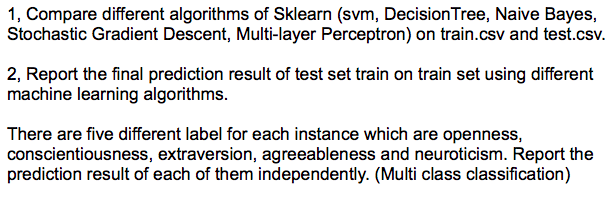
1, Compare different algorithms of Sklearn (svm, DecisionTree, Naive Bayes, Stochastic Gradient Descent, Multi-layer Perceptron) on train.csv and test.csv. 2, Report the final prediction result of test set train on train set using different machine learning algorithms. There are five different label for each instance which are openness, conscientiousness, extraversion, agreeableness and neuroticism. Report the prediction result of each of them independently. (Multi class classification)
Step by Step Solution
There are 3 Steps involved in it

Get step-by-step solutions from verified subject matter experts
 Study Help