







Question: reject the null hypothesis when it is true, ( 2 ) you reject the null hypothesis when it is true, ( 3 ) you don't
reject the null hypothesis when it is true, you reject the null hypothesis when it is true, you don't reject the null hypothesis when it is fal and you reject the null hypothesis when it is false.
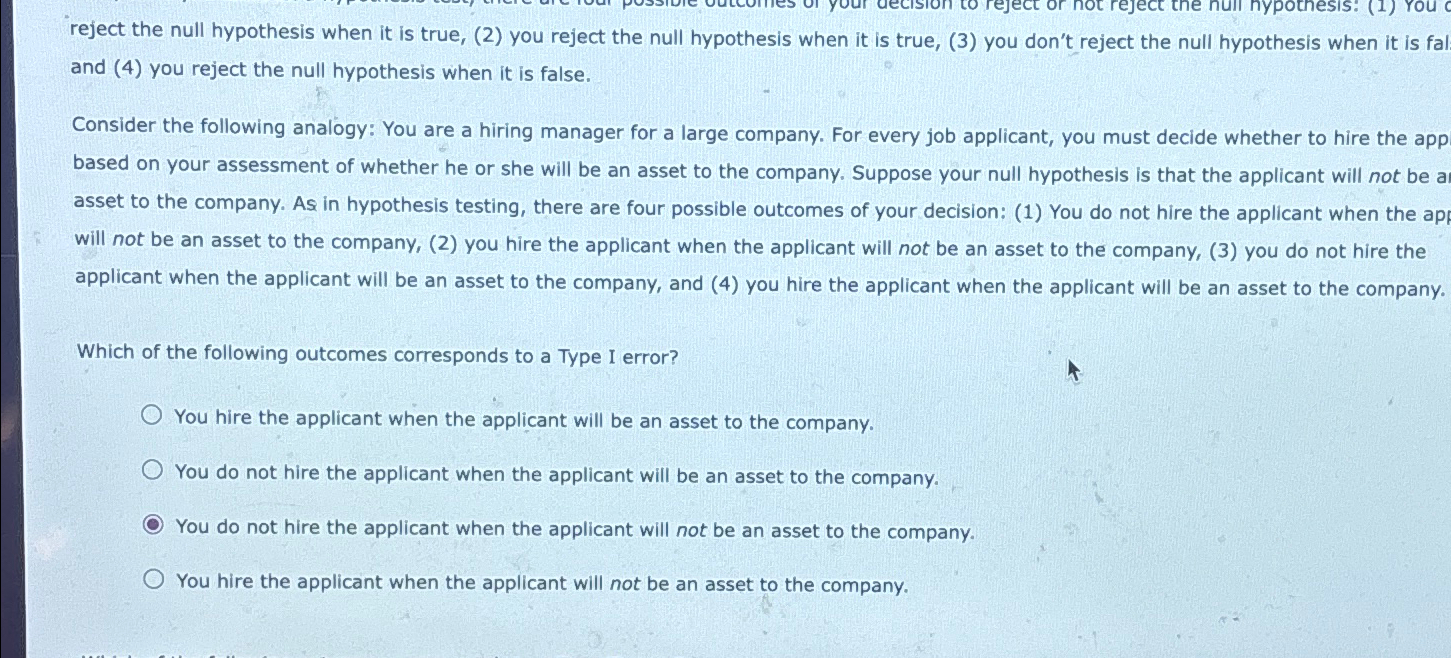
Consider the following analogy: You are a hiring manager for a large company. For every job applicant, you must decide whether to hire the app based on your assessment of whether he or she will be an asset to the company. Suppose your null hypothesis is that the applicant will not be a asset to the company. As in hypothesis testing, there are four possible outcomes of your decision: You do not hire the applicant when the apl will not be an asset to the company, you hire the applicant when the applicant will not be an asset to the company, you do not hire the applicant when the applicant will be an asset to the company, and you hire the applicant when the applicant will be an asset to the company.
Which of the following outcomes corresponds to a Type I error?
You hire the applicant when the applicant will be an asset to the company.
You do not hire the applicant when the applicant will be an asset to the company.
You do not hire the applicant when the applicant will not be an asset to the company.
You hire the applicant when the applicant will not be an asset to the company.
Step by Step Solution
There are 3 Steps involved in it
1 Expert Approved Answer
Step: 1 Unlock

Question Has Been Solved by an Expert!
Get step-by-step solutions from verified subject matter experts
Step: 2 Unlock
Step: 3 Unlock
 Study Help