







Question: relation R(A, B, C, D, E). given the following set F of functional dependencies for a F {ABC, BCD, EA, BEC, ABE D} =
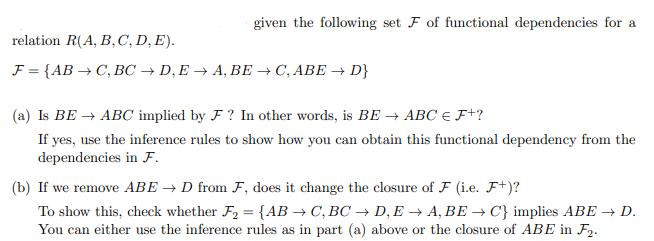
relation R(A, B, C, D, E). given the following set F of functional dependencies for a F {ABC, BCD, EA, BEC, ABE D} = (a) Is BE ABC implied by F? In other words, is BE ABC F+? If yes, use the inference rules to show how you can obtain this functional dependency from the dependencies in F. (b) If we remove ABED from F, does it change the closure of F (i.e. F+)? To show this, check whether F2 = {ABC, BCD, EA, BEC} implies ABE D. You can either use the inference rules as in part (a) above or the closure of ABE in F2.
Step by Step Solution
There are 3 Steps involved in it
To solve these questions we will use Armstrongs axioms which are a set of rules used for manipulatin... View full answer

Get step-by-step solutions from verified subject matter experts
 Study Help