





Question: Remarks & Instructions: 1. Do not scale any coefficient or function. All coefficients must be numerical values. 2. Right-hand side of each constraint should be
Remarks & Instructions: 1. Do not scale any

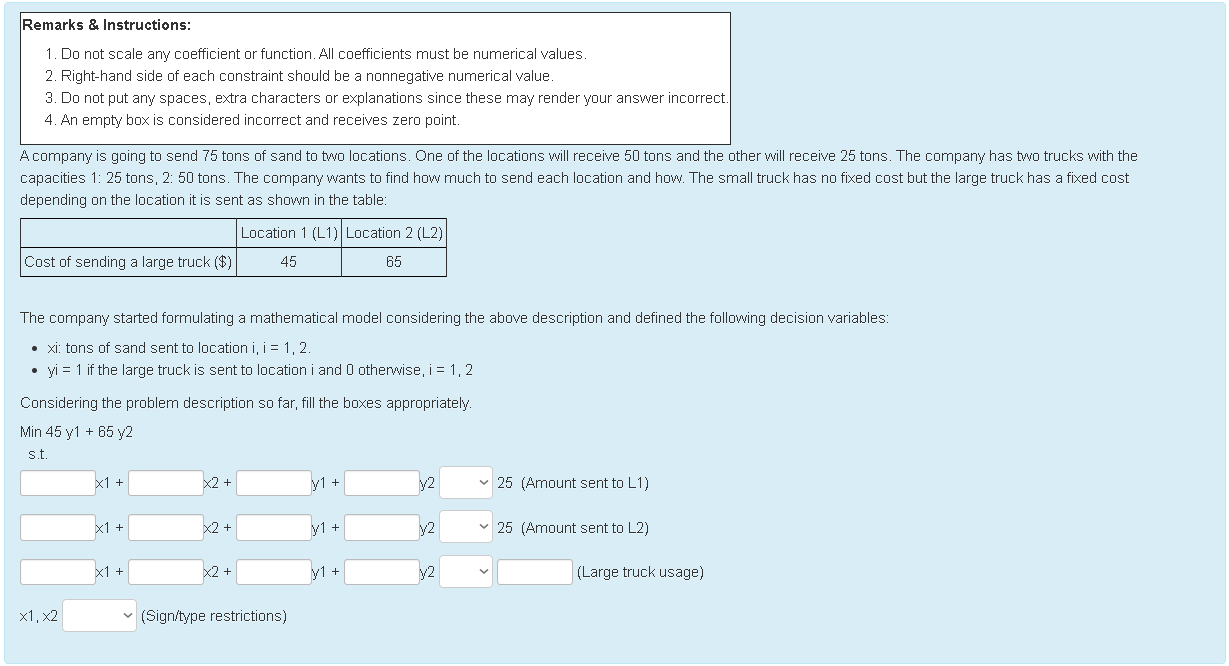
Remarks & Instructions: 1. Do not scale any coefficient or function. All coefficients must be numerical values. 2. Right-hand side of each constraint should be a nonnegative numerical value 3. Do not put any spaces, extra characters or explanations since these may render your answer incorrect. 4. An empty box is considered incorrect and receives zero point. A company is going to send 75 tons of sand to two locations. One of the locations will receive 50 tons and the other will receive 25 tons. The company has two trucks with the capacities 1: 25 tons, 2: 50 tons. The company wants to find how much to send each location and how. The small truck has no fixed cost but the large truck has a fixed cost depending on the location it is sent as shown in the table: Location 1 (L1) Location 2 (L2) Cost of sending a large truck ($) 45 65 The company started formulating a mathematical model considering the above description and defined the following decision variables: xi: tons of sand sent to location i, i = 1,2. yi = 1 if the large truck is sent to location i and 1 otherwise, i = 1,2 Considering the problem description so far, fill the boxes appropriately. Min 45 y1 + 65 y2 S.T. X1 + X2 + y1 + y2 25 (Amount sent to L1) X1 + X2 + 71 + V2 25 (Amount sent to L2) X1 + X2 + 71 + y2 (Large truck usage) x1, x2 (Sign/type restrictions) Remarks & Instructions: 1. Do not scale any coefficient or function. All coefficients must be numerical values. 2. Right-hand side of each constraint should be a nonnegative numerical value 3. Do not put any spaces, extra characters or explanations since these may render your answer incorrect. 4. An empty box is considered incorrect and receives zero point. A company is going to send 75 tons of sand to two locations. One of the locations will receive 50 tons and the other will receive 25 tons. The company has two trucks with the capacities 1: 25 tons, 2: 50 tons. The company wants to find how much to send each location and how. The small truck has no fixed cost but the large truck has a fixed cost depending on the location it is sent as shown in the table: Location 1 (L1) Location 2 (L2) Cost of sending a large truck ($) 45 65 The company started formulating a mathematical model considering the above description and defined the following decision variables: xi: tons of sand sent to location i, i = 1,2. yi = 1 if the large truck is sent to location i and 1 otherwise, i = 1,2 Considering the problem description so far, fill the boxes appropriately. Min 45 y1 + 65 y2 S.T. X1 + X2 + y1 + y2 25 (Amount sent to L1) X1 + X2 + 71 + V2 25 (Amount sent to L2) X1 + X2 + 71 + y2 (Large truck usage) x1, x2 (Sign/type restrictions)

Step by Step Solution

There are 3 Steps involved in it

1 Expert Approved Answer
Step: 1 Unlock blur-text-image

Question Has Been Solved by an Expert!

Get step-by-step solutions from verified subject matter experts

Step: 2 Unlock
Step: 3 Unlock

Students Have Also Explored These Related General Management Questions!