







Question: Remarks: Solve the following 5 questions. For each algorithm, always explain how and why it works. ALWAYS analyze the complexity of your algorithms. In all
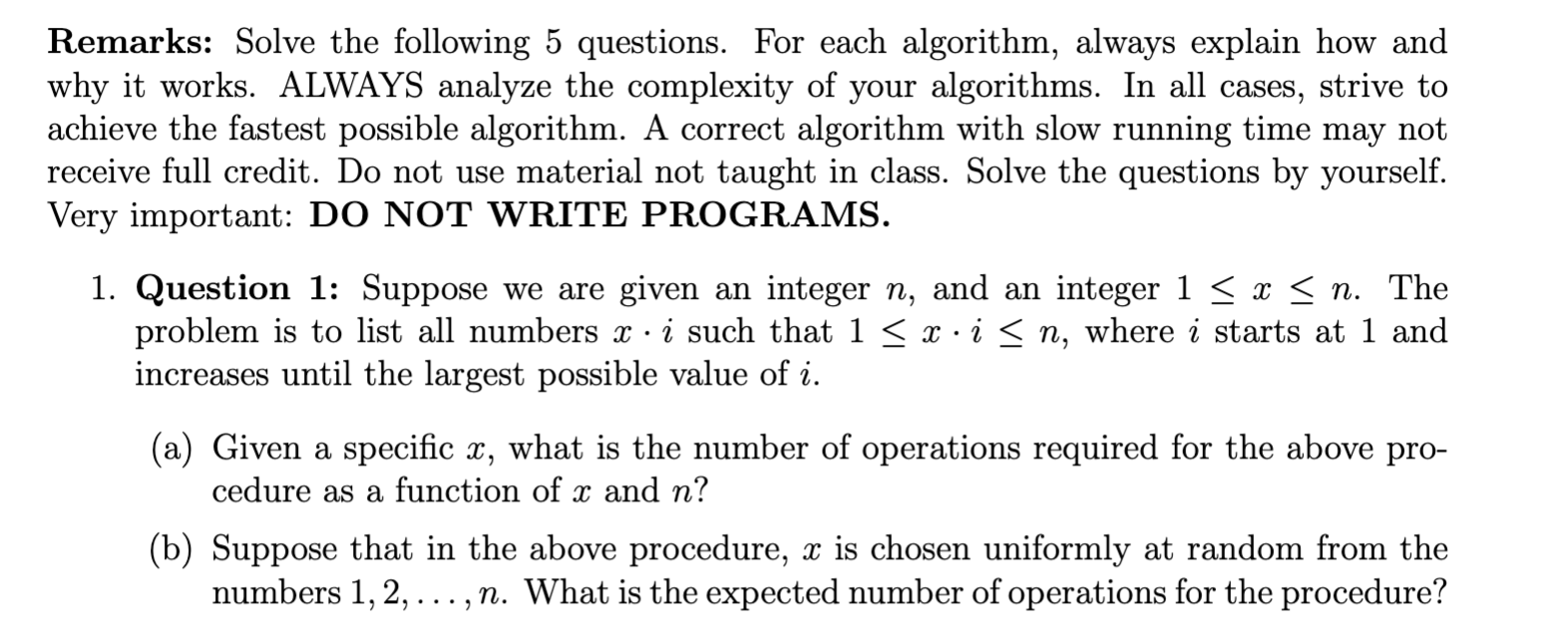
Remarks: Solve the following questions. For each algorithm, always explain how and why it works. ALWAYS analyze the complexity of your algorithms. In all cases, strive to achieve the fastest possible algorithm. A correct algorithm with slow running time may not receive full credit. Do not use material not taught in class. Solve the questions by yourself.
Very important: DO NOT WRITE PROGRAMS.
Question : Suppose we are given an integer n and an integer x n The problem is to list all numbers xi such that xi n where i starts at and increases until the largest possible value of i
a Given a specific x what is the number of operations required for the above pro cedure as a function of x and n
b Suppose that in the above procedure, x is chosen uniformly at random from the numbers dots,n What is the expected number of operations for the procedure?
Step by Step Solution
There are 3 Steps involved in it
1 Expert Approved Answer
Step: 1 Unlock

Question Has Been Solved by an Expert!
Get step-by-step solutions from verified subject matter experts
Step: 2 Unlock
Step: 3 Unlock
 Study Help