







Question: Reminder: Read through this entire project description before you begin working on it. Introduction: For this project, you will investigate the performance differences between a
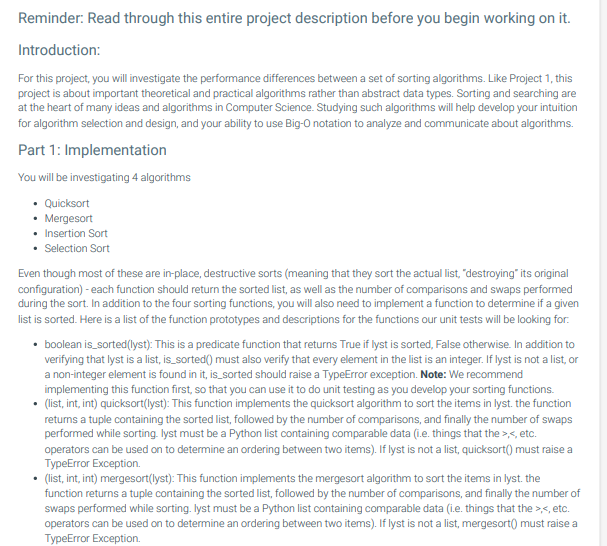
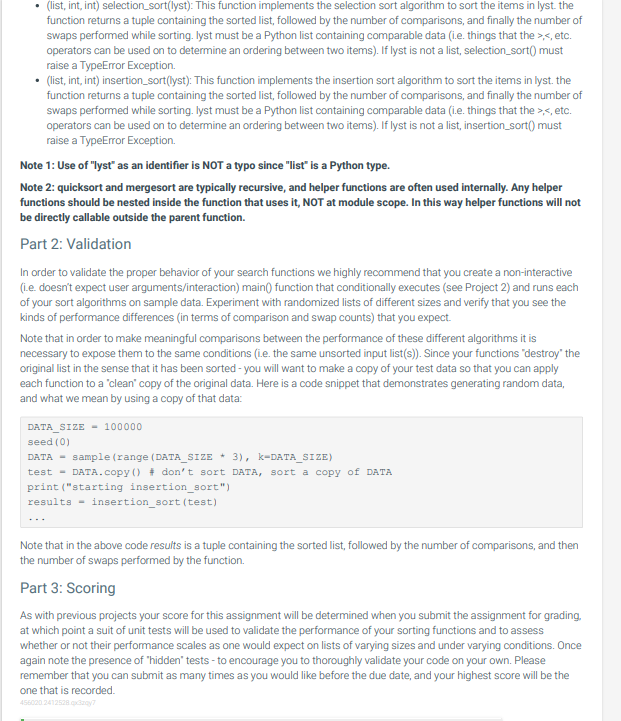
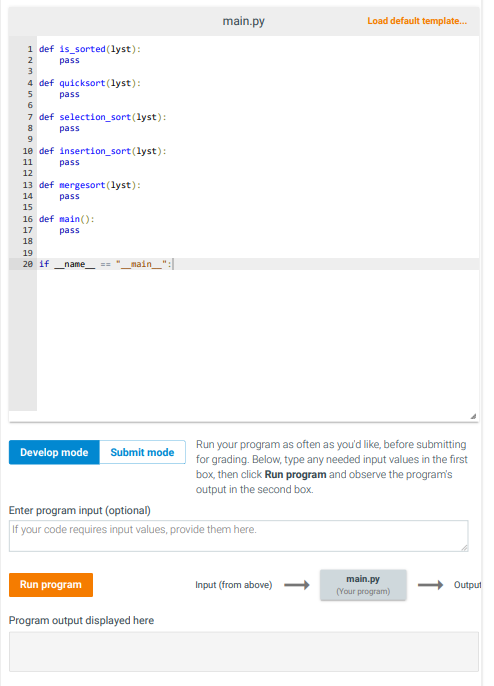
Reminder: Read through this entire project description before you begin working on it. Introduction: For this project, you will investigate the performance differences between a set of sorting algorithms. Like Project 1, this project is about important theoretical and practical algorithms rather than abstract data types. Sorting and searching are at the heart of many ideas and algorithms in Computer Science. Studying such algorithms will help develop your intuition for algorithm selection and design, and your ability to use Big-0 notation to analyze and communicate about algorithms. Part 1: Implementation You will be investigating 4 algorithms - Quicksort - Mergesort - Insertion Sort - Selection Sort Even though most of these are in-place, destructive sorts (meaning that they sort the actual list, "destroying" its original configuration) - each function should return the sorted list, as well as the number of comparisons and swaps performed during the sort. In addition to the four sorting functions, you will also need to implement a function to determine if a given list is sorted. Here is a list of the function prototypes and descriptions for the functions our unit tests will be looking for. - boolean is_sorted(lyst): This is a predicate function that returns True if lyst is sorted, False otherwise. In addition to verifying that lyst is a list, is_sorted() must also verify that every element in the list is an integer. If lyst is not a list, or a non-integer element is found in it, is_sorted should raise a TypeError exception. Note: We recommend implementing this function first, so that you can use it to do unit testing as you develop your sorting functions. - (list, int, int) quicksort(lyst): This function implements the quicksort algorithm to sort the items in lyst. the function returns a tuple containing the sorted list, followed by the number of comparisons, and finally the number of swaps performed while sorting. lyst must be a Python list containing comparable data (i.e. things that the >,, etc. operators can be used on to determine an ordering between two items). If lyst is not a list, quicksort() must raise a TypeError Exception. - (list, int, int) mergesort(lyst): This function implements the mergesort algorithm to sort the items in lyst. the function returns a tuple containing the sorted list, followed by the number of comparisons, and finally the number of swaps performed while sorting. lyst must be a Python list containing comparable data (i.e. things that the , e, etc. operators can be used on to determine an ordering between two items). If lyst is not a list, selection_sort() must raise a TypeError Exception. - (list, int, int) insertion_sort(lyst): This function implements the insertion sort algorithm to sort the items in lyst. the function returns a tuple containing the sorted list, followed by the number of comparisons, and finally the number of swaps performed while sorting. lyst must be a Python list containing comparable data (i.e. things that the >, +3), k-DATA_SIZE) test - DATA.copy() * don't sort DATA, sort a copy of DATA print ("starting insertion_sort") results - insertion_sort(test) ... Note that in the above code results is a tuple containing the sorted list, followed by the number of comparisons, and then the number of swaps performed by the function. Part 3: Scoring As with previous projects your score for this assignment will be determined when you submit the assignment for grading, at which point a suit of unit tests will be used to validate the performance of your sorting functions and to assess whether or not their performance scales as one would expect on lists of varying sizes and under varying conditions. Once again note the presence of "hidden" tests - to encourage you to thoroughly validate your code on your own. Please remember that you can submit as many times as you would like before the due date, and your highest score will be the one that is recorded. Run your program as often as you'd like, before submitting for grading. Below, type any needed input values in the first box, then click Run program and observe the program's output in the second box. Enter program input (optional) Proqram output displayed here
Step by Step Solution
There are 3 Steps involved in it

Get step-by-step solutions from verified subject matter experts
 Study Help