Question: Reply the article's abstract posed with a single phrase in ALL CAPS from the list below and then explain why you chose that word. The
Reply the article's abstract posed with a single phrase in ALL CAPS from the list below and then explain why you chose that word. The word is to reflect about the contents of the article.
- WOW
- SURPRISING
- INTERESTING
- UNLIKELY
- IMPOSSIBLE
- ABOUT TIME
- WASTED EFFORT
- NO REAL CHANGE
- INNOVATIVE
- NO WAY
- SO WHAT
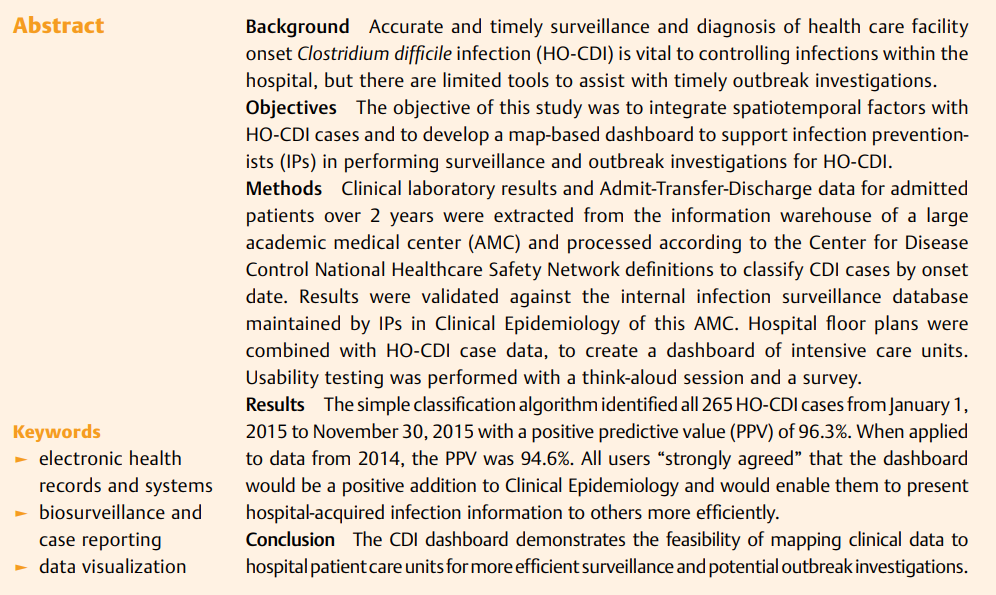
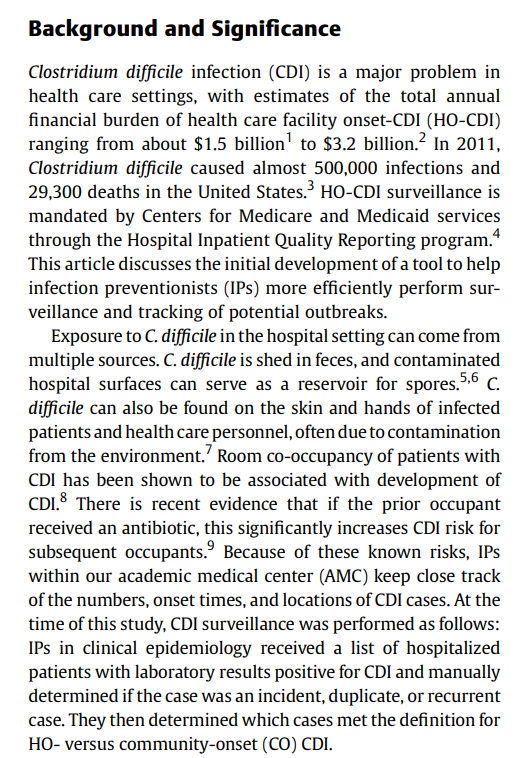
Abstract Background Accurate and timely surveillance and diagnosis of health care facility onset Clostridium difficile infection (HO-CDI) is vital to controlling infections within the hospital, but there are limited tools to assist with timely outbreak investigations. Objectives The objective of this study was to integrate spatiotemporal factors with HO-CDI cases and to develop a map-based dashboard to support infection prevention- ists (IPs) in performing surveillance and outbreak investigations for HO-CDI. Methods Clinical laboratory results and Admit-Transfer-Discharge data for admitted patients over 2 years were extracted from the information warehouse of a large academic medical center (AMC) and processed according to the Center for Disease Control National Healthcare Safety Network definitions to classify CDI cases by onset date. Results were validated against the internal infection surveillance database maintained by IPs in Clinical Epidemiology of this AMC. Hospital floor plans were combined with HO-CDI case data, to create a dashboard of intensive care units. Usability testing was performed with a think-aloud session and a survey. Results The simple classification algorithm identified all 265 HO-CDI cases from January 1, 2015 to November 30, 2015 with a positive predictive value (PPV) of 96.3%. When applied to data from 2014, the PPV was 94.6%. All users strongly agreed that the dashboard would be a positive addition to Clinical Epidemiology and would enable them to present hospital-acquired infection information to others more efficiently. Conclusion The CDI dashboard demonstrates the feasibility of mapping clinical data to hospital patient care units for more efficient surveillance and potential outbreak investigations. health Keywords electronic health records and systems biosurveillance and case reporting data visualization Background and Significance Clostridium difficile infection (CDI) is a major problem in health care settings, with estimates of the total annual financial burden of health care facility onset-CDI (HO-CDI) ranging from about $1.5 billion' to $3.2 billion.? In 2011, Clostridium difficile caused almost 500,000 infections and 29,300 deaths in the United States. HO-CDI surveillance is mandated by Centers for Medicare and Medicaid services through the Hospital Inpatient Quality Reporting program." This article discusses the initial development of a tool to help infection preventionists (IPs) more efficiently perform sur- veillance and tracking of potential outbreaks. Exposure to C. difficile in the hospital setting can come from multiple sources. C. difficile is shed in feces, and contaminated hospital surfaces can serve as a reservoir for spores..6 C. difficile can also be found on the skin and hands of infected patients and health care personnel, often due to contamination from the environment.' Room co-occupancy of patients with CDI has been shown to be associated with development of CDI. There is recent evidence that if the prior occupant received an antibiotic, this significantly increases CDI risk for subsequent occupants. Because of these known risks, IPs within our academic medical center (AMC) keep close track of the numbers, onset times, and locations of CDI cases. At the time of this study, CDI surveillance was performed as follows: IPs in clinical epidemiology received a list of hospitalized patients with laboratory results positive for CDI and manually determined if the case was an incident, duplicate, or recurrent case. They then determined which cases met the definition for HO- versus community-onset (CO) CDI









 Study Help