Question: Reply the article's abstract posed with a single phrase in ALL CAPS from the list below and then explain why you chose that word. The
Reply the article's abstract posed with a single phrase in ALL CAPS from the list below and then explain why you chose that word. The word is to reflect about the contents of the article.
- WOW
- SURPRISING
- INTERESTING
- UNLIKELY
- IMPOSSIBLE
- ABOUT TIME
- WASTED EFFORT
- NO REAL CHANGE
- INNOVATIVE
- NO WAY
- SO WHAT
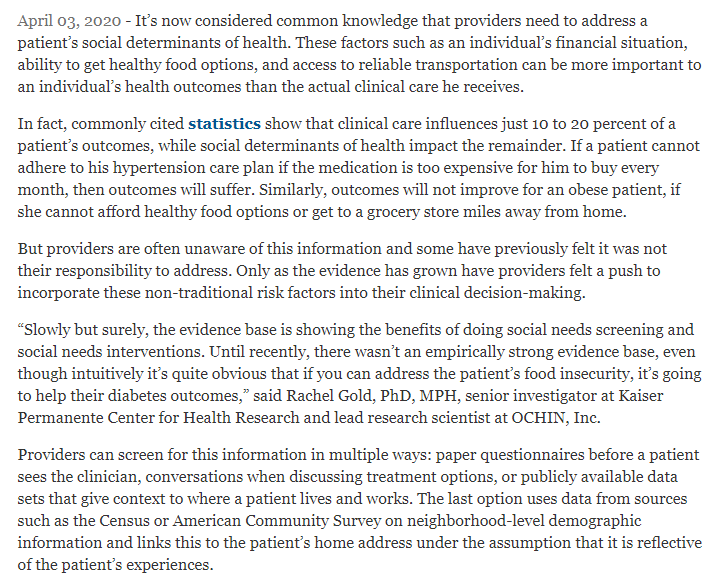
Integrating Social Determinants of Health into the EHR Addressing social determinant requires integration of this information into the EHR. Otherwise, providers will not be able to use it for clinical decision-making. April 03, 2020 - It's now considered common knowledge that providers need to address a patient's social determinants of health. These factors such as an individual's financial situation, ability to get healthy food options, and access to reliable transportation can be more important to an individual's health outcomes than the actual clinical care he receives. In fact, commonly cited statistics show that clinical care influences just 10 to 20 percent of a patient's outcomes, while social determinants of health impact the remainder. If a patient cannot adhere to his hypertension care plan if the medication is too expensive for him to buy every month, then outcomes will suffer. Similarly, outcomes will not improve for an obese patient, if she cannot afford healthy food options or get to a grocery store miles away from home. But providers are often unaware of this information and some have previously felt it was not their responsibility to address. Only as the evidence has grown have providers felt a push to incorporate these non-traditional risk factors into their clinical decision-making. "Slowly but surely, the evidence base is showing the benefits of doing social needs screening and social needs interventions. Until recently, there wasn't an empirically strong evidence base, even though intuitively it's quite obvious that if you can address the patient's food insecurity, it's going to help their diabetes outcomes," said Rachel Gold, PhD, MPH, senior investigator at Kaiser Permanente Center for Health Research and lead research scientist at OCHIN, Inc. Providers can screen for this information in multiple ways: paper questionnaires before a patient sees the clinician, conversations when discussing treatment options, or publicly available data sets that give context to where a patient lives and works. The last option uses data from sources such as the Census or American Community Survey on neighborhood-level demographic information and links this to the patient's home address under the assumption that it is reflective of the patient's experiences









 Study Help