







Question: - * Required 1. How much joint costs per batch should be allocated to turpentine and to methanol, assuming that joint costs are allocated based
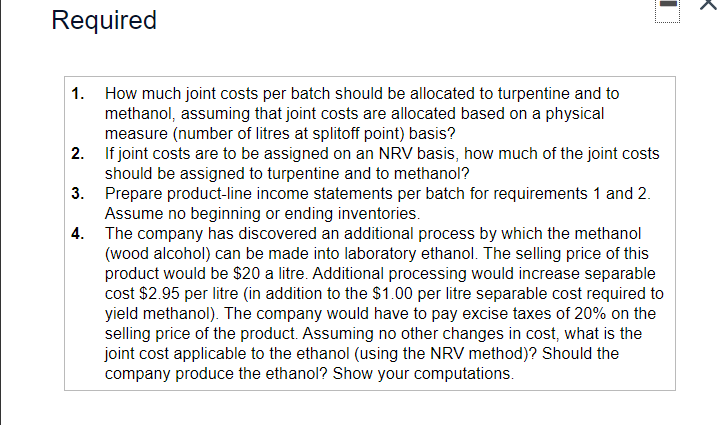
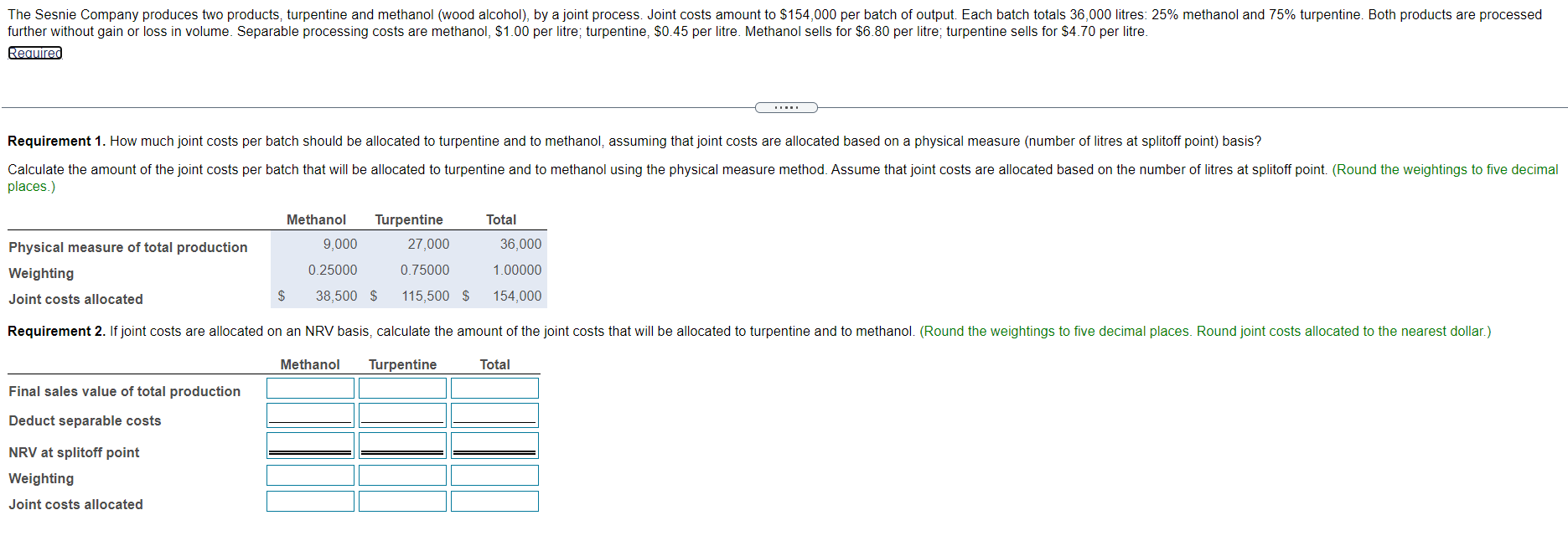
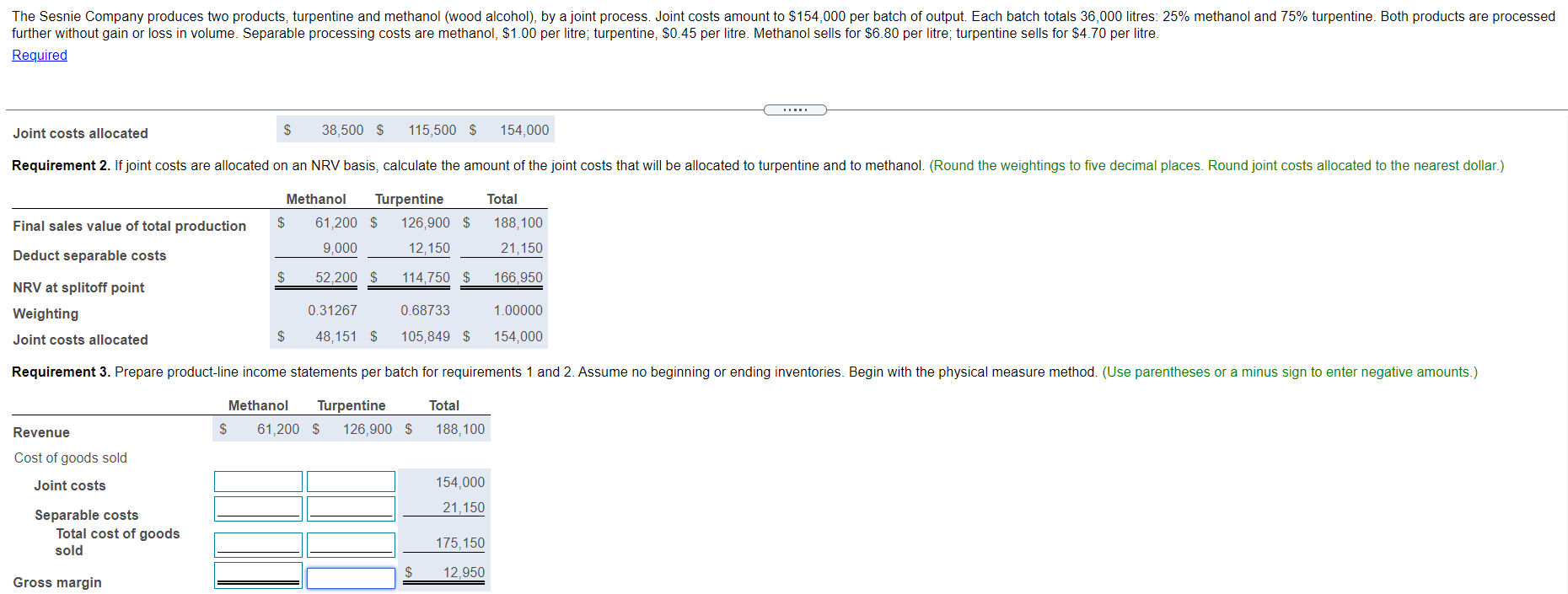
- * Required 1. How much joint costs per batch should be allocated to turpentine and to methanol, assuming that joint costs are allocated based on a physical measure (number of litres at splitoff point) basis? 2. If joint costs are to be assigned on an NRV basis, how much of the joint costs should be assigned to turpentine and to methanol? 3. Prepare product-line income statements per batch for requirements 1 and 2. Assume no beginning or ending inventories. 4. The company has discovered an additional process by which the methanol (wood alcohol) can be made into laboratory ethanol. The selling price of this product would be $20 a litre. Additional processing would increase separable cost $2.95 per litre (in addition to the $1.00 per litre separable cost required to yield methanol). The company would have to pay excise taxes of 20% on the selling price of the product. Assuming no other changes in cost, what is the joint cost applicable to the ethanol (using the NRV method)? Should the company produce the ethanol? Show your computations. The Sesnie Company produces two products, turpentine and methanol (wood alcohol), by a joint process. Joint costs amount to $154,000 per batch of output. Each batch totals 36,000 litres: 25% methanol and 75% turpentine. Both products are processed further without gain or loss in volume. Separable processing costs are methanol, $1.00 per litre; turpentine, S0.45 per litre. Methanol sells for $6.80 per litre; turpentine sells for $4.70 per litre. Required Requirement 1. How much joint costs per batch should be allocated to turpentine and to methanol, assuming that joint costs are allocated based on a physical measure (number of litres at splitoff point) basis? Calculate the amount of the joint costs per batch that will be allocated to turpentine and to methanol using the physical measure method. Assume that joint costs are allocated based on the number of litres at splitoff point. (Round the weightings to five decimal places.) Total Methanol 9,000 Turpentine 27,000 36,000 Physical measure of total production Weighting Joint costs allocated 0.25000 0.75000 1.00000 $ 38,500 $ 115,500 $ 154,000 Requirement 2. If joint costs are allocated on an NRV basis, calculate the amount of the joint costs that will be allocated to turpentine and to methanol. (Round the weightings to five decimal places. Round joint costs allocated to the nearest dollar.) Methanol Turpentine Total Final sales value of total production Deduct separable costs NRV at splitoff point Weighting Joint costs allocated The Sesnie Company produces two products, turpentine and methanol (wood alcohol), by a joint process. Joint costs amount to $154,000 per batch of output. Each batch totals 36,000 litres: 25% methanol and 75% turpentine. Both products are processed further without gain or loss in volume. Separable processing costs are methanol, $1.00 per litre; turpentine, $0.45 per litre. Methanol sells for $6.80 per litre; turpentine sells for $4.70 per litre. Required Joint costs allocated 38,500 $ 115,500 $ 154,000 Requirement 2. If joint costs are allocated on an NRV basis, calculate the amount of the joint costs that will be allocated to turpentine and to methanol. (Round the weightings to five decimal places. Round joint costs allocated to the nearest dollar.) Total Final sales value of total production Methanol Turpentine $ 61,200 $ 126,900 $ 9,000 12,150 188,100 21,150 Deduct separable costs $ 52,200 $ 114.750 $ 166,950 NRV at splitoff point 0.31267 0.68733 1.00000 Weighting Joint costs allocated $ 48,151 $ 105,849 $ 154,000 Requirement 3. Prepare product-line income statements per batch for requirements 1 and 2. Assume no beginning or ending inventories. Begin with the physical measure method. (Use parentheses or a minus sign to enter negative amounts.) Total Methanol Turpentine 61,200 $ 126,900 $ Revenue 188,100 Cost of goods sold Joint costs 154,000 21,150 Separable costs Total cost of goods sold 175,150 $ 12,950 Gross margin
Step by Step Solution
There are 3 Steps involved in it

Get step-by-step solutions from verified subject matter experts
 Study Help