



Question: Required information Exercise 4-11 Contrasting Activity-Based Costing and Conventional Product Costing (L04-2, L04-3, L04. 4) The following information applies to the questions displayed below) Rusties
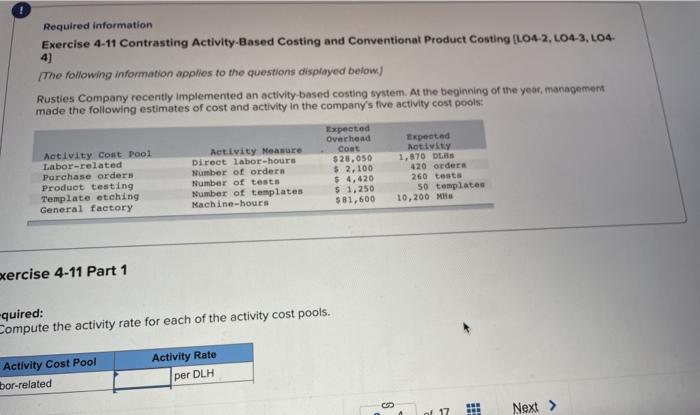
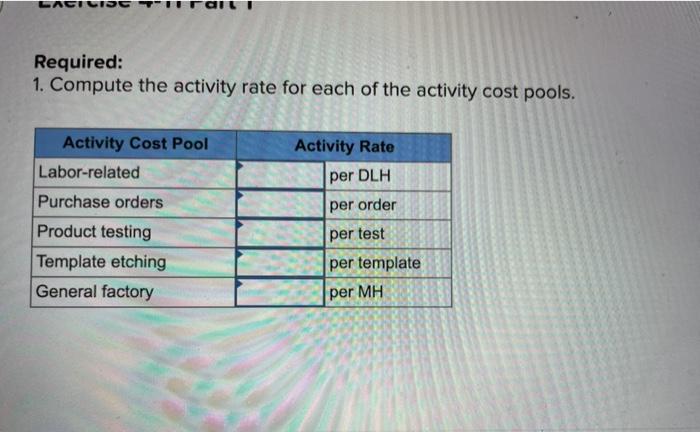
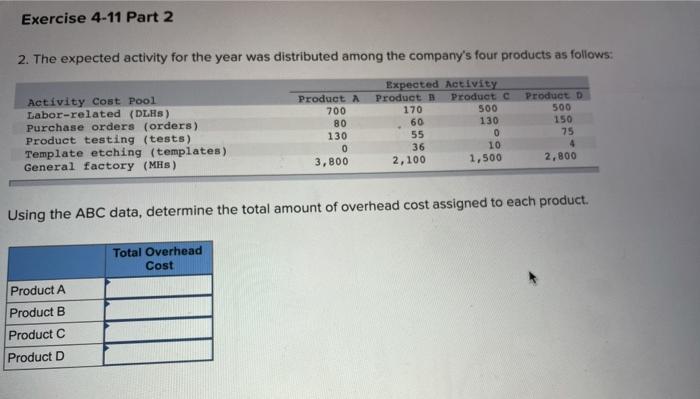
Required information Exercise 4-11 Contrasting Activity-Based Costing and Conventional Product Costing (L04-2, L04-3, L04. 4) The following information applies to the questions displayed below) Rusties Company recently implemented an activity-based costing system. At the beginning of the year, management made the following estimates of cost and activity in the company's five activity cost pools: Expected Overhead Expected Activity Coat Pool Activity Measure coat Activity Labor-related Direct labor-hours $28,050 1,870 Ls Purchase orders Number of orders $ 2,100 420 orders Product testing Number of tests $ 4,420 260 tests Template etching Number of templates $ 1,250 50 templates General factory Machine-hours $81,600 10, 200 M xercise 4-11 Part 1 quired: Compute the activity rate for each of the activity cost pools. Activity Cost Pool bor-related Activity Rate per DLH S 17 Next > GACICIS Required: 1. Compute the activity rate for each of the activity cost pools. Activity Rate per DLH per order Activity Cost Pool Labor-related Purchase orders Product testing Template etching General factory per test per template per MH Exercise 4-11 Part 2 2. The expected activity for the year was distributed among the company's four products as follows: Activity Cost Pool Labor-related (DLHS) Purchase orders (orders) Product testing (tests) Template etching (templates) General factory (MHS) Product 700 80 130 0 3,800 Expected Activity Product 1 Product C 170 500 60 130 55 0 36 10 2,100 1,500 Product D 500 150 75 2,800 Using the ABC data, determine the total amount of overhead cost assigned to each product. Total Overhead Cost Product A Product B Product C Product D
Step by Step Solution
There are 3 Steps involved in it

Get step-by-step solutions from verified subject matter experts