







Question: . Required Questions: 1. Porter Five Force Analysis (8 Marks) 2. PESTEL Analysis (9 Marks) 3. Write a recommended Strategies to Overcome this central Issue.
.
Required Questions:
1. Porter Five Force Analysis (8 Marks)
2. PESTEL Analysis (9 Marks)
3. Write a recommended Strategies to Overcome this central Issue.
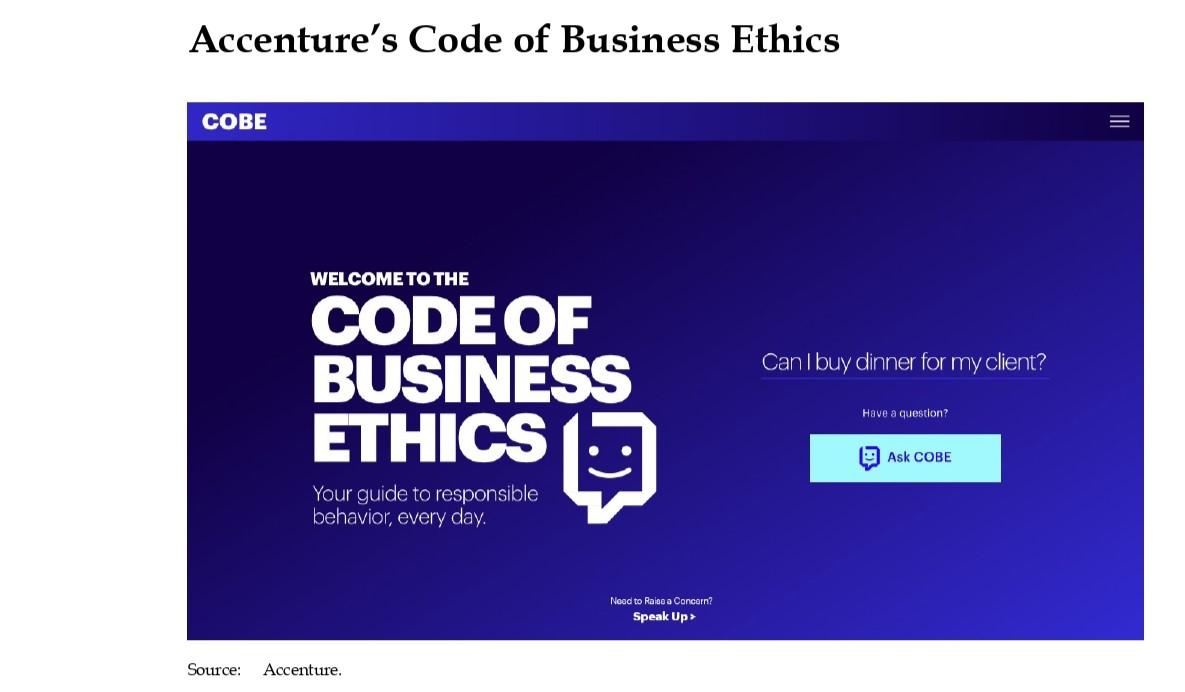
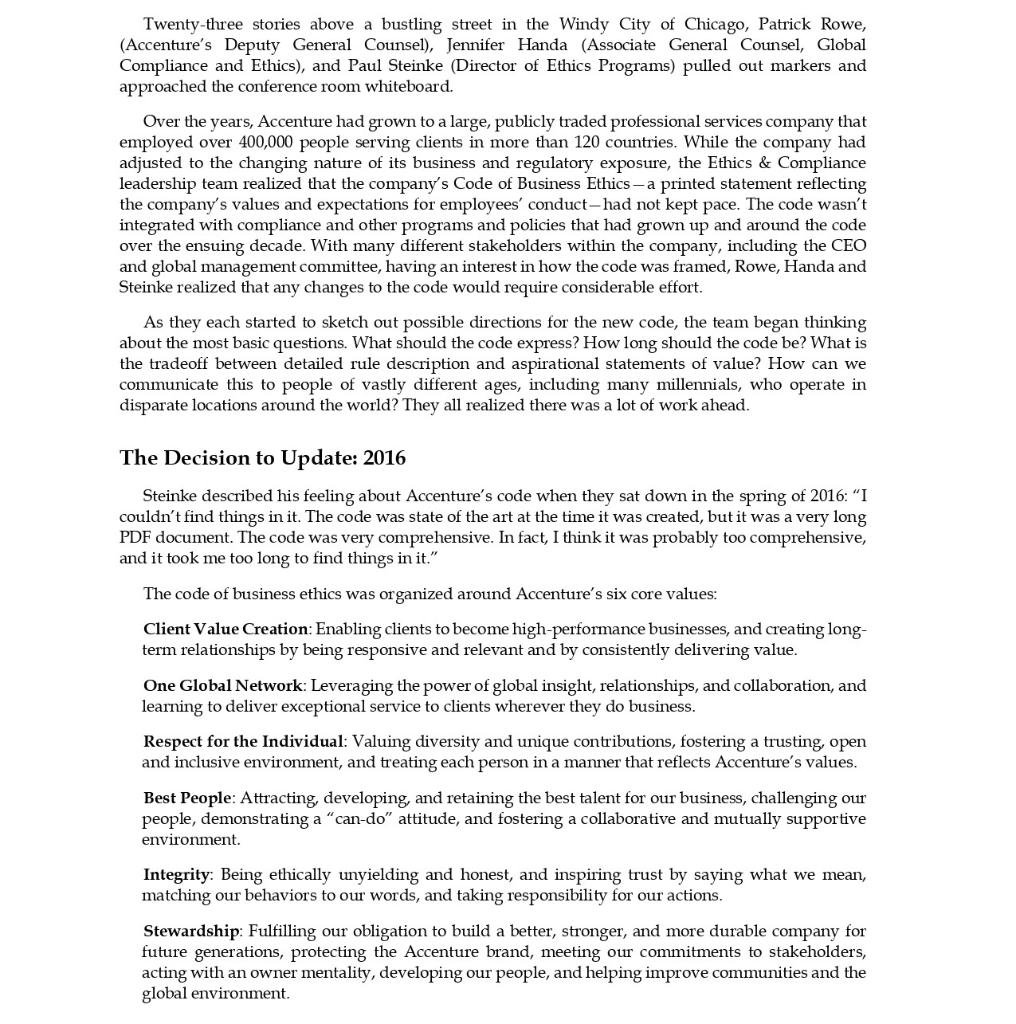
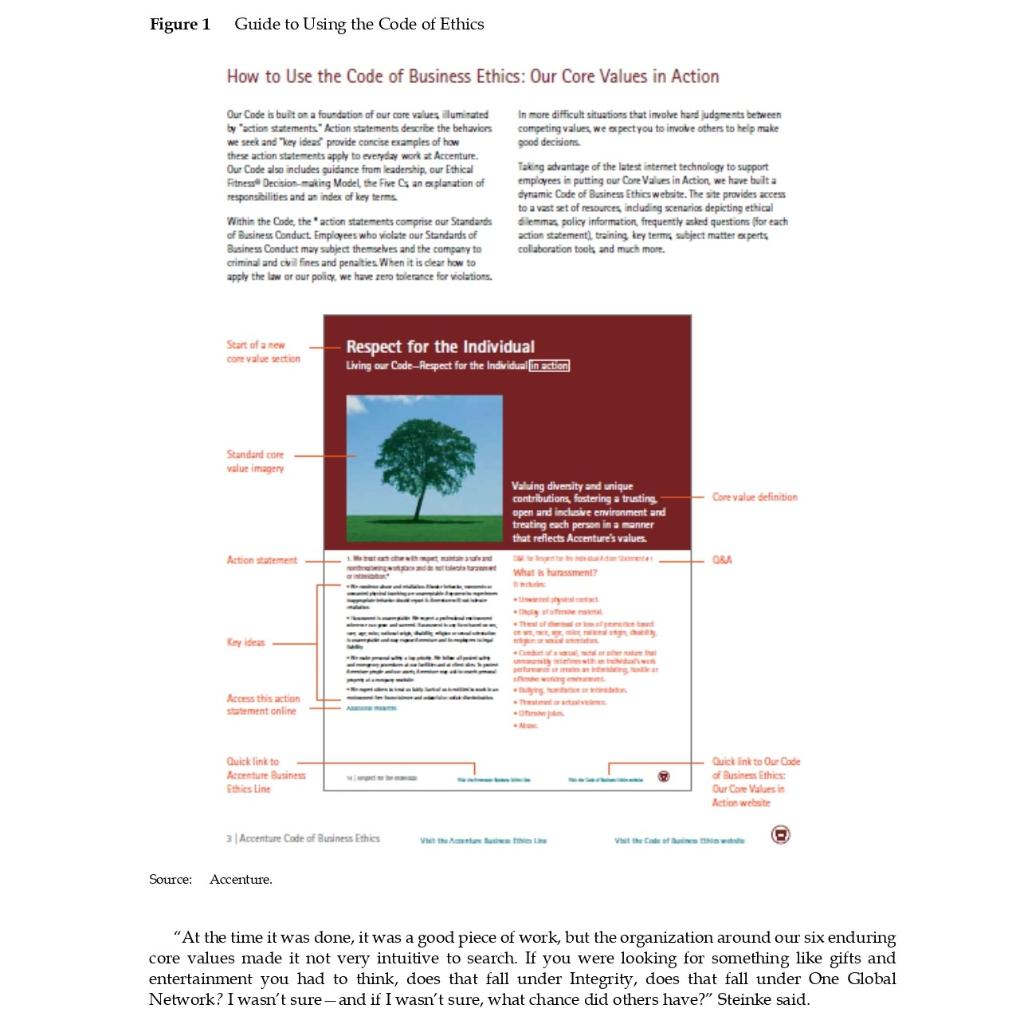
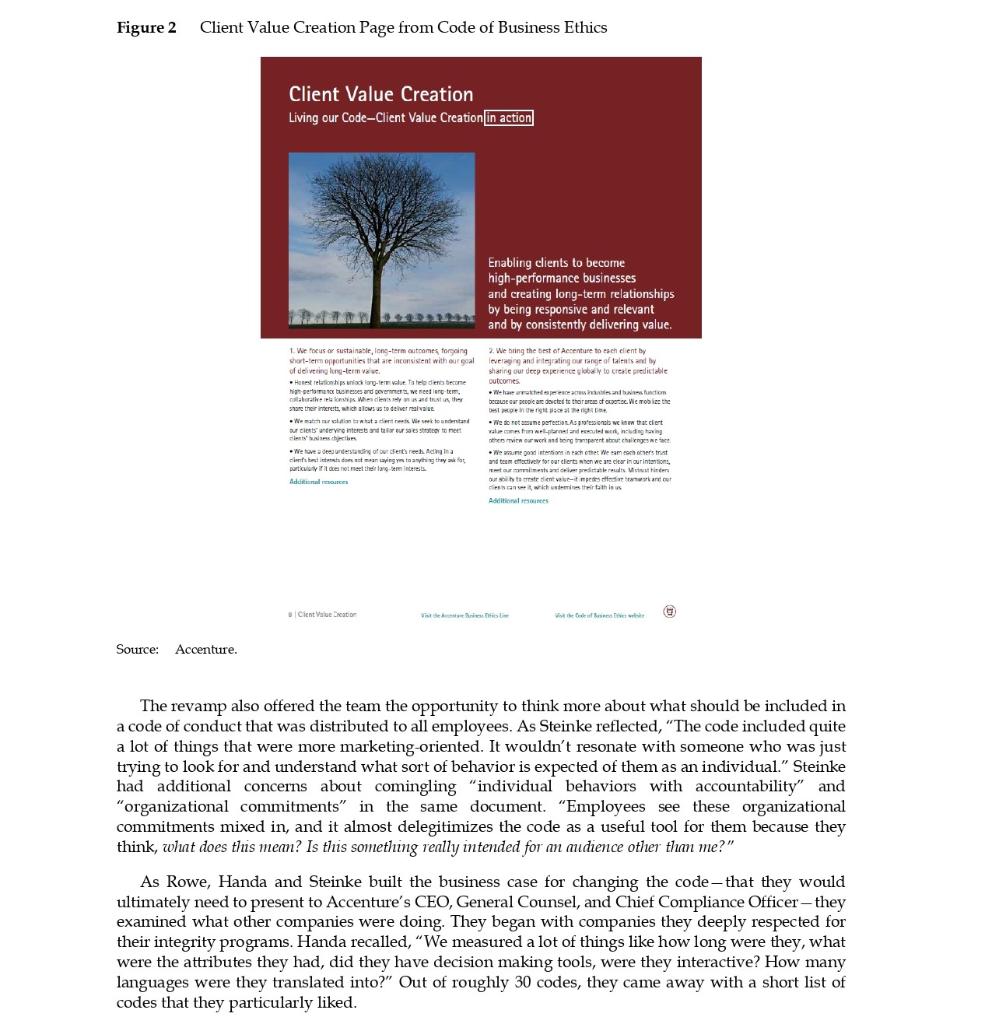
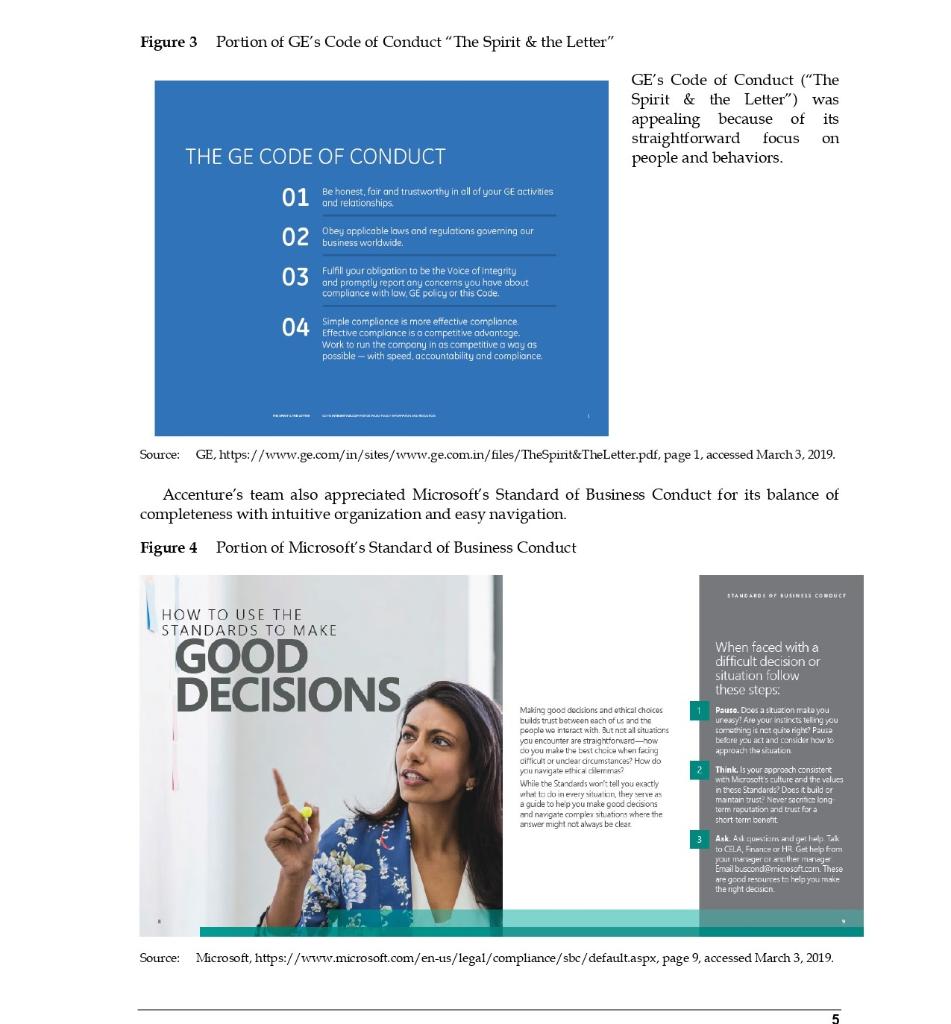
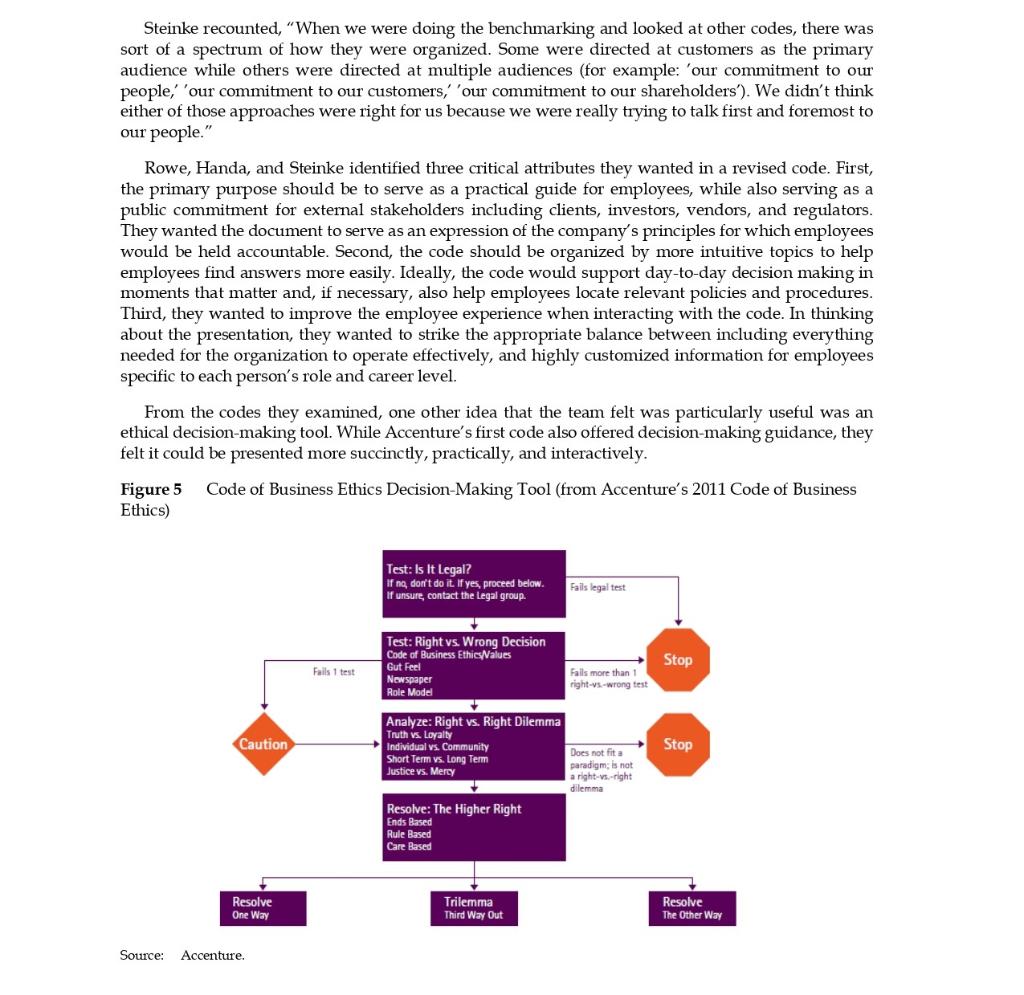
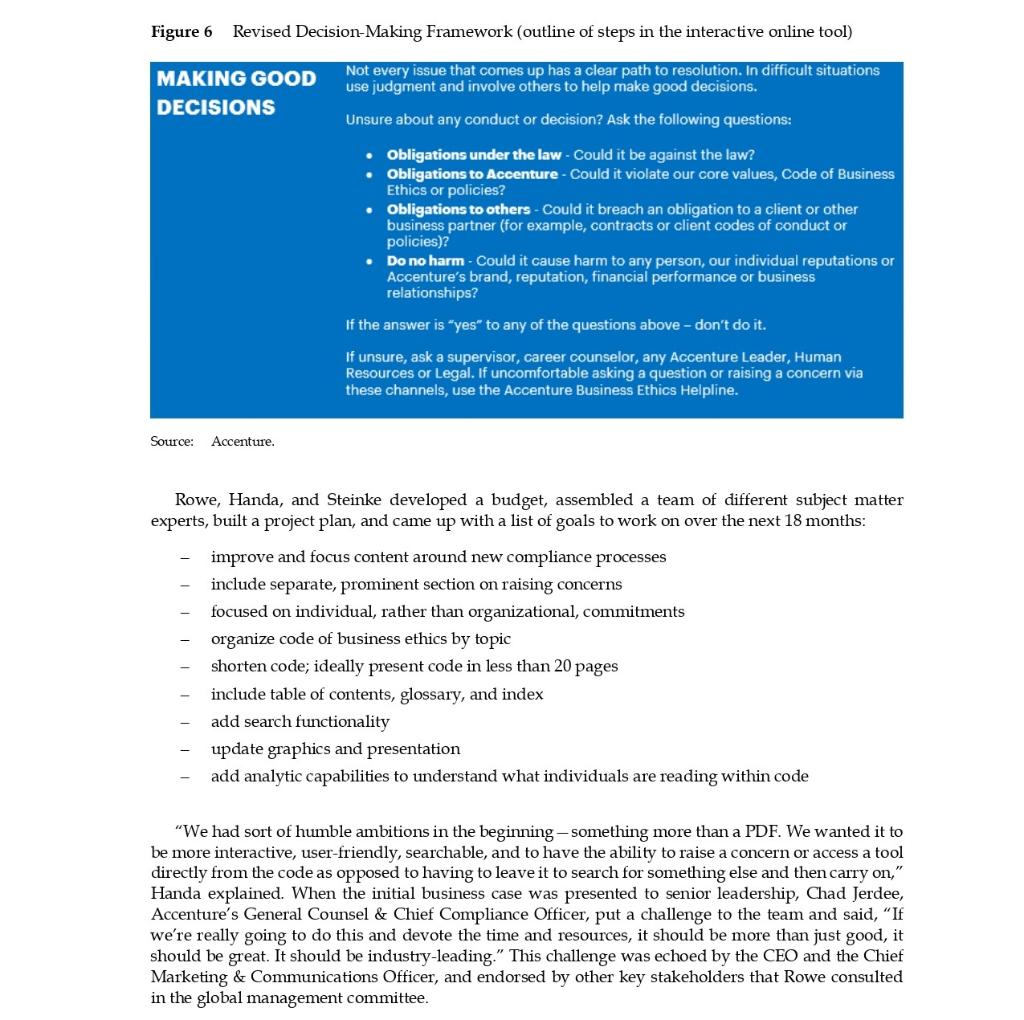
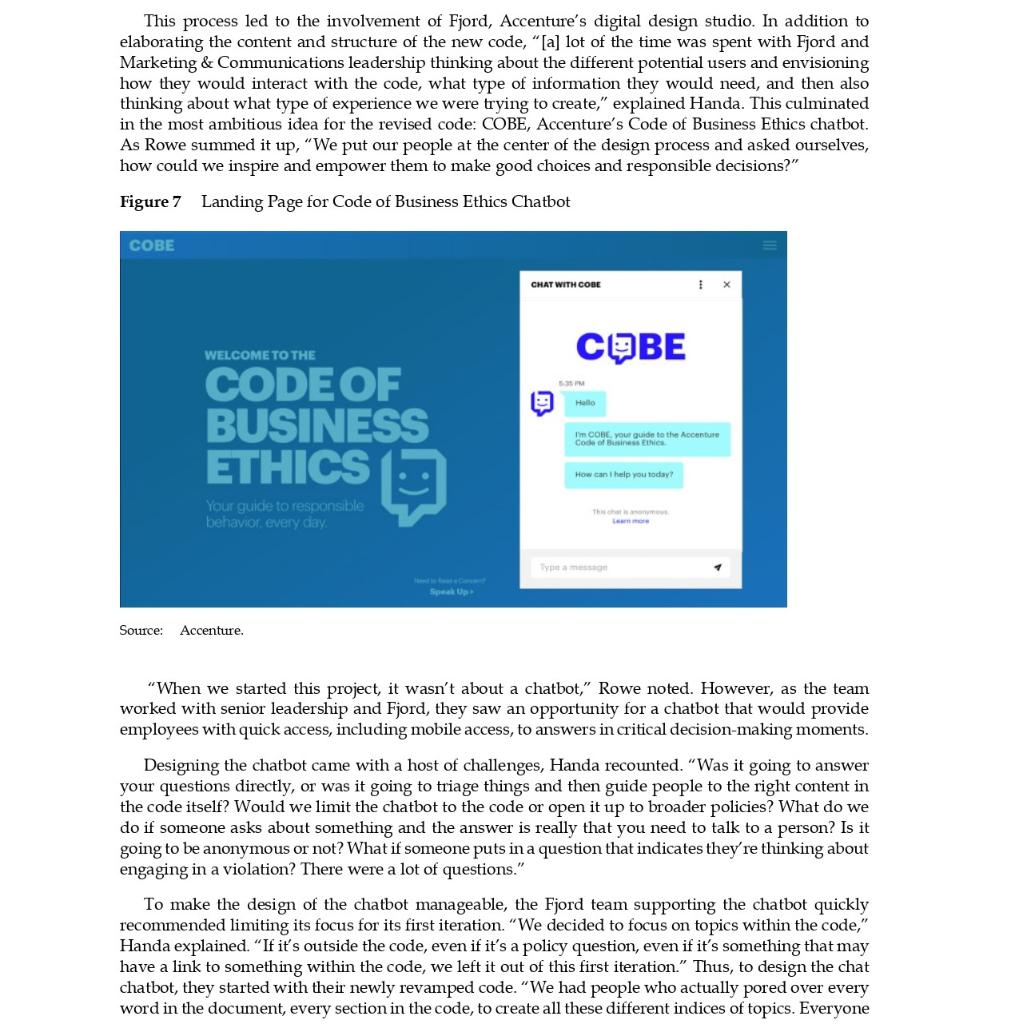
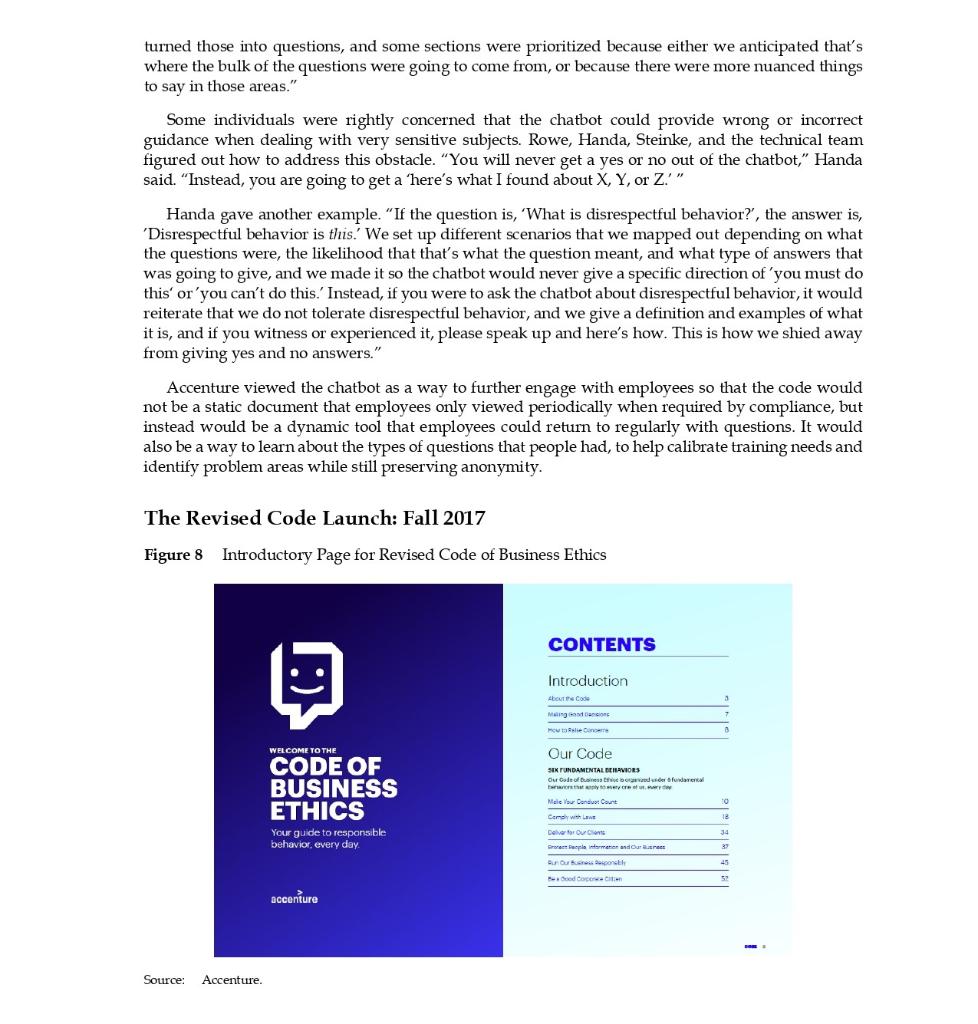
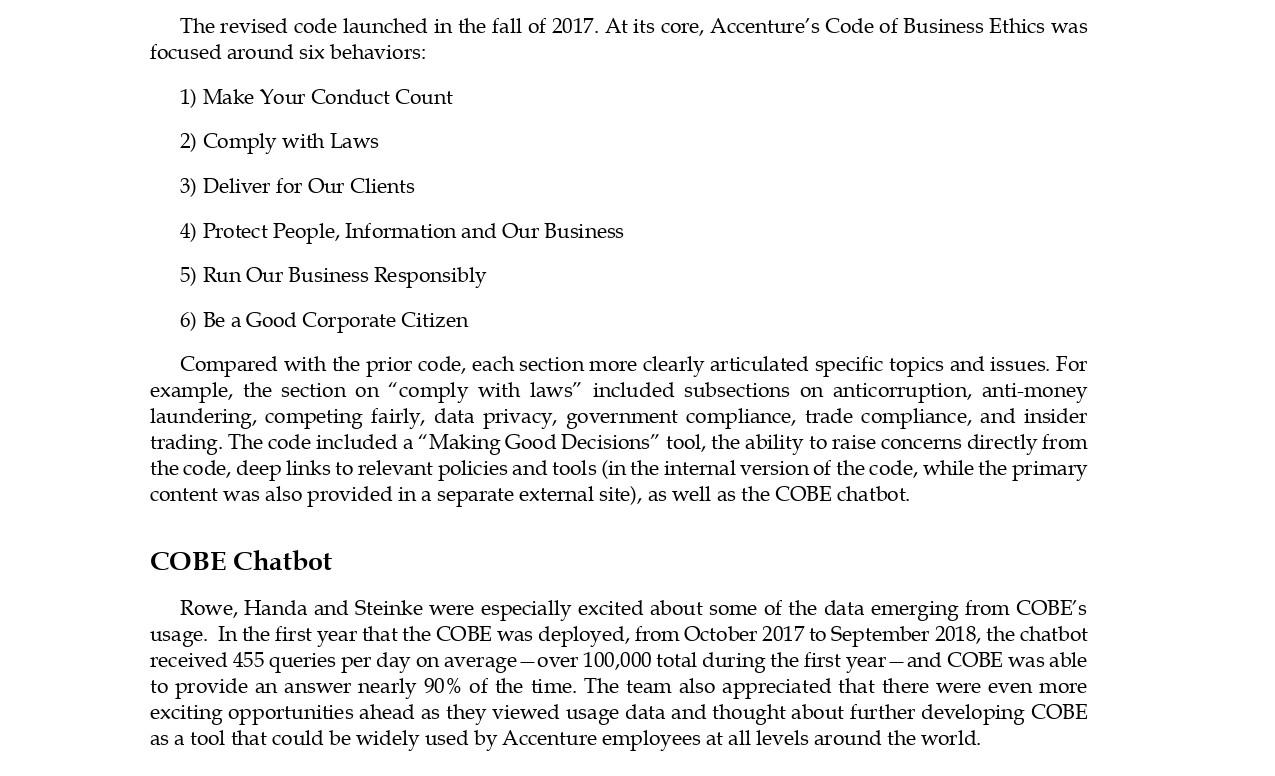
Accenture's Code of Business Ethics Twenty-three stories above a bustling street in the Windy City of Chicago, Patrick Rowe, (Accenture's Deputy General Counsel), Jennifer Handa (Associate General Counsel, Global Compliance and Ethics), and Paul Steinke (Director of Ethics Programs) pulled out markers and approached the conference room whiteboard. Over the years, Accenture had grown to a large, publicly traded professional services company that employed over 400,000 people serving clients in more than 120 countries. While the company had adjusted to the changing nature of its business and regulatory exposure, the Ethics \& Compliance leadership team realized that the company's Code of Business Ethics - a printed statement reflecting the company's values and expectations for employees' conduct-had not kept pace. The code wasn't integrated with compliance and other programs and policies that had grown up and around the code over the ensuing decade. With many different stakeholders within the company, including the CEO and global management committee, having an interest in how the code was framed, Rowe, Handa and Steinke realized that any changes to the code would require considerable effort. As they each started to sketch out possible directions for the new code, the team began thinking about the most basic questions. What should the code express? How long should the code be? What is the tradeoff between detailed rule description and aspirational statements of value? How can we communicate this to people of vastly different ages, including many millennials, who operate in disparate locations around the world? They all realized there was a lot of work ahead. The Decision to Update: 2016 Steinke described his feeling about Accenture's code when they sat down in the spring of 2016: "I couldn't find things in it. The code was state of the art at the time it was created, but it was a very long PDF document. The code was very comprehensive. In fact, I think it was probably too comprehensive, and it took me too long to find things in it." The code of business ethics was organized around Accenture's six core values: Client Value Creation: Enabling clients to become high-performance businesses, and creating longterm relationships by being responsive and relevant and by consistently delivering value. One Global Network: Leveraging the power of global insight, relationships, and collaboration, and learning to deliver exceptional service to clients wherever they do business. Respect for the Individual: Valuing diversity and unique contributions, fostering a trusting, open and inclusive environment, and treating each person in a manner that reflects Accenture's values. Best People: Attracting, developing, and retaining the best talent for our business, challenging our people, demonstrating a "can-do" attitude, and fostering a collaborative and mutually supportive environment. Integrity: Being ethically unyielding and honest, and inspiring trust by saying what we mean, matching our behaviors to our words, and taking responsibility for our actions. Stewardship: Fulfilling our obligation to build a better, stronger, and more durable company for future generations, protecting the Accenture brand, meeting our commitments to stakeholders, acting with an owner mentality, developing our people, and helping improve communities and the global environment. Our Cose is buit on a foundetion of our core values illuminated In more difficult situations that imvolet hard judgments between by "action statements" Action statements dexcrbe the behavises competing valuet we apectyou to involve others to help make we seek and 'key isea' provide concise examples of haw good decivions. these action statements apply to exeyday work at Accenture. Our Code also indudes guidance from leadership, our Ethical Taking alvantage of the latest internet technology to sugport Fithes" Decision-mating Model, the Five C an aplaration of employes in putting our Core Values in Action, we have buit a repponskilities and an inder of key terms dynamic Cade of Basiness Cthics webrite. The site provides access to a vat set of resoures induding senerias depicting etbical Within the Code, the "action statements comprise our Standars. diemmas policy information, frequently aied questions ffor each of Business Conduct. Employees who violate our Standands of action tatementl, taining key terms subject matter oxperts Basiness Conduct may subject thenselves and the company to colaboration tooks and much more. criminal and ciil fines and penaties. When it is dear how to apply the law or our polic. we have zeso tolerance for violations. 3 | Accentare Cote of Aluiness Fthics Whe thentien Luive tise in Viat in tite uf auins naiewithe Source: Accenture. "At the time it was done, it was a good piece of work, but the organization around our six enduring core values made it not very intuitive to search. If you were looking for something like gifts and entertainment you had to think, does that fall under Integrity, does that fall under One Global Network? I wasn't sure - and if I wasn't sure, what chance did others have?" Steinke said. Figure 2 Client Value Creation Page from Code of Business Ethics - Cient baiue Deatior () Source: Accenture. The revamp also offered the team the opportunity to think more about what should be included in a code of conduct that was distributed to all employees. As Steinke reflected, "The code included quite a lot of things that were more marketing-oriented. It wouldn't resonate with someone who was just trying to look for and understand what sort of behavior is expected of them as an individual." Steinke had additional concerns about comingling "individual behaviors with accountability" and "organizational commitments" in the same document. "Employees see these organizational commitments mixed in, and it almost delegitimizes the code as a useful tool for them because they think, what does this mean? Is this something really intended for an audience other than me?" As Rowe, Handa and Steinke built the business case for changing the code-that they would ultimately need to present to Accenture's CEO, General Counsel, and Chief Compliance Officer - they examined what other companies were doing. They began with companies they deeply respected for their integrity programs. Handa recalled, "We measured a lot of things like how long were they, what were the attributes they had, did they have decision making tools, were they interactive? How many languages were they translated into?" Out of roughly 30 codes, they came away with a short list of codes that they particularly liked. Figure 3 Portion of GE's Code of Conduct "The Spirit \& the Letter" GE's Code of Conduct ("The Spirit \& the Letter") was appealing because of its straightforward focus on people and behaviors. THE GE CODE OF CONDUCT 01 Be honest, fair and trustworthy in all of your GE activities and relationships. 02 Obey applicable laws and regulations gaveming our business worldwide. 03 Fulfill your obligation to be the voice of integnity and promptly report ang concerns you hove about compliance with law, GE pclicy or this Code. 04 Simple complionce is more effective compliance. Effective compliance is a competit ive advantoge. Work to run the company in as competitive a vay as possible - with speed, accountabiity and comptiance. Source: GE, https://www.ge.com/in/sites/www.ge.com.in/files/TheSpirit\&TheLetter.pdf, page 1, accessed March 3 , 2019. Accenture's team also appreciated Microsoft's Standard of Business Conduct for its balance of completeness with intuitive organization and easy navigation. Figure 4 Portion of Microsoft's Standard of Business Conduct Source: Microsoft, https://www.microsoft.com/en-us/legal/compliance/sbc/default.aspx, page 9, accessed March 3, 2019. Steinke recounted, "When we were doing the benchmarking and looked at other codes, there was sort of a spectrum of how they were organized. Some were directed at customers as the primary audience while others were directed at multiple audiences (for example: 'our commitment to our people,' 'our commitment to our customers,' 'our commitment to our shareholders'). We didn't think either of those approaches were right for us because we were really trying to talk first and foremost to our people." Rowe, Handa, and Steinke identified three critical attributes they wanted in a revised code. First, the primary purpose should be to serve as a practical guide for employees, while also serving as a public commitment for external stakeholders including clients, investors, vendors, and regulators. They wanted the document to serve as an expression of the company's principles for which employees would be held accountable. Second, the code should be organized by more intuitive topics to help employees find answers more easily. Ideally, the code would support day-to-day decision making in moments that matter and, if necessary, also help employees locate relevant policies and procedures. Third, they wanted to improve the employee experience when interacting with the code. In thinking about the presentation, they wanted to strike the appropriate balance between including everything needed for the organization to operate effectively, and highly customized information for employees specific to each person's role and career level. From the codes they examined, one other idea that the team felt was particularly useful was an ethical decision-making tool. While Accenture's first code also offered decision-making guidance, they felt it could be presented more succinctly, practically, and interactively. Figure 5 Code of Business Ethics Decision-Making Tool (from Accenture's 2011 Code of Business Ethics) Figure 6 Revised Decision-Making Framework (outline of steps in the interactive online tool) Source: Accenture. Rowe, Handa, and Steinke developed a budget, assembled a team of different subject matter experts, built a project plan, and came up with a list of goals to work on over the next 18 months: - improve and focus content around new compliance processes - include separate, prominent section on raising concerns - focused on individual, rather than organizational, commitments - organize code of business ethics by topic - shorten code; ideally present code in less than 20 pages - include table of contents, glossary, and index - add search functionality - update graphics and presentation - add analytic capabilities to understand what individuals are reading within code "We had sort of humble ambitions in the beginning - something more than a PDF. We wanted it to be more interactive, user-friendly, searchable, and to have the ability to raise a concern or access a tool directly from the code as opposed to having to leave it to search for something else and then carry on," Handa explained. When the initial business case was presented to senior leadership, Chad Jerdee, Accenture's General Counsel \& Chief Compliance Officer, put a challenge to the team and said, "If we're really going to do this and devote the time and resources, it should be more than just good, it should be great. It should be industry-leading." This challenge was echoed by the CEO and the Chief Marketing \& Communications Officer, and endorsed by other key stakeholders that Rowe consulted in the global management committee. This process led to the involvement of Fjord, Accenture's digital design studio. In addition to elaborating the content and structure of the new code, "[a] lot of the time was spent with Fjord and Marketing \& Communications leadership thinking about the different potential users and envisioning how they would interact with the code, what type of information they would need, and then also thinking about what type of experience we were trying to create," explained Handa. This culminated in the most ambitious idea for the revised code: COBE, Accenture's Code of Business Ethics chatbot. As Rowe summed it up, "We put our people at the center of the design process and asked ourselves, how could we inspire and empower them to make good choices and responsible decisions?" Figure 7 Landing Page for Code of Business Ethics Chatbot Source: Accenture. "When we started this project, it wasn't about a chatbot," Rowe noted. However, as the team worked with senior leadership and Fjord, they saw an opportunity for a chatbot that would provide employees with quick access, including mobile access, to answers in critical decision-making moments. Designing the chatbot came with a host of challenges, Handa recounted. "Was it going to answer your questions directly, or was it going to triage things and then guide people to the right content in the code itself? Would we limit the chatbot to the code or open it up to broader policies? What do we do if someone asks about something and the answer is really that you need to talk to a person? Is it going to be anonymous or not? What if someone puts in a question that indicates they're thinking about engaging in a violation? There were a lot of questions." To make the design of the chatbot manageable, the Fjord team supporting the chatbot quickly recommended limiting its focus for its first iteration. "We decided to focus on topics within the code," Handa explained. "If it's outside the code, even if it's a policy question, even if it's something that may have a link to something within the code, we left it out of this first iteration." Thus, to design the chat chatbot, they started with their newly revamped code. "We had people who actually pored over every word in the document, every section in the code, to create all these different indices of topics. Everyone turned those into questions, and some sections were prioritized because either we anticipated that's where the bulk of the questions were going to come from, or because there were more nuanced things to say in those areas." Some individuals were rightly concerned that the chatbot could provide wrong or incorrect guidance when dealing with very sensitive subjects. Rowe, Handa, Steinke, and the technical team figured out how to address this obstacle. "You will never get a yes or no out of the chatbot," Handa said. "Instead, you are going to get a 'here's what I found about X, Y, or Z.'" Handa gave another example. "If the question is, 'What is disrespectful behavior?', the answer is, 'Disrespectful behavior is this.' We set up different scenarios that we mapped out depending on what the questions were, the likelihood that that's what the question meant, and what type of answers that was going to give, and we made it so the chatbot would never give a specific direction of 'you must do this' or' you can't do this.' Instead, if you were to ask the chatbot about disrespectful behavior, it would reiterate that we do not tolerate disrespectful behavior, and we give a definition and examples of what it is, and if you witness or experienced it, please speak up and here's how. This is how we shied away from giving yes and no answers." Accenture viewed the chatbot as a way to further engage with employees so that the code would not be a static document that employees only viewed periodically when required by compliance, but instead would be a dynamic tool that employees could return to regularly with questions. It would also be a way to learn about the types of questions that people had, to help calibrate training needs and identify problem areas while still preserving anonymity. The Revised Code Launch: Fall 2017 Figure 8 Introductory Page for Revised Code of Business Ethics The revised code launched in the fall of 2017. At its core, Accenture's Code of Business Ethics was focused around six behaviors: 1) Make Your Conduct Count 2) Comply with Laws 3) Deliver for Our Clients 4) Protect People, Information and Our Business 5) Run Our Business Responsibly 6) Be a Good Corporate Citizen Compared with the prior code, each section more clearly articulated specific topics and issues. For example, the section on "comply with laws" included subsections on anticorruption, anti-money laundering, competing fairly, data privacy, government compliance, trade compliance, and insider trading. The code included a "Making Good Decisions" tool, the ability to raise concerns directly from the code, deep links to relevant policies and tools (in the internal version of the code, while the primary content was also provided in a separate external site), as well as the COBE chatbot. COBE Chatbot Rowe, Handa and Steinke were especially excited about some of the data emerging from COBE's usage. In the first year that the COBE was deployed, from October 2017 to September 2018, the chatbot received 455 queries per day on average - over 100,000 total during the first year-and COBE was able to provide an answer nearly 90% of the time. The team also appreciated that there were even more exciting opportunities ahead as they viewed usage data and thought about further developing COBE as a tool that could be widely used by Accenture employees at all levels around the world
Step by Step Solution
There are 3 Steps involved in it

Get step-by-step solutions from verified subject matter experts
 Study Help