Requirements (SCENARIO EXAMPLES): Read the article below "Cynicism and skepticism" in the context of employee's resistance to change in an organization. Please give real life or made up scenarios in an organization do define "skepticism" and "Cynicism" in the context of the article. And also give a scenario example on the cynicism spiral diagram. (The examples should be given in the context of an organization going through change)
For example:
Scenario example of Skepticism: In XYZ company, manager wants to introduce a new software to increase efficiency during work. The employees doubt the company has enough time and resources to implement the new software. (the example you give should be more specific, the more specific the better)
-------------------------------------------------------------------------------------
Cynicism and skepticism
Cynicism and skepticism are two concepts which are quite closely related but also, quite different. Stanley, Meyer and Topolnytsky, (2005, p. 436), consider that skepticism towards change is: doubt about the viability of a change for the attainment of its stated objective. Cynicism towards change differs in that it is a: disbelief about a managements implied or stated motives for a specific organizational change. In other words, cynicism indicates a lack of trust and is likely to be associated with disturbance of the psychological contract. Stanley et al. (2005) found that cynicism was a moderate predictor of resistance to change. This link implies that change agents should work on overcoming cynical reactions in communication strategies. If employees are disbelieving and distrusting of management in general then the ingredients of a problem are in place and cynical reactions can spiral out of control, as shown in Figure 6.11.
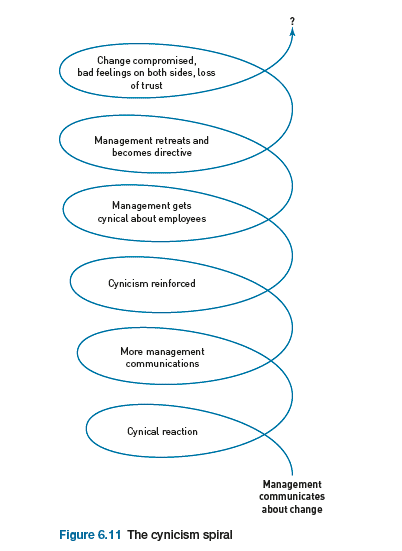
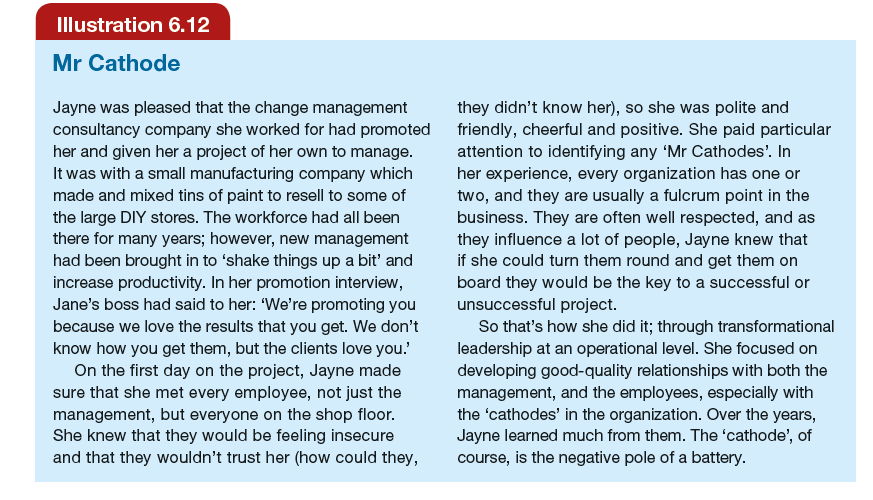
Illustration 6.12 shows how communication and building engagement, as well as recognizing others feelings paid dividends in helping staff accept their new boss. It also shows how recognizing possible sources of cynicism can assist strategies for overcoming such resistance in the future.
Change compromised bad feelings on both sides, loss of trust Management retreats and becomes directive Management gets cynical about employees Cynicism reinforced More management communications Cynical reaction Management communicates about change Figure 6.11 The cynicism spiral Illustration 6.12 Mr Cathode Jayne was pleased that the change management consultancy company she worked for had promoted her and given her a project of her own to manage. It was with a small manufacturing company which made and mixed tins of paint to resell to some of the large DIY stores. The workforce had all been there for many years; however, new management had been brought in to'shake things up a bit' and increase productivity. In her promotion interview, Jane's boss had said to her: 'We're promoting you because we love the results that you get. We don't know how you get them, but the clients love you.' On the first day on the project, Jayne made sure that she met every employee, not just the management, but everyone on the shop floor. She knew that they would be feeling insecure and that they wouldn't trust her (how could they, they didn't know her), so she was polite and friendly, cheerful and positive. She paid particular attention to identifying any 'Mr Cathodes?. In her experience, every organization has one or two, and they are usually a fulcrum point in the business. They are often well respected, and as they influence a lot of people, Jayne knew that if she could turn them round and get them on board they would be the key to a successful or unsuccessful project. So that's how she did it; through transformational leadership at an operational level. She focused on developing good-quality relationships with both the management, and the employees, especially with the 'cathodes' in the organization. Over the years, Jayne learned much from them. The 'cathode', of course, is the negative pole of a battery. Change compromised bad feelings on both sides, loss of trust Management retreats and becomes directive Management gets cynical about employees Cynicism reinforced More management communications Cynical reaction Management communicates about change Figure 6.11 The cynicism spiral Illustration 6.12 Mr Cathode Jayne was pleased that the change management consultancy company she worked for had promoted her and given her a project of her own to manage. It was with a small manufacturing company which made and mixed tins of paint to resell to some of the large DIY stores. The workforce had all been there for many years; however, new management had been brought in to'shake things up a bit' and increase productivity. In her promotion interview, Jane's boss had said to her: 'We're promoting you because we love the results that you get. We don't know how you get them, but the clients love you.' On the first day on the project, Jayne made sure that she met every employee, not just the management, but everyone on the shop floor. She knew that they would be feeling insecure and that they wouldn't trust her (how could they, they didn't know her), so she was polite and friendly, cheerful and positive. She paid particular attention to identifying any 'Mr Cathodes?. In her experience, every organization has one or two, and they are usually a fulcrum point in the business. They are often well respected, and as they influence a lot of people, Jayne knew that if she could turn them round and get them on board they would be the key to a successful or unsuccessful project. So that's how she did it; through transformational leadership at an operational level. She focused on developing good-quality relationships with both the management, and the employees, especially with the 'cathodes' in the organization. Over the years, Jayne learned much from them. The 'cathode', of course, is the negative pole of a battery




