



Question: Requirements (SCENARIO EXAMPLES): Read the article below Readiness for change in the context of employee's readiness to change in an organization. Please give real life
Requirements (SCENARIO EXAMPLES): Read the article below "Readiness for change" in the context of employee's readiness to change in an organization. Please give real life or made up scenarios in an organization to define the following terms: urgency, readiness, low readiness/ low urgency (communicate), low readiness/ high urgency (crisis), high readiness/ low urgency (maintain) and high readiness/ high urgency (quick response) in the context of the article. (The examples should be given in the context of an organization going through change)
For example:
1: Scenario example of low readiness/ low urgency (communicate) : In XYZ company, the manager is going to implement a new software in the company to be used by the employees in 3 months time (low urgency), the employees can actively communicate together about the new change and actively take part in discussions and form opinions about the new software (low readiness)
_____________________________________________________________
Readiness for change
Readiness for change helps facilitate change. It is an important precursor to coping with resistance according to Armenakis, Harris and Mossholde (1993). Readiness involves shaping and conditioning attitudes and beliefs to be favourable for change. As such, communication strategies need to emphasize two key messages:
Urgency The need for change, i.e., explaining the gap between what the organization needs to be doing in the future compared to what it is currently doing, and the critical time available before the change must occur.
Readiness Employees ability to change and their ability to do it well. This is important because if employees think they cannot achieve the required changes, then they will avoid any discretionary effort into achieving it.
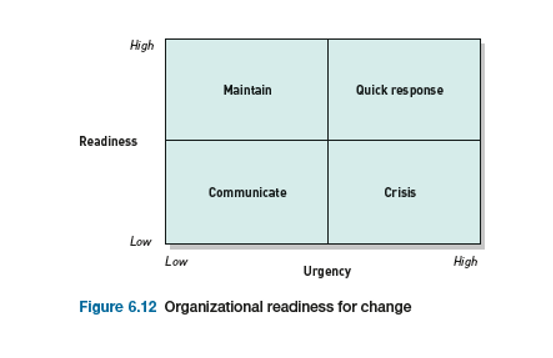
Combining the two concepts of urgency and readiness generates the typology shown in Figure 6.12.
These are, together with the responses suggested on how to cope with the four states of change:
Low readiness/low urgency calls for a communication strategy to enhance readiness. This could involve opinion forming and active participation of employees in events that raise readiness. This might be the least problematic state of change.
Low readiness/high urgency this is a crisis which may need a rapid injection of new personnel and reassignment of people to new tasks.
High readiness/low urgency the priority here is to keep messages about the discrepancy current with frequent communications about progress.
High readiness/high urgency a quick response scenario exists in which high energy for change needs to be maintained. The change here could happen smoothly, but vigilance for unexpected glitches is needed.
Step by Step Solution
There are 3 Steps involved in it

Get step-by-step solutions from verified subject matter experts