



Question: Resonance as a zero-friction limit. Assuming that p, q > 0, for large t > 0, every solution of the equation y + p .y
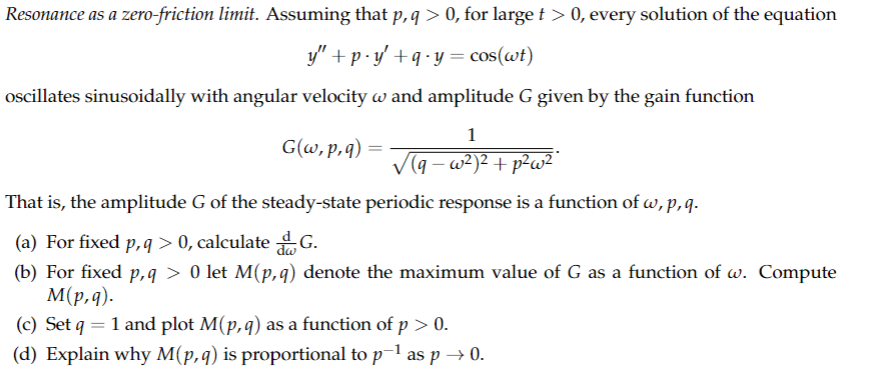
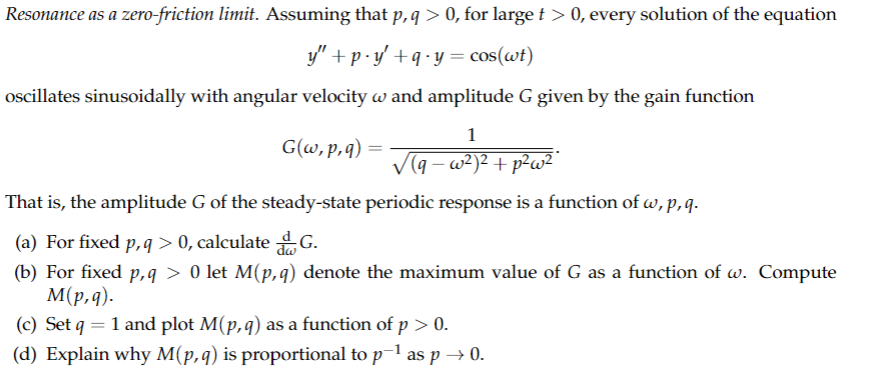
Resonance as a zero-friction limit. Assuming that p, q > 0, for large t > 0, every solution of the equation y" + p .y +q-y= cos(wt) oscillates sinusoidally with angular velocity w and amplitude G given by the gain function 1 G (w, P, 9) = V( 9 - (2) 2 + p2 (2" That is, the amplitude G of the steady-state periodic response is a function of @, p, q. (a) For fixed p, q > 0, calculate G. (b) For fixed p,q > 0 let M(p, q) denote the maximum value of G as a function of w. Compute M(P, q). (c) Set q = 1 and plot M(p, q) as a function of p > 0. (d) Explain why M(p, q) is proportional to p 1 as p -+ 0
Step by Step Solution
There are 3 Steps involved in it
1 Expert Approved Answer
Step: 1 Unlock

Question Has Been Solved by an Expert!
Get step-by-step solutions from verified subject matter experts
Step: 2 Unlock
Step: 3 Unlock