







Question: resource website: https://www.nejm.org/doi/full/10.1056ejmoa1403285 For the questions below, you only need to consider the primary outcome measure (number of ventilator-free days), so you don't need to
resource website: https://www.nejm.org/doi/full/10.1056ejmoa1403285
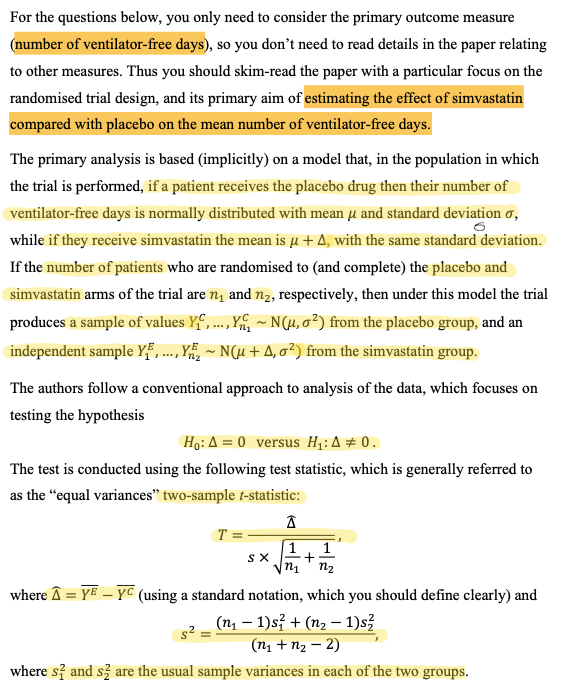
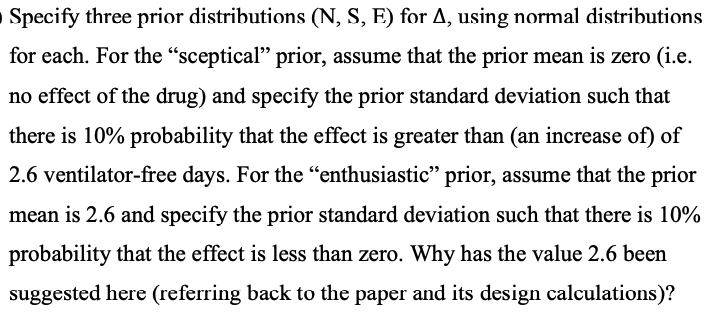
For the questions below, you only need to consider the primary outcome measure (number of ventilator-free days), so you don't need to read details in the paper relating to other measures. Thus you should skim-read the paper with a particular focus on the randomised trial design, and its primary aim of estimating the effect of simvastatin compared with placebo on the mean number of ventilator-free days. The primary analysis is based (implicitly) on a model that, in the population in which the trial is performed, if a patient receives the placebo drug then their number of ventilator-free days is normally distributed with mean / and standard deviation o, while if they receive simvastatin the mean is / + 4, with the same standard deviation. If the number of patients who are randomised to (and complete) the placebo and simvastatin arms of the trial are n, and n2, respectively, then under this model the trial produces a sample of values Yf, ..., Y, ~ N(u, 62) from the placebo group, and an independent sample YF, ..., Yng ~ N(u + A, o') from the simvastatin group. The authors follow a conventional approach to analysis of the data, which focuses on testing the hypothesis Ho: 4 = 0 versus H1:4 # 0. The test is conducted using the following test statistic, which is generally referred to as the "equal variances" two-sample f-statistic: T = SX 1 + 1 n1 nz where A = YE - YC (using a standard notation, which you should define clearly) and (n - 1)s, + (n2 - 1)s2 (n1 + n2 - 2) where s? and s are the usual sample variances in each of the two groups.Specify three prior distributions (N, S, E) for A, using normal distributions for each. For the "sceptical" prior, assume that the prior mean is zero (i.e. no effect of the drug) and specify the prior standard deviation such that there is 10% probability that the effect is greater than (an increase of) of 2.6 ventilator-free days. For the "enthusiastic" prior, assume that the prior mean is 2.6 and specify the prior standard deviation such that there is 10% probability that the effect is less than zero. Why has the value 2.6 been suggested here (referring back to the paper and its design calculations)
Step by Step Solution
There are 3 Steps involved in it

Get step-by-step solutions from verified subject matter experts
 Study Help