







Question: Response Questions Part A To C A) Write 5-6 Sentences For Your Response: Using the IMA Statement of Ethical Professional Practice below as an ethical
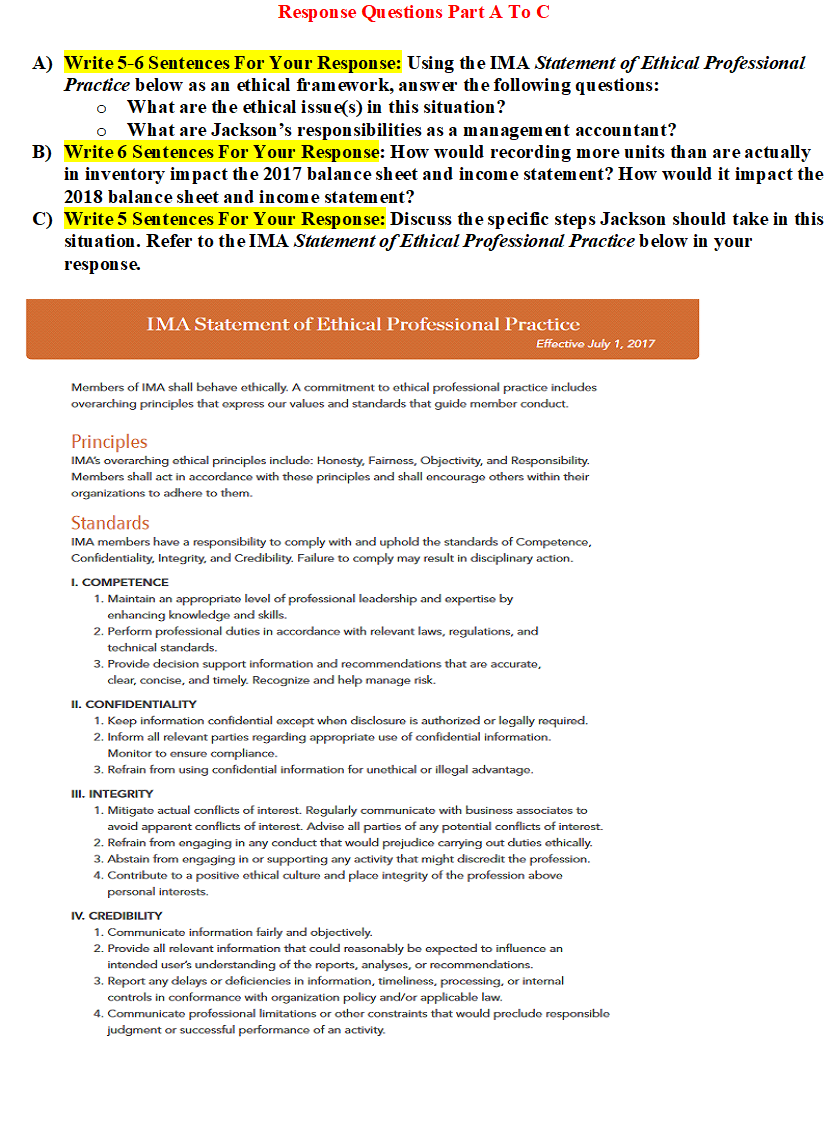
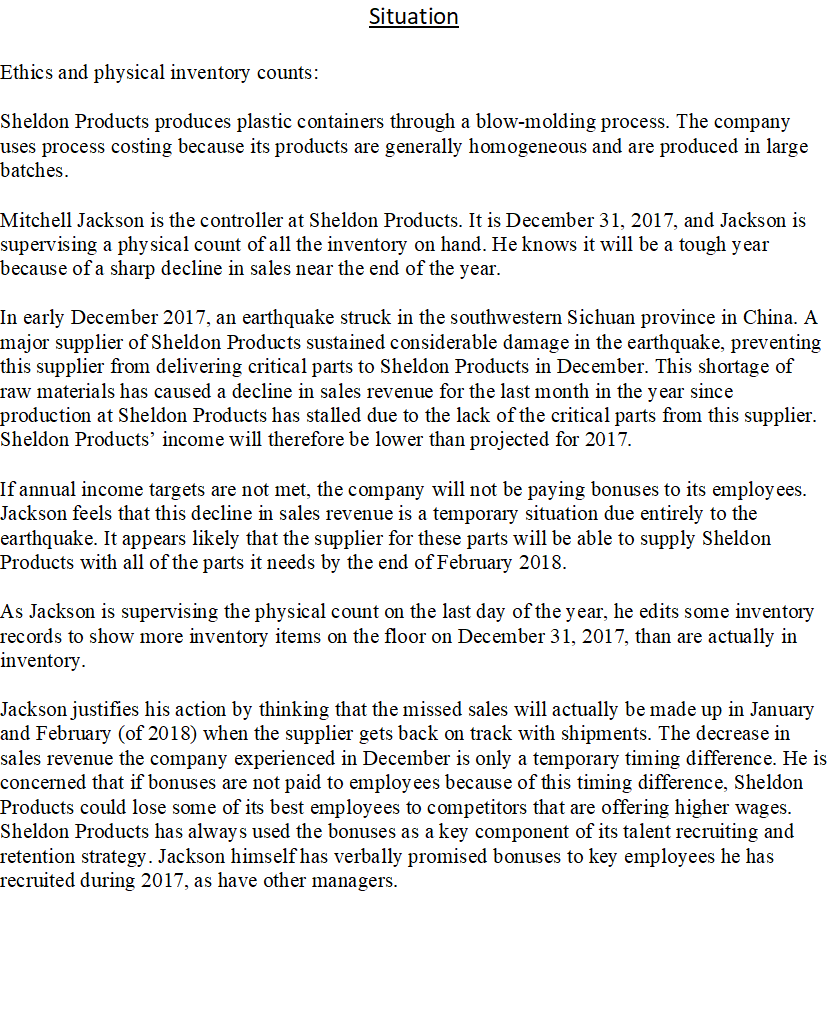
Response Questions Part A To C A) Write 5-6 Sentences For Your Response: Using the IMA Statement of Ethical Professional Practice below as an ethical framework, answer the following questions: o What are the ethical issue(s) in this situation? o What are Jackson's responsibilities as a management accountant? Write 6 Sentences For Your Response: How would recording more units than are actually in inventory impact the 2017 balance sheet and income statement? How would it impact the 2018 balance sheet and income statement? Write 5 Sentences For Your Response: Discuss the specific steps Jackson should take in this situation. Refer to the IMA Statement of Ethical Professional Practice below in your response IMA Statement of Ethical Professional Practice Effective July 1, 2017 Members of IMA shall behave ethically. A commitment to ethical professional practice includes overarching principles that express our values and standards that guide member conduct. Principles IMA's overarching othical principles include: Honesty, Fairness, Objectivity, and Responsibility Members shall act in accordance with these principles and shall encourage others within their organizations to adhere to them. Standards IMA members have a responsibility to comply with and uphold the standards of Competence, Confidentiality, Integrity, and Credibility. Failure to comply may result in disciplinary action. I. COMPETENCE 1. Maintain an appropriate lovel of professional leadership and expertise by enhancing knowledge and skills. 2. Perform professional duties in accordance with relevant laws, regulations, and technical standards. 3. Provide decision support information and recommendations that are accurato, clear, concise, and timely. Recognize and help manage risk. II. CONFIDENTIALITY 1. Keep information confidential except when disclosure is authorized or legally required. 2. Inform all relevant parties regarding appropriate use of confidential information. Monitor to ensure compliance. 3. Rofrain from using confidential information for unethical or illegal advantago III. INTEGRITY 1. Mitigato actual conflicts of interest. Rogularly communicate with businoss associates to avoid apparent conflicts of interest. Advise all parties of any potential conflicts of interest. 2. Refrain from engaging in any conduct that would prejudice carrying out duties othically. 3. Abstain from engaging in or supporting any activity that might discredit the profession. 4. Contribute to a positive ethical culture and place integrity of the profession abovo personal interosts. IV. CREDIBILITY 1. Communicate information fairly and objectively. 2. Provide all relovant information that could reasonably be expected to influence an intended user's understanding of the reports, analyses, or recommendations. 3. Report any delays or deficiencies in information, timeliness, processing, or internal controls in conformance with organization policy and/or applicable law. 4. Communicato profossional limitations or other constraints that would procludo responsible judgment or successful performance of an activity. Situation Ethics and physical inventory counts: Sheldon Products produces plastic containers through a blow-molding process. The company uses process costing because its products are generally homogeneous and are produced in large batches. Mitchell Jackson is the controller at Sheldon Products. It is December 31, 2017, and Jackson is supervising a physical count of all the inventory on hand. He knows it will be a tough year because of a sharp decline in sales near the end of the year. In early December 2017, an earthquake struck in the southwestern Sichuan province in China. A major supplier of Sheldon Products sustained considerable damage in the earthquake, preventing this supplier from delivering critical parts to Sheldon Products in December. This shortage of raw materials has caused a decline in sales revenue for the last month in the year since production at Sheldon Products has stalled due to the lack of the critical parts from this supplier. Sheldon Products' income will therefore be lower than projected for 2017. If annual income targets are not met, the company will not be paying bonuses to its employees. Jackson feels that this decline in sales revenue is a temporary situation due entirely to the earthquake. It appears likely that the supplier for these parts will be able to supply Sheldon Products with all of the parts it needs by the end of February 2018. As Jackson is supervising the physical count on the last day of the year, he edits some inventory records to show more inventory items on the floor on December 31, 2017, than are actually in inventory. Jackson justifies his action by thinking that the missed sales will actually be made up in January and February (of 2018) when the supplier gets back on track with shipments. The decrease in sales revenue the company experienced in December is only a temporary timing difference. He is concerned that if bonuses are not paid to employees because of this timing difference, Sheldon Products could lose some of its best employees to competitors that are offering higher wages. Sheldon Products has always used the bonuses as a key component of its talent recruiting and retention strategy. Jackson himself has verbally promised bonuses to key employees he has recruited during 2017, as have other managers
Step by Step Solution
There are 3 Steps involved in it

Get step-by-step solutions from verified subject matter experts
 Study Help