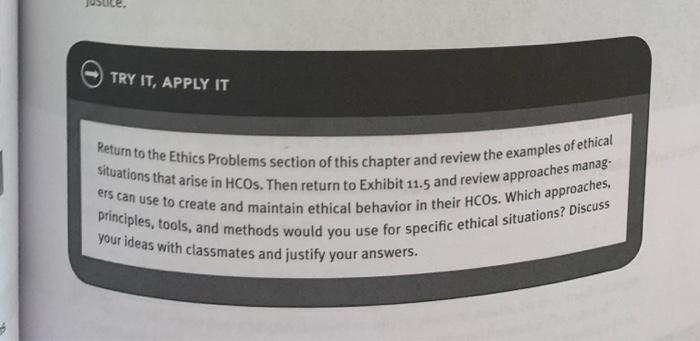
Question: Return to the Ethics Problems section of this chapter and review the examples of ethical situations that arise in HCOs. Then return to Exhibit 11.5
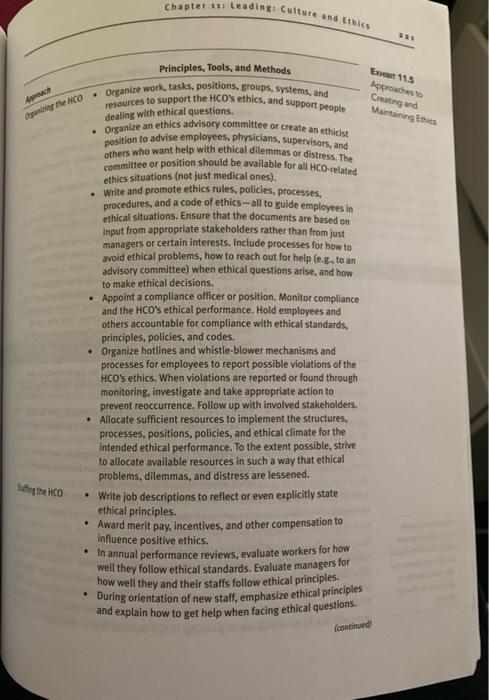
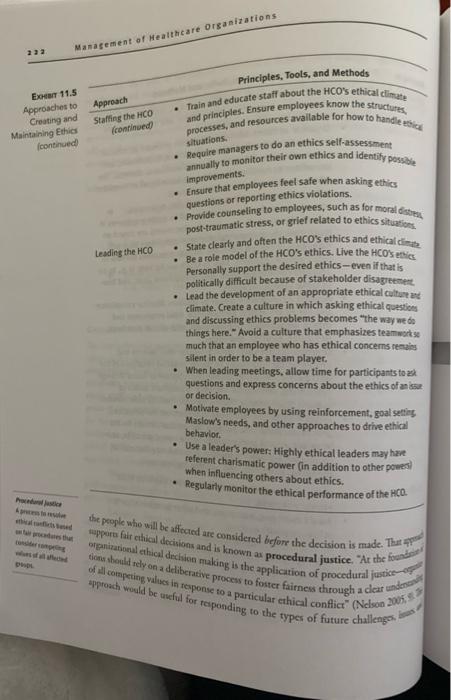
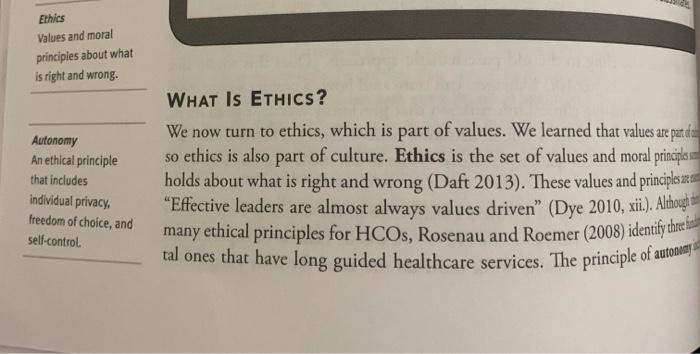
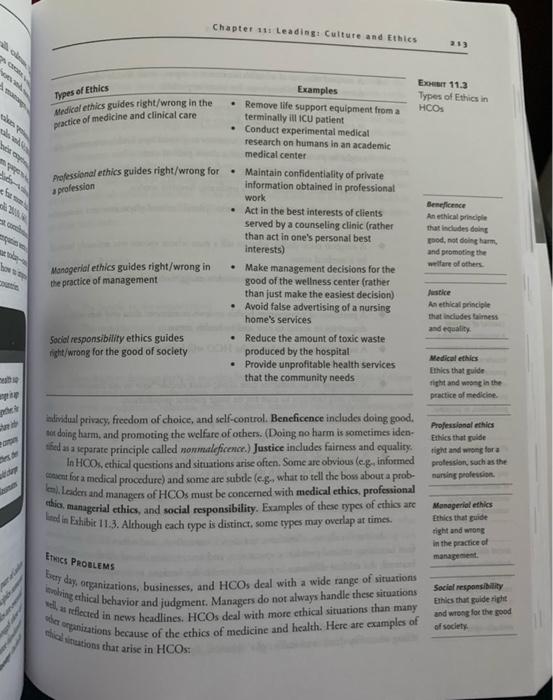
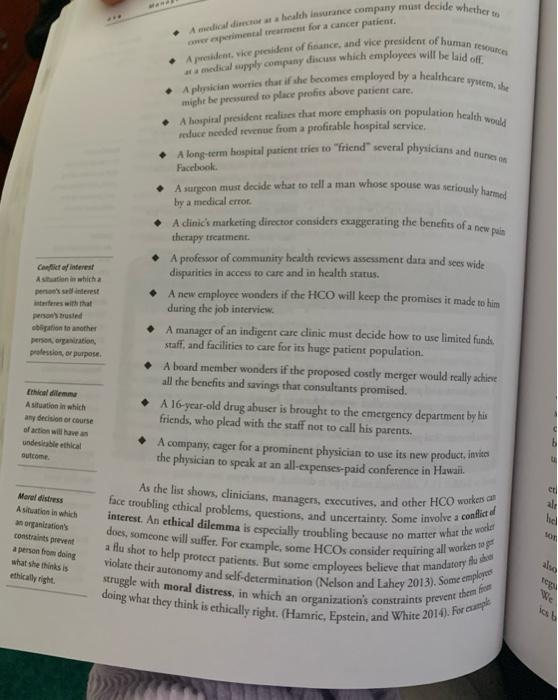
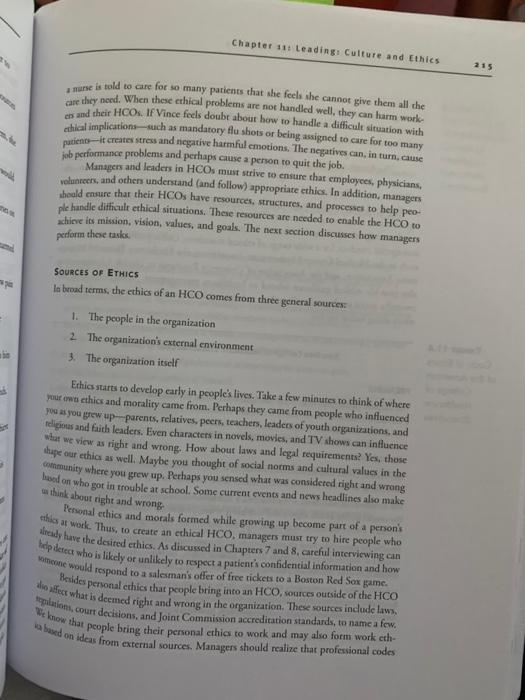
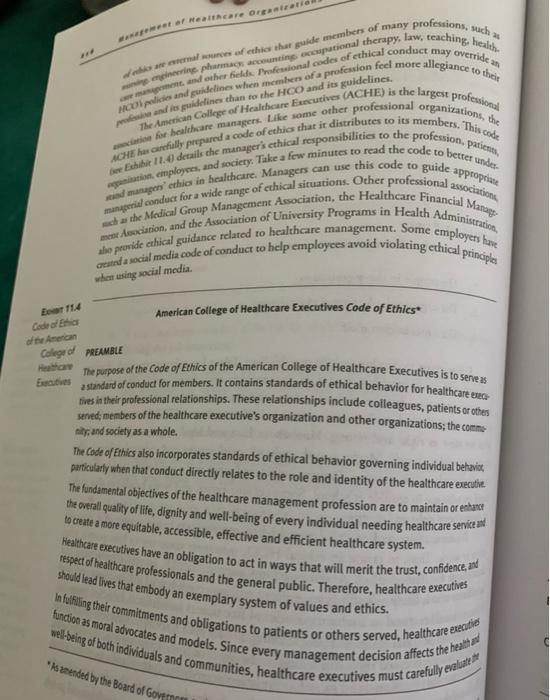
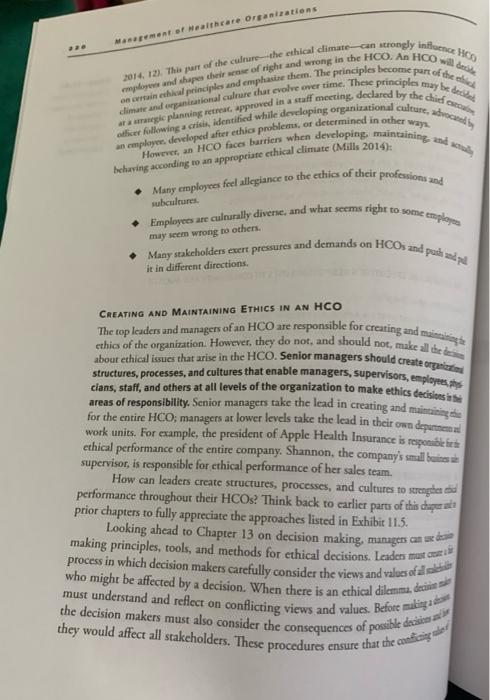
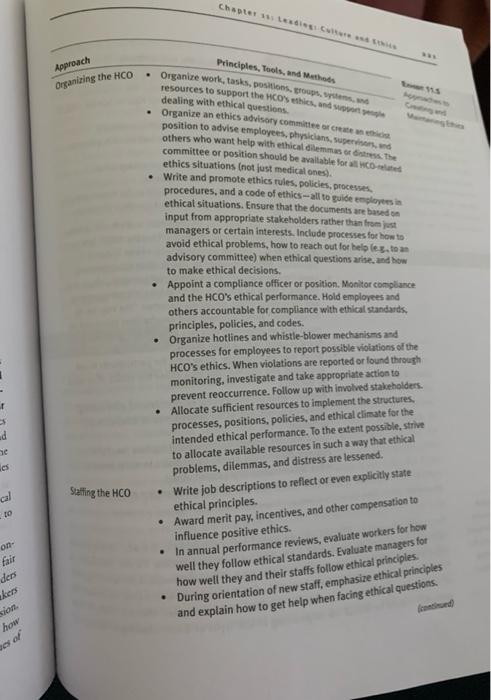
Return to the Ethics Problems section of this chapter and review the examples of ethical situations that arise in HCOs. Then return to Exhibit 11.5 and review approaches manag- ers can use to create and maintain ethical behavior in their HCOs. Which approaches, principles, tools, and methods would you use for specific ethical situations? Discuss your ideas with classmates and justify your answers. Suce. TRY IT, APPLY IT 23 EX 15 Approaches to Creating and Maintaining Erics Ayam the CO Chapter 111 Leading Culture and Ethics Organize work, tasks, positions, groups, systems, and resources to support the HCO's ethics, and support people Organize an ethics advisory Committee of create an ethicist position to advise employees, physicians, supervisors, and others who want help with ethical dilemmas or distress. The committee or position should be available for all HCO-related procedures, and a code of ethics-all to guide employees in and explain how to get help when facing ethical questions. Principles, Tools, and Methods dealing with ethical questions, ethics situations (not just medical ones). . Write and promote ethics rules, policies, processes, ethical situations. Ensure that the documents are based on input from appropriate stakeholders rather than from just managers or certain interests. Include processes for how to avoid ethical problems, how to reach out for help (e.g. to an advisory Committee) when ethical questions arise, and how to make ethical decisions. Appoint a compliance officer or position. Monitor compliance and the HCO's ethical performance. Hold employees and others accountable for compliance with ethical standards, principles, policies, and codes. Organize hotlines and whistle-blower mechanisms and processes for employees to report possible violations of the HCO's ethics. When violations are reported or found through monitoring, investigate and take appropriate action to prevent reoccurrence. Follow up with involved stakeholders. Allocate sufficient resources to implement the structures, processes, positions, policies, and ethical climate for the intended ethical performance. To the extent possible, strive to allocate available resources in such a way that ethical problems, dilemmas, and distress are lessened. Write job descriptions to reflect or even explicitly state ethical principles Award merit pay, incentives, and other compensation to influence positive ethics. In annual performance reviews, evaluate workers for how well they follow ethical standards. Evaluate managers for how well they and their staffs follow ethical principles. . During orientation of new staff, emphasize ethical principles Sting the HCO [continued Train and educate staff about the HCO's ethical dima and principles. Ensure employees know the structures Provide counseling to employees, such as for moral post-traumatic stress, or grief related to ethics situation the people who will be affected are considered before the decision is made. That supports fait ethical decisions and is known as procedural justice. At the found nizational hical decision making is the application of procedural justice tions should rely on a deliberative process to foster fairness through a clear and of will competing values in tesponse to a particular ethical conflict (Nelson 2005 approach would be useful for responding to the types of future challenges processes, and resources available for how to handle Ensure that employees feel safe when asking ethics State clearly and often the HCO's ethics and ethical Management of Healthcare Organizations Principles, Tools, and Methods Ex 11.5 Approaches to Creating and Maintaining Ethics continued Approach Staffing the HCO (continued situations . Require managers to do an ethics self-assessment annually to monitor their own ethics and identify postaja improvements questions or reporting ethics violations Leading the HCO Be a role model of the HCO's ethics. Live the HCO's envies Personally support the desired ethics--even if that is politically difficult because of stakeholder disagreement Lead the development of an appropriate ethical culture and climate. Create a culture in which asking ethical questions and discussing ethics problems becomes the way we de things here. Avoid a culture that emphasizes teamwork se much that an employee who has ethical concerns remains silent in order to be a team player. When leading meetings, allow time for participants to ask questions and express concerns about the ethics of an e or decision. Motivate employees by using reinforcement, goal setting Maslow's needs, and other approaches to drive ethical behavior Use a leader's power: Highly ethical leaders may have referent charismatic power in addition to other power Regularly monitor the ethical performance of the HCO when influencing others about ethics. Ethics Values and moral principles about what is right and wrong. Autonomy An ethical principle that includes individual privacy freedom of choice, and self-control. WHAT IS ETHICS? We now turn to ethics, which is part of values. We learned that values are part de so ethics is also part of culture. Ethics is the set of values and moral principles holds about what is right and wrong (Daft 2013). These values and principles zace "Effective leaders are almost always values driven" (Dye 2010, xii). Although many ethical principles for HCOs, Rosenau and Roemer (2008) identify the time tal ones that have long guided healthcare services. The principle of autonve chic stations that arise in HCOS: Chapter 11: Leading Culture and Ethics 13 Professional ethics guides right/wrong for Maintain confidentiality of private brery day, yanizations, businesses, and HCOs deal with a wide range of situations robing chical behavior and judgment Managers do not always handle these situations was feated in news headlines. HCOs deal with more ethical situations than many shanizations because of the ethics of medicine and health. Here are examples of Examples Remove life support equipment from a terminally ill icu patient Conduct experimental medical research on humans in an academic medical center Types of Ethics EX 11.3 Types of Ethics in HCOS Wedical ethics guides right/wrong in the practice of medicine and clinical care profession Beneficence An ethical principle that includes doing mod, not doingham and promoting the welfare of others Managerial ethics guides right/wrong in the practice of management information obtained in professional work Act in the best interests of clients served by a counseling clinic (rather than act in one's personal best Interests) Make management decisions for the good of the wellness center (rather than just make the easiest decision) Avoid false advertising of a nursing home's services Reduce the amount of toxic waste produced by the hospital Provide unprofitable health services that the community needs Justice An ethical principle that includes alimess and equality Social responsibility ethics guides right/wrong for the good of society Medical ethics Ethics that guide right and wrong in the practice of medicine individual privacy, freedom of choice, and self-control. Beneficence includes doing good. tot doing harm, and promoting the welfare of others. (Doing no harm is sometimes iden- tibed as a separate principle called normaleficence.) Justice includes fairness and equality. In Hcos, ethical questions and situations arise often. Some are obvious (c.g., informed sent for a medical procedure) and some are subtle (eg, what to tell the bow about a prob- al leader and managers of HCOs must be concerned with medical ethics, professional thics, managerial ethics, and social responsibility. Examples of these types of this are wel in Exhibit 11.3. Although each type is distinct, some types may overlap at times. Professional ethics Ethies that pulde right and wrong for a profession such as the nursing professor Managerial ethics Ethics that guide right and wrong in the practice of Ethics PROBLEMS Social responsibility Ethics that guide right and wrong for the good of society doing what they think is ethically right. (Hamric, Epstein, and White 2014). For comple www xperimental treatment for a cancer patient seriously harmed Aldara health insurance company must decide whether to A or vice president of ance, and vice president of human resources ar a medical supply company discuss which employees will be laid off. Aplysician worries tharif she becomes employed by a healthcare system, she A long-term hospital patient tries to "friend several physicians and tursson As the list shows, clinicians, managers, executives, and other HCO workea face troubling ethical problems, questions, and uncertainty. Some involve a conflicto does, someone will suffer. For example, some HCOs consider requiring all workers a flu shot to help protect patients. But some employees believe that mandatory to se struggle with moral distress, in which an organization's constraints violate their autonomy and self-determination (Nelson and Lahey 2013). Some employees might be pressured to place profits above patient care A health mula reduce needed revenue from a profitable hospital service Facebook A surgeon must decide what to tell a man whose spouse was by a medical error A clinic's marketing director considers exaggerating the benefits of a new palla therapy treatment A professor of community health reviews assessment data and sees wide Conflict of interest disparities in access to care and in health status. Astation in which a pens interest A new employee wonders if the HCO will keep the promises it made to him during the job interview persons on to another A manager of an indigent care cinic must decide how to use limited funds staff, and facilities to care for its huge patient population. profession, or purpose A board member wonders if the proposed costly merger would really achine all the benefits and savings that consultants promised. A 16-year-old drug abuser is brought to the emergency department by his friends, who plead with the staff not to call his parents. A company, eager for a prominent physician to use its new product, invite outcome the physician to speak at an all-expenses-paid conference in Hawaii. A situation in which any decisions or course 5 ct alt he Moral distress A situation in which In organisation's constraints prevent a person from doing what she thinks is ethically right prevent nurse is told to care for so many patients that she feels she cannot give them all the ready have the desired ethics. As discussed in Chapters 7 and 8, careful interviewing can Ido detect who is likely or unlikely to respect a patient's confidential information and how acone would respond to a salesman's offer of free tickets to a Boston Red Sox game. hotect what is deemed right and wrong in the organization. These sources include Laws, Besides personal ethics that people bring into an HCO, sources outside of the HCO suplans, court decisions, and Joint Commission accreditation standards, to name a few. We know that people bring their personal ethics to work and may also form work eth- based on ideas from external sources Managers should realize that professional codes Chapter 11: Leading: Culture and Ethics 215 care they need. When these ethical problems are not handled well, they can harm work en and their HCOS. If Vince feels doubt about how to handle a difficult situation with ethical implications such as mandatory flu shots or being assigned to cure for too many patienoit creates stress and negative harmful emotions. The negatives can, in turn, cause performance problems and perhaps cause a person to quit the job. Managers and leaders in HCO, must strive to ensure that employees, physicians, volunteers, and other understand and follow) appropriate ethics. In addition, managers haald ensure that their HCOs have resources, structures, and processes to help peo- ple handle difficult ethical situations. These resources are needed to enable the HCO to Achieve its mission, vision, values, and goals. The next section discusses how managers perform these tasks SOURCES OF ETHICS In broad terms, the ethics of an HCO comes from three general sources 1. The people in the organization 2. The organization's external environment 3. The organization itself Ethics starts to develop early in people's lives. Take a few minutes to think of where your own ethics and morality came from. Perhaps they came from people who influenced poc as you grew up-parents, relatives, peers, teachers, leaders of youth organizations, and religious and faith leaders. Even characters in novels, movies, and TV shows can influence what we view as right and wrong. How about laws and legal requirements? Yes, those dupe our ethics as well. Maybe you thought of social norms and cultural values in the auditerunity where you grew up. Perhaps you sensed what was considered right and wrong wed on who got in trouble at school. Some current events and news headlines also make wrong Personal ethics and morals formed while growing up become part of a person's ethics at work. Thus, to create an ethical HCO managers must try to hire people who w think about right and a nurse is told to care for so many patients that she feels she cannot give them all the ready have the desired ethics. As discussed in Chapters 7 and 8, careful interviewing can Ido detect who is likely or unlikely to respect a patient's confidential information and how acone would respond to a salesman's offer of free tickets to a Boston Red Sox game. hotect what is deemed right and wrong in the organization. These sources include Laws, Besides personal ethics that people bring into an HCO, sources outside of the HCO suplans, court decisions, and Joint Commission accreditation standards, to name a few. We know that people bring their personal ethics to work and may also form work eth- based on ideas from external sources Managers should realize that professional codes Chapter 11: Leading: Culture and Ethics 215 care they need. When these ethical problems are not handled well, they can harm work en and their HCOS. If Vince feels doubt about how to handle a difficult situation with ethical implications such as mandatory flu shots or being assigned to cure for too many patienoit creates stress and negative harmful emotions. The negatives can, in turn, cause performance problems and perhaps cause a person to quit the job. Managers and leaders in HCO, must strive to ensure that employees, physicians, volunteers, and other understand and follow) appropriate ethics. In addition, managers haald ensure that their HCOs have resources, structures, and processes to help peo- ple handle difficult ethical situations. These resources are needed to enable the HCO to Achieve its mission, vision, values, and goals. The next section discusses how managers perform these tasks SOURCES OF ETHICS In broad terms, the ethics of an HCO comes from three general sources 1. The people in the organization 2. The organization's external environment 3. The organization itself Ethics starts to develop early in people's lives. Take a few minutes to think of where your own ethics and morality came from. Perhaps they came from people who influenced poc as you grew up-parents, relatives, peers, teachers, leaders of youth organizations, and religious and faith leaders. Even characters in novels, movies, and TV shows can influence what we view as right and wrong. How about laws and legal requirements? Yes, those dupe our ethics as well. Maybe you thought of social norms and cultural values in the auditerunity where you grew up. Perhaps you sensed what was considered right and wrong wed on who got in trouble at school. Some current events and news headlines also make wrong Personal ethics and morals formed while growing up become part of a person's ethics at work. Thus, to create an ethical HCO managers must try to hire people who w think about right and a narrat Healthcare Oreascar neral of this the guide members of many professions, such in pharmaceutin occupational therapy, law, teaching, health on and other fields. Phafesional codes of ethical conduct may override and delines when members of a profession feel more The American College of Healthcare Executives CACHE) is the largest professional for healthcare managers. Like some other professional organizations, the ACHE her carefully prepared a code of ethics that it distributes to its members. This code un employees, and society. Take a few minutes to read the code to better under Echib 11.0) details the managers ethical responsibilities to the profession, patients, man ethics in healthcare Managers can use this code to mangel conduct for a wide range of ethical situations. Other professional association merociation, and the Association of University Programs in Health Administration, car the Medical Group Management Association, the Healthcare Financial Mana created a social media code of conduct to help employees avoid violating ethical principles ale provide ethical guidance related to healthcare management. Some employers Healthcare Executives have an obligation to act in ways that will merit the trust, confidence and respect of healthcare professionals and the general public. Therefore, healthcare executives should lead lives that embody an exemplary system of values and ethics. In fulfilling their commitments and obligations to patients or others served, healthcare executio well-being of both individuals and communities, healthcare executives must carefully evaluate function as moral advocates and models. Since every management decision affects the heath allegiance to the and le guidelines than to the HCO and its guidelines. guide appropriate when using social media American College of Healthcare Executives Code of Ethics Ear 114 Code of the of the American College of PREAMBLE Ees The purpose of the Code of Ethics of the American College of Healthcare Executives is to senes sanderd of conduct for members . It contains standards of ethical behavior for healthcare eres tves in their professional relationships. These relationships include colleagues, patients or others served members of the healthcare executive's organization and other organizations; the comme nity and society as a as a whole. The Code of Ethics also incorporates standards of ethical behavior governing individual behavis particularly when that conduct directly relates to the role and identity of the healthcare executit. The fundamental objectives of the healthcare management profession are to maintain or enhance the overall quality of life, dignity and well-being of every individual needing healthcare service at to create a more equitable, accessible, effective and efficient healthcare system. szmended by the Board of Governo However, an HCO faces barriers when developing maintaining and Many stakeholders exert pressures and demands on HCOs and pro Manent of Wealthcare Organizations 2014, 12). This of the curthe ethical climate can strongly influence 996) climate and organizational culrure that evolve over time. These principles may be os certain the principles and emphasize them. The principles become part of the employees and shape their of right and wrong in the HCO. An HCO will ar al planning to approved in a staff meeting, declared by the chic officer following crisis, identified while developing organizational culture, an employee developed after this problems, or determined in other ethics of the organization. However, they do not, and should not make all the The top leaders and managers of an HCO are responsible for creating and maintaining about ethical issues that arise in the HCO. Senior managers should create organic structures, processes, and cultures that enable managers, supervisors, employees who might be affected by a decision. When there is an ethical dilemma de must understand and reflect on conflicting views and values. Before makingad the decision makers must also consider the consequences of possible decor they would affect all stakeholders. These procedures ensure that the contender ways. behaving according to an appropriate ethical climate (Mill, 2014) to some employees ubcultures Employees are culturally diverse, and what seems right may seem wrong to others. it in different directions Many employees feel allegiance to the ethics of their professions and process in which decision makers carefully consider the views and values of all CREATING AND MAINTAINING ETHICS IN AN HCO cians, staff, and others at all levels of the organization to make ethics decisions is areas of responsibility. Senior managers take the lead in creating and maintaining for the entire HCO, managers at lower levels take the lead in their own depanneau work units. For example, the president of Apple Health Insurance is responsible for ethical performance of the entire company. Shannon, the company's small business supervisor, is responsible for ethical performance of her sales team. How can leaders create structures, processes, and cultures to strengthens performance throughout their HCO? Think back to carlier parts of this chapeado prior chapters to fully appreciate the approaches listed in Exhibit 11.5. Looking ahead to Chapter 13 on decision making, managers can sedang making principles, tools, and methods for ethical decisions. Leaders met e Chapter 1 Approach Organizing the HCO Principles, Tools, and Methods Organize work tasks. positions. trouwens. resources to support the cos ethics, and dealing with ethical questions Organize an ethics advisory Committee or create position to advise employees, physicians, Superior, und others who want help with ethical dilemmas tres. The committee or position should be available for all ethics situations (not just medical ones). Write and promote ethics rules, policies, processes procedures, and a code of ethics-all to guide employees in ethical situations. Ensure that the documents are based on input from appropriate stakeholders rather than from just managers or certain interests. Include processes for how to avoid ethical problems, how to reach out for helples. to an advisory Committee) when ethical questions arise, and how to make ethical decisions Appoint a compliance officer or position. Monitor compliance and the HCO's ethical performance. Hold employees and others accountable for compliance with ethical standards, principles, policies, and codes. Organize hotlines and whistle blower mechanisms and processes for employees to report possible violations of the HCO's ethics. When violations are reported or found through monitoring, investigate and take appropriate action to prevent reoccurrence. Follow up with involved stakeholders. Allocate sufficient resources to implement the structures, . d Staffing the HCO . DO processes, positions, policies, and ethical climate for the intended ethical performance. To the extent possible, strive to allocate available resources in such a way that ethical problems, dilemmas, and distress are lessened. Write job descriptions to reflect or even explicitly state ethical principles. Award merit pay, incentives, and other compensation to influence positive ethics. In annual performance reviews, evaluate workers for how well they follow ethical standards. Evaluate managers for how well they and their staffs follow ethical principles During orientation of new staff, emphasize ethical principles and explain how to get help when facing ethical questions on- fair ders kers how Return to the Ethics Problems section of this chapter and review the examples of ethical situations that arise in HCOs. Then return to Exhibit 11.5 and review approaches manag- ers can use to create and maintain ethical behavior in their HCOs. Which approaches, principles, tools, and methods would you use for specific ethical situations? Discuss your ideas with classmates and justify your answers. Suce. TRY IT, APPLY IT 23 EX 15 Approaches to Creating and Maintaining Erics Ayam the CO Chapter 111 Leading Culture and Ethics Organize work, tasks, positions, groups, systems, and resources to support the HCO's ethics, and support people Organize an ethics advisory Committee of create an ethicist position to advise employees, physicians, supervisors, and others who want help with ethical dilemmas or distress. The committee or position should be available for all HCO-related procedures, and a code of ethics-all to guide employees in and explain how to get help when facing ethical questions. Principles, Tools, and Methods dealing with ethical questions, ethics situations (not just medical ones). . Write and promote ethics rules, policies, processes, ethical situations. Ensure that the documents are based on input from appropriate stakeholders rather than from just managers or certain interests. Include processes for how to avoid ethical problems, how to reach out for help (e.g. to an advisory Committee) when ethical questions arise, and how to make ethical decisions. Appoint a compliance officer or position. Monitor compliance and the HCO's ethical performance. Hold employees and others accountable for compliance with ethical standards, principles, policies, and codes. Organize hotlines and whistle-blower mechanisms and processes for employees to report possible violations of the HCO's ethics. When violations are reported or found through monitoring, investigate and take appropriate action to prevent reoccurrence. Follow up with involved stakeholders. Allocate sufficient resources to implement the structures, processes, positions, policies, and ethical climate for the intended ethical performance. To the extent possible, strive to allocate available resources in such a way that ethical problems, dilemmas, and distress are lessened. Write job descriptions to reflect or even explicitly state ethical principles Award merit pay, incentives, and other compensation to influence positive ethics. In annual performance reviews, evaluate workers for how well they follow ethical standards. Evaluate managers for how well they and their staffs follow ethical principles. . During orientation of new staff, emphasize ethical principles Sting the HCO [continued Train and educate staff about the HCO's ethical dima and principles. Ensure employees know the structures Provide counseling to employees, such as for moral post-traumatic stress, or grief related to ethics situation the people who will be affected are considered before the decision is made. That supports fait ethical decisions and is known as procedural justice. At the found nizational hical decision making is the application of procedural justice tions should rely on a deliberative process to foster fairness through a clear and of will competing values in tesponse to a particular ethical conflict (Nelson 2005 approach would be useful for responding to the types of future challenges processes, and resources available for how to handle Ensure that employees feel safe when asking ethics State clearly and often the HCO's ethics and ethical Management of Healthcare Organizations Principles, Tools, and Methods Ex 11.5 Approaches to Creating and Maintaining Ethics continued Approach Staffing the HCO (continued situations . Require managers to do an ethics self-assessment annually to monitor their own ethics and identify postaja improvements questions or reporting ethics violations Leading the HCO Be a role model of the HCO's ethics. Live the HCO's envies Personally support the desired ethics--even if that is politically difficult because of stakeholder disagreement Lead the development of an appropriate ethical culture and climate. Create a culture in which asking ethical questions and discussing ethics problems becomes the way we de things here. Avoid a culture that emphasizes teamwork se much that an employee who has ethical concerns remains silent in order to be a team player. When leading meetings, allow time for participants to ask questions and express concerns about the ethics of an e or decision. Motivate employees by using reinforcement, goal setting Maslow's needs, and other approaches to drive ethical behavior Use a leader's power: Highly ethical leaders may have referent charismatic power in addition to other power Regularly monitor the ethical performance of the HCO when influencing others about ethics. Ethics Values and moral principles about what is right and wrong. Autonomy An ethical principle that includes individual privacy freedom of choice, and self-control. WHAT IS ETHICS? We now turn to ethics, which is part of values. We learned that values are part de so ethics is also part of culture. Ethics is the set of values and moral principles holds about what is right and wrong (Daft 2013). These values and principles zace "Effective leaders are almost always values driven" (Dye 2010, xii). Although many ethical principles for HCOs, Rosenau and Roemer (2008) identify the time tal ones that have long guided healthcare services. The principle of autonve chic stations that arise in HCOS: Chapter 11: Leading Culture and Ethics 13 Professional ethics guides right/wrong for Maintain confidentiality of private brery day, yanizations, businesses, and HCOs deal with a wide range of situations robing chical behavior and judgment Managers do not always handle these situations was feated in news headlines. HCOs deal with more ethical situations than many shanizations because of the ethics of medicine and health. Here are examples of Examples Remove life support equipment from a terminally ill icu patient Conduct experimental medical research on humans in an academic medical center Types of Ethics EX 11.3 Types of Ethics in HCOS Wedical ethics guides right/wrong in the practice of medicine and clinical care profession Beneficence An ethical principle that includes doing mod, not doingham and promoting the welfare of others Managerial ethics guides right/wrong in the practice of management information obtained in professional work Act in the best interests of clients served by a counseling clinic (rather than act in one's personal best Interests) Make management decisions for the good of the wellness center (rather than just make the easiest decision) Avoid false advertising of a nursing home's services Reduce the amount of toxic waste produced by the hospital Provide unprofitable health services that the community needs Justice An ethical principle that includes alimess and equality Social responsibility ethics guides right/wrong for the good of society Medical ethics Ethics that guide right and wrong in the practice of medicine individual privacy, freedom of choice, and self-control. Beneficence includes doing good. tot doing harm, and promoting the welfare of others. (Doing no harm is sometimes iden- tibed as a separate principle called normaleficence.) Justice includes fairness and equality. In Hcos, ethical questions and situations arise often. Some are obvious (c.g., informed sent for a medical procedure) and some are subtle (eg, what to tell the bow about a prob- al leader and managers of HCOs must be concerned with medical ethics, professional thics, managerial ethics, and social responsibility. Examples of these types of this are wel in Exhibit 11.3. Although each type is distinct, some types may overlap at times. Professional ethics Ethies that pulde right and wrong for a profession such as the nursing professor Managerial ethics Ethics that guide right and wrong in the practice of Ethics PROBLEMS Social responsibility Ethics that guide right and wrong for the good of society doing what they think is ethically right. (Hamric, Epstein, and White 2014). For comple www xperimental treatment for a cancer patient seriously harmed Aldara health insurance company must decide whether to A or vice president of ance, and vice president of human resources ar a medical supply company discuss which employees will be laid off. Aplysician worries tharif she becomes employed by a healthcare system, she A long-term hospital patient tries to "friend several physicians and tursson As the list shows, clinicians, managers, executives, and other HCO workea face troubling ethical problems, questions, and uncertainty. Some involve a conflicto does, someone will suffer. For example, some HCOs consider requiring all workers a flu shot to help protect patients. But some employees believe that mandatory to se struggle with moral distress, in which an organization's constraints violate their autonomy and self-determination (Nelson and Lahey 2013). Some employees might be pressured to place profits above patient care A health mula reduce needed revenue from a profitable hospital service Facebook A surgeon must decide what to tell a man whose spouse was by a medical error A clinic's marketing director considers exaggerating the benefits of a new palla therapy treatment A professor of community health reviews assessment data and sees wide Conflict of interest disparities in access to care and in health status. Astation in which a pens interest A new employee wonders if the HCO will keep the promises it made to him during the job interview persons on to another A manager of an indigent care cinic must decide how to use limited funds staff, and facilities to care for its huge patient population. profession, or purpose A board member wonders if the proposed costly merger would really achine all the benefits and savings that consultants promised. A 16-year-old drug abuser is brought to the emergency department by his friends, who plead with the staff not to call his parents. A company, eager for a prominent physician to use its new product, invite outcome the physician to speak at an all-expenses-paid conference in Hawaii. A situation in which any decisions or course 5 ct alt he Moral distress A situation in which In organisation's constraints prevent a person from doing what she thinks is ethically right prevent nurse is told to care for so many patients that she feels she cannot give them all the ready have the desired ethics. As discussed in Chapters 7 and 8, careful interviewing can Ido detect who is likely or unlikely to respect a patient's confidential information and how acone would respond to a salesman's offer of free tickets to a Boston Red Sox game. hotect what is deemed right and wrong in the organization. These sources include Laws, Besides personal ethics that people bring into an HCO, sources outside of the HCO suplans, court decisions, and Joint Commission accreditation standards, to name a few. We know that people bring their personal ethics to work and may also form work eth- based on ideas from external sources Managers should realize that professional codes Chapter 11: Leading: Culture and Ethics 215 care they need. When these ethical problems are not handled well, they can harm work en and their HCOS. If Vince feels doubt about how to handle a difficult situation with ethical implications such as mandatory flu shots or being assigned to cure for too many patienoit creates stress and negative harmful emotions. The negatives can, in turn, cause performance problems and perhaps cause a person to quit the job. Managers and leaders in HCO, must strive to ensure that employees, physicians, volunteers, and other understand and follow) appropriate ethics. In addition, managers haald ensure that their HCOs have resources, structures, and processes to help peo- ple handle difficult ethical situations. These resources are needed to enable the HCO to Achieve its mission, vision, values, and goals. The next section discusses how managers perform these tasks SOURCES OF ETHICS In broad terms, the ethics of an HCO comes from three general sources 1. The people in the organization 2. The organization's external environment 3. The organization itself Ethics starts to develop early in people's lives. Take a few minutes to think of where your own ethics and morality came from. Perhaps they came from people who influenced poc as you grew up-parents, relatives, peers, teachers, leaders of youth organizations, and religious and faith leaders. Even characters in novels, movies, and TV shows can influence what we view as right and wrong. How about laws and legal requirements? Yes, those dupe our ethics as well. Maybe you thought of social norms and cultural values in the auditerunity where you grew up. Perhaps you sensed what was considered right and wrong wed on who got in trouble at school. Some current events and news headlines also make wrong Personal ethics and morals formed while growing up become part of a person's ethics at work. Thus, to create an ethical HCO managers must try to hire people who w think about right and a nurse is told to care for so many patients that she feels she cannot give them all the ready have the desired ethics. As discussed in Chapters 7 and 8, careful interviewing can Ido detect who is likely or unlikely to respect a patient's confidential information and how acone would respond to a salesman's offer of free tickets to a Boston Red Sox game. hotect what is deemed right and wrong in the organization. These sources include Laws, Besides personal ethics that people bring into an HCO, sources outside of the HCO suplans, court decisions, and Joint Commission accreditation standards, to name a few. We know that people bring their personal ethics to work and may also form work eth- based on ideas from external sources Managers should realize that professional codes Chapter 11: Leading: Culture and Ethics 215 care they need. When these ethical problems are not handled well, they can harm work en and their HCOS. If Vince feels doubt about how to handle a difficult situation with ethical implications such as mandatory flu shots or being assigned to cure for too many patienoit creates stress and negative harmful emotions. The negatives can, in turn, cause performance problems and perhaps cause a person to quit the job. Managers and leaders in HCO, must strive to ensure that employees, physicians, volunteers, and other understand and follow) appropriate ethics. In addition, managers haald ensure that their HCOs have resources, structures, and processes to help peo- ple handle difficult ethical situations. These resources are needed to enable the HCO to Achieve its mission, vision, values, and goals. The next section discusses how managers perform these tasks SOURCES OF ETHICS In broad terms, the ethics of an HCO comes from three general sources 1. The people in the organization 2. The organization's external environment 3. The organization itself Ethics starts to develop early in people's lives. Take a few minutes to think of where your own ethics and morality came from. Perhaps they came from people who influenced poc as you grew up-parents, relatives, peers, teachers, leaders of youth organizations, and religious and faith leaders. Even characters in novels, movies, and TV shows can influence what we view as right and wrong. How about laws and legal requirements? Yes, those dupe our ethics as well. Maybe you thought of social norms and cultural values in the auditerunity where you grew up. Perhaps you sensed what was considered right and wrong wed on who got in trouble at school. Some current events and news headlines also make wrong Personal ethics and morals formed while growing up become part of a person's ethics at work. Thus, to create an ethical HCO managers must try to hire people who w think about right and a narrat Healthcare Oreascar neral of this the guide members of many professions, such in pharmaceutin occupational therapy, law, teaching, health on and other fields. Phafesional codes of ethical conduct may override and delines when members of a profession feel more The American College of Healthcare Executives CACHE) is the largest professional for healthcare managers. Like some other professional organizations, the ACHE her carefully prepared a code of ethics that it distributes to its members. This code un employees, and society. Take a few minutes to read the code to better under Echib 11.0) details the managers ethical responsibilities to the profession, patients, man ethics in healthcare Managers can use this code to mangel conduct for a wide range of ethical situations. Other professional association merociation, and the Association of University Programs in Health Administration, car the Medical Group Management Association, the Healthcare Financial Mana created a social media code of conduct to help employees avoid violating ethical principles ale provide ethical guidance related to healthcare management. Some employers Healthcare Executives have an obligation to act in ways that will merit the trust, confidence and respect of healthcare professionals and the general public. Therefore, healthcare executives should lead lives that embody an exemplary system of values and ethics. In fulfilling their commitments and obligations to patients or others served, healthcare executio well-being of both individuals and communities, healthcare executives must carefully evaluate function as moral advocates and models. Since every management decision affects the heath allegiance to the and le guidelines than to the HCO and its guidelines. guide appropriate when using social media American College of Healthcare Executives Code of Ethics Ear 114 Code of the of the American College of PREAMBLE Ees The purpose of the Code of Ethics of the American College of Healthcare Executives is to senes sanderd of conduct for members . It contains standards of ethical behavior for healthcare eres tves in their professional relationships. These relationships include colleagues, patients or others served members of the healthcare executive's organization and other organizations; the comme nity and society as a as a whole. The Code of Ethics also incorporates standards of ethical behavior governing individual behavis particularly when that conduct directly relates to the role and identity of the healthcare executit. The fundamental objectives of the healthcare management profession are to maintain or enhance the overall quality of life, dignity and well-being of every individual needing healthcare service at to create a more equitable, accessible, effective and efficient healthcare system. szmended by the Board of Governo However, an HCO faces barriers when developing maintaining and Many stakeholders exert pressures and demands on HCOs and pro Manent of Wealthcare Organizations 2014, 12). This of the curthe ethical climate can strongly influence 996) climate and organizational culrure that evolve over time. These principles may be os certain the principles and emphasize them. The principles become part of the employees and shape their of right and wrong in the HCO. An HCO will ar al planning to approved in a staff meeting, declared by the chic officer following crisis, identified while developing organizational culture, an employee developed after this problems, or determined in other ethics of the organization. However, they do not, and should not make all the The top leaders and managers of an HCO are responsible for creating and maintaining about ethical issues that arise in the HCO. Senior managers should create organic structures, processes, and cultures that enable managers, supervisors, employees who might be affected by a decision. When there is an ethical dilemma de must understand and reflect on conflicting views and values. Before makingad the decision makers must also consider the consequences of possible decor they would affect all stakeholders. These procedures ensure that the contender ways. behaving according to an appropriate ethical climate (Mill, 2014) to some employees ubcultures Employees are culturally diverse, and what seems right may seem wrong to others. it in different directions Many employees feel allegiance to the ethics of their professions and process in which decision makers carefully consider the views and values of all CREATING AND MAINTAINING ETHICS IN AN HCO cians, staff, and others at all levels of the organization to make ethics decisions is areas of responsibility. Senior managers take the lead in creating and maintaining for the entire HCO, managers at lower levels take the lead in their own depanneau work units. For example, the president of Apple Health Insurance is responsible for ethical performance of the entire company. Shannon, the company's small business supervisor, is responsible for ethical performance of her sales team. How can leaders create structures, processes, and cultures to strengthens performance throughout their HCO? Think back to carlier parts of this chapeado prior chapters to fully appreciate the approaches listed in Exhibit 11.5. Looking ahead to Chapter 13 on decision making, managers can sedang making principles, tools, and methods for ethical decisions. Leaders met e Chapter 1 Approach Organizing the HCO Principles, Tools, and Methods Organize work tasks. positions. trouwens. resources to support the cos ethics, and dealing with ethical questions Organize an ethics advisory Committee or create position to advise employees, physicians, Superior, und others who want help with ethical dilemmas tres. The committee or position should be available for all ethics situations (not just medical ones). Write and promote ethics rules, policies, processes procedures, and a code of ethics-all to guide employees in ethical situations. Ensure that the documents are based on input from appropriate stakeholders rather than from just managers or certain interests. Include processes for how to avoid ethical problems, how to reach out for helples. to an advisory Committee) when ethical questions arise, and how to make ethical decisions Appoint a compliance officer or position. Monitor compliance and the HCO's ethical performance. Hold employees and others accountable for compliance with ethical standards, principles, policies, and codes. Organize hotlines and whistle blower mechanisms and processes for employees to report possible violations of the HCO's ethics. When violations are reported or found through monitoring, investigate and take appropriate action to prevent reoccurrence. Follow up with involved stakeholders. Allocate sufficient resources to implement the structures, . d Staffing the HCO . DO processes, positions, policies, and ethical climate for the intended ethical performance. To the extent possible, strive to allocate available resources in such a way that ethical problems, dilemmas, and distress are lessened. Write job descriptions to reflect or even explicitly state ethical principles. Award merit pay, incentives, and other compensation to influence positive ethics. In annual performance reviews, evaluate workers for how well they follow ethical standards. Evaluate managers for how well they and their staffs follow ethical principles During orientation of new staff, emphasize ethical principles and explain how to get help when facing ethical questions on- fair ders kers how









 Study Help