Question: REVIEW THE ARTICLE IN 750 WORDS. NOTE:ONLY FEW INITIAL PAGES OF ARTICLE IS POSTED BY ME YOU PLEASE USE OTHER SOURCES TO COLLECT INFORMATION OF
REVIEW THE ARTICLE IN 750 WORDS.
NOTE:ONLY FEW INITIAL PAGES OF ARTICLE IS POSTED BY ME YOU PLEASE USE OTHER SOURCES TO COLLECT INFORMATION OF THE TOPIC.
PLEASE STRICTLY FOLLOW THE WORD REQUIREMENT I WILL THUMBS UP. THANK YOU
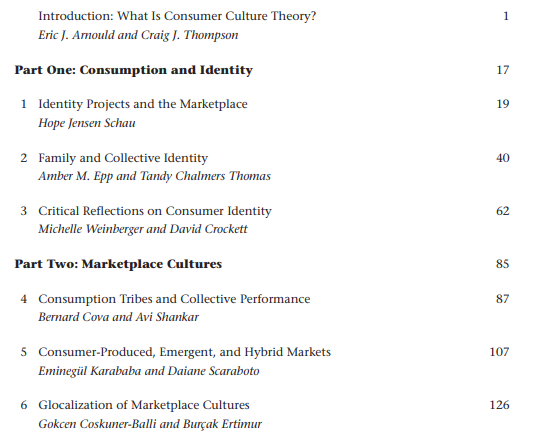
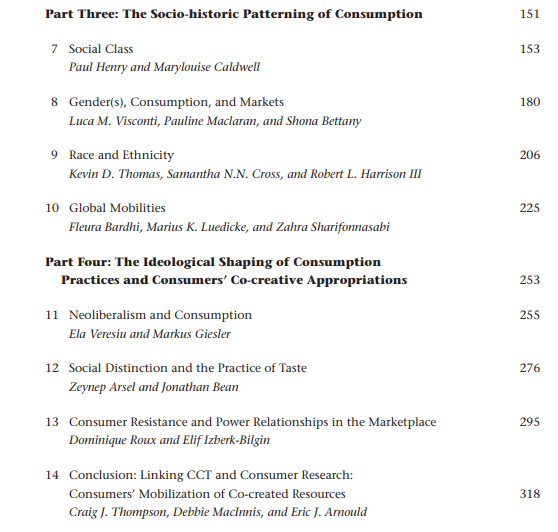
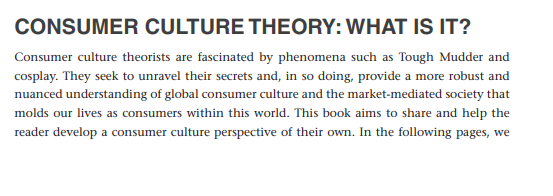
Consumer Culture Theory 1 Introduction: What Is Consumer Culture Theory? Eric J. Arould and Craig J. Thompson Part One: Consumption and Identity 17 19 1 Identity Projects and the Marketplace Hope Jensen Schau 40 2 Family and Collective Identity Amber M. Epp and Tandy Chalmers Thomas 62 3 Critical Reflections on Consumer Identity Michelle Weinberger and David Crockett Part Two: Marketplace Cultures 85 87 4 Consumption Tribes and Collective Performance Bernard Cova and Avi Shankar 107 5 Consumer-Produced, Emergent, and Hybrid Markets Eminegl Karababa and Daiane Scaraboto 126 6 Glocalization of Marketplace Cultures Gokcen Coskuner-Balli and Burak Ertimur 151 Part Three: The Socio-historic Patterning of Consumption 7 Social Class Paul Henry and Marylouise Caldwell 153 180 8 Gender(s), Consumption, and Markets Luca M. Visconti, Pauline Maclaran, and Shona Bettany 206 9 Race and Ethnicity Kevin D. Thomas, Samantha N.N. Cross, and Robert L. Harrison III 225 10 Global Mobilities Fleura Bardhi, Marius K. Luedicke, and Zahra Sharifonnasabi Part Four: The Ideological Shaping of Consumption Practices and Consumers' Co-creative Appropriations 253 255 11 Neoliberalism and Consumption Ela Veresiu and Markus Giesler 12 Social Distinction and the Practice of Taste Zeynep Arsel and Jonathan Bean 276 295 13 Consumer Resistance and Power Relationships in the Marketplace Dominique Roux and Elif Izberk-Bilgin 14 Conclusion: Linking CCT and Consumer Research: Consumers' Mobilization of Co-created Resources Craig J. Thompson, Debbie MacInnis, and Eric J. Arould 318 CONSUMER CULTURE THEORY: WHAT IS IT? Consumer culture theorists are fascinated by phenomena such as Tough Mudder and cosplay. They seek to unravel their secrets and, in so doing, provide a more robust and nuanced understanding of global consumer culture and the market-mediated society that molds our lives as consumers within this world. This book aims to share and help the reader develop a consumer culture perspective of their own. In the following pages, we define consumer culture theory, outline its general contours with the help of some recent examples and finally outline the book itself. Consumer culture theory (CCT) is a field of inquiry that seeks to unravel the complexi- ties of consumer culture. Rather than viewing culture as a fairly homogenous system of collectively shared meanings, ways of life and unifying values shared by a member of soci- ety (e.g. Americans share this kind of culture, Japanese share that kind of culture), CCT explores the heterogeneous distribution of meanings and the multiplicity of overlapping cultural groupings that exist within the broader socio-historical frame of globalization and market capitalism. From a CCT standpoint, consumer culture is as a dynamic net- work of boundary spanning material, economic, symbolic, and social relationships or connections. Consumer culture is what consumers do and believe rather than an attribute of character. Similarly, being a consumer' is an identity intrinsic to market capitalism, our dominant global economic system, and the two evolve and develop in tandem. Concretely, as Don Slater (1997) proposes, consumer culture denotes a social arrange- ment in which markets either directly or indirectly mediate the relationships between lived experiences, that is, between meaningful ways of life and the symbolic and material resources like brands on which they depend. Again, following Don Slater, the consumption of market- made commodities and desire-inducing commercialized symbols is central to consumer culture. At the same time, the perpetuation and reproduction of this system is largely dependent upon the exercise of personal choice in the private sphere of everyday life, that is, the choice to choose among commercialized offerings. The term consumer culture also conceptual- izes an interconnected system of commercially produced images, texts, and objects that groups use through the construction of overlapping and even conflicting consumption practices, identities, and meanings - to make collective sense of their environments and to anchor and orient their members' experiences and lives









 Study Help