Question: Review the case. Amazon: Improving the work environment. Apply the Weight of Reasons framework, step 7 to identity a long-term solution to address the root
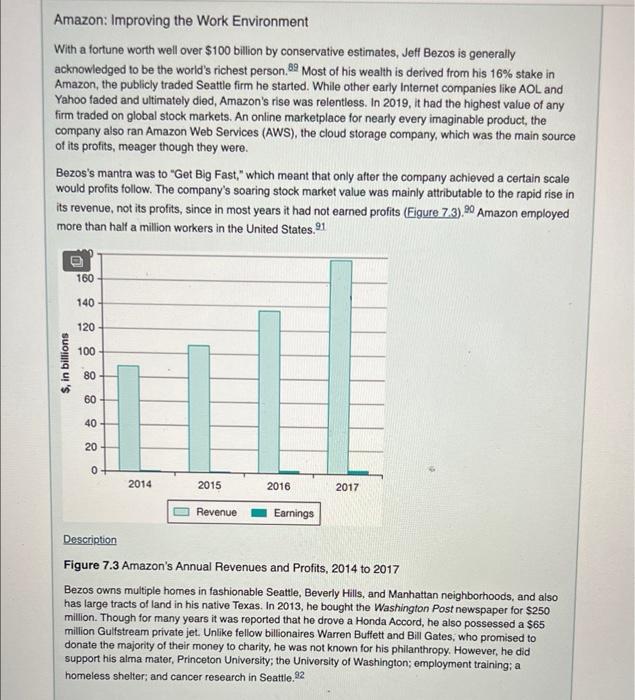
Review the case. Amazon: Improving the work environment. Apply the Weight of Reasons framework, step 7 to identity a long-term solution to address the root cause of the ethical dilemma facing Amazon as depicted in the case, which is how Amazon can improve the working conditions in its warehouses while maintaining its profitabilty Use factual evidence from the case to support your response. Note that long-term refers to a time horizon of 3 years or more Amazon: Improving the Work Environment With a fortune worth well over $100 billion by conservative estimates, Jeff Bezos is generally acknowledged to be the world's richest person. Most of his wealth is derived from his 16% stake in Amazon, the publicly traded Seattle firm he started. While other early Internet companies like AOL and Yahoo faded and ultimately died, Amazon's rise was relentless. In 2019, it had the highest value of any firm traded on global stock markets. An online marketplace for nearly every imaginable product, the company also ran Amazon Web Services (AWS), the cloud storage company, which was the main source of its profits, meager though they were Bezos's mantra was to "Get Big Fast," which meant that only after the company achieved a certain scale would profits follow. The company's soaring stock market value was mainly attributable to the rapid rise in its revenue, not its profits, since in most years it had not earned profits (Figure 7.3) 90 Amazon employed more than half a million workers in the United States. 91 160 140 120 100 80 s, in billions 8 8 8 60 0+ 2014 2016 2017 2015 Revenue Earnings Description Figure 7.3 Amazon's Annual Revenues and Profits, 2014 to 2017 Bezos owns multiple homes in fashionable Seattle, Beverly Hills, and Manhattan neighborhoods, and also has large tracts of land in his native Texas. In 2013, he bought the Washington Post newspaper for $250 million. Though for many years it was reported that he drove a Honda Accord, he also possessed a $65 million Gulfstream private jet. Unlike fellow billionaires Warren Buffett and Bill Gates, who promised to donate the majority of their money to charity, he was not known for his philanthropy. However, he did support his alma mater, Princeton University; the University of Washington; employment training; a homeless shelter; and cancer research in Seattle.92 Pushing Hard Bezos has pushed himself very hard. In 2015, an expos in The New York Times described the work culture at Amazon as brutal and nearly Darwinian in nature. According to The New York Times, employees were instructed to discard "poor habits they had acquired at prior jobs, and when they hit the wall from the unrelenting pressure, they were supposed to climb the wall." They have to sign lengthy confidentiality agreements, their behavior is continuously monitored and measured, and they are incited to rip apart one another's ideas and work late into the night with the expectation that the emails received after midnight will be answered then Tumover is high at Amazon, and many employees have retused to stick with the system. They have had to send secret complaints about peers to supervisors with sample texts to convey concerns about peers who were not completing their tasks or being inflexible. Those with illnesses or other personal Issues sometimes have received unfavorable evaluations and felt compelled to leave. Other companies have done away with the practice of rank and yank," as it often onded in the termination of talented people to meet quotas, but team members at Amazon are regularly rated and those at the bottom released. Many bolieve the competition-and-elimination system to be biased against women, Unlike other tech companies, there were no women in the top leadership team as of 2015. Balancing raising children with the demands of the job is difficult.93 Yet many employees have thrived in this atmosphere. They loved that Amazon is willing to embrace risk and that relatively Junior employees can make important contributions and advance quickly. Everyone's ideas, even those who are most senior in the company, are subject to serious criticism. Some employees consider the company to be an ideal meritocracy, The New York Times article cited above quotes Susan Harker, Amazon's top recruiter, as saying that Amazon is "shooting for the moon," implying that Amazon was not the right place for a person of limited ambition and mediocre talent or commitment. The blas is for "action and for people who have "big ideas. Apparently Amazon is meant only for an elite corps of driven white-collar workers. Blue-Collar Workers Bezos has strived to establish a hard-driving culture throughout the company and not only among its white- collar employees. As a result, the company requires as much of its blue-collar workers, who fulfill orders in its warehouses, as It does of white collar workers. Legendary is the story that workers in an eastern Pennsylvania warehouse toiled in more than 100 *F temperatures in 2011, and when they collapsed from the intense temperatures, waiting ambulances were there to take them away to a hospital. Only after being criticized in a local newspaper did the company agree to install air-conditioning The company is data-driven in all that it does, including blue-collar working conditions. Very detailed metrics control its relationship with the workers in the same way that they dictate relationships with their customers. The warehouses monitor employees with sophisticated electronic systems to guarantee that they pack enough boxes every hour. Blue-collar employees are subject to Intensive reviews and are held accountable by the numbers.25 Since its founding, Amazon had successfully fended off any hint of employee unionization. If workers show signs of unionizing. It might shut down a facility and lay them off rather than allow them to form a union. In Europe, the lack of unionization has been less tolerated than it has been in the United States. German, Polish, and Spanish workers have participated in demonstrations and labor strikes to draw awareness to their lack of rights, their low compensation, and tho unsatisfactory working conditions they are convinced prevall in Amazon Warehouses. Amazon has been adamant and maintained that strikes will not affect the fulfillment of customers' orders. It has presented itself as being a fair and responsible employer that maintains an open and direct dialogue with associates." It provides "good jobs with highly competitive pay, full benefits, and innovative training with associates." I provides good jobs with highly competitive pay, full benefits, and innovative training programs. According to the company, its working conditions were both sate and positive. 20 Sanders's Criticism Democratic presidential candidate Bernie Sanders sees the situation very differently. He criticized the company during his 2016 presidential campaign for the way in which it treats its workers. He brought attention to the fact that many were poorly paid and subject to unsafe working conditions. Ho introduced a bill in the U.S. Senate called the Stop Bad Employers by Zeroing Out Subsidies Act, the STOP BEZOS Act. The bill called for ending food stamps, Medicaid, and public housing benefits for employees of large companies such as Amazon and requiring the companies themselves to provide those benefits to its employees instead. 22 Amazon reacted by raising its minimum wage to S15 for its U.S. employees. However, it was discovered that one of its contractors, California Cartago Co., has continued to violate California state's minimum wage laws. In his critique of the company, Sanders also pointed to incidents where workers had been injured or killed. The National Council for Occupational Safety and Health reported that seven workers have died since 2013. Then, in 2017, the Indiana Department of Labor started an investigation after a worker was fatally crushed when a forklift's lift foll on him while he was doing maintenance. In the same year, OSHA investigated the death of another warehouse worker in Pennsylvania who was crushed to death by a truck near the fulfillment center loading dock. It was alleged that the company refused to accept worker's compensation claims from employees who were injured on the job and that several workers who had refused the company's settlement offers had their jobs terminated, after which they confronted homelessness In one lawsuit against the company, workers claimed that during periods of excessive heat they were not given time to rest and that the company retaliated against those who complained. There were also stories of employees urinating in soda cans and water bottles rather than taking the time to walk to a restroom, because the company's break system allows them only 30 minutes for lunch and three other quarter-hour free-time periods during a shift. Amazon Warehouses are mammoth, and the number of toilets tend to be few in number. Between scanning and packing an item, the distances that employees have to travel can be great, which means that workers often are seen running to meet their quotas. Due to long shifts and few breaks, many employees have complained of back pain, heart problems, and other aches and injuries Reporters have found that employees who have needed emergency help due to health concerns could not call for help directly but instead had to contact Amazon security guards first, resulting in delays that could cost them their lives. The company has also subjected workers to demeaning and overly time-consuming security checks without pay so they did not steal goods from the company.28 Amazon's Response On its blog, Amazon has declared that such criticisms about low pay and poor workplace are "inaccurate and misleading. The Vice President of North American Operations has mainlained that the company has goals for employees in regards to performance metrics," and a foam regularly examines the metrics to ensure that they are "safe, fair, and attainablo." Amazon announced that its workers already earning $15 an hour would get raises of $1 per hour. Additionally, it introduced a cash bonus of $1,500 to $3,000 for tenure milestones when workers roach 5, 10, 15, and 20 years with the company. Furthermore, Amazon has indicated that workers with good attendance in the month of December--the busiest month of the year --would be eligible to receive an extra $100 bonus. As noted in the chapter, the federal minimum wage currently is $7.25 per hour Amazon's Response On its blog, Amazon has declared that such criticisms about low pay and poor workplace are "inaccurate and misleading." The Vice President of North American Operations has maintained that the company has *goals for employees in regards to performance metrics," and a team regularly examines the metrics to ensure that they are "safe, fair, and attainable." Amazon announced that its workers already earning $15 an hour would get raises of $1 per hour. Additionally, it introduced a cash bonus of $1,500 to $3,000 for tenure milestones when workers reach 5, 10, 15, and 20 years with the company. Furthermore, Amazon has indicated that workers with good attendance in the month of December--the busiest month of the year --would be eligible to receive an extra $100 bonus. As noted in the chapter, the federal minimum wage currently is $7.25 per hour. Amazon has proclaimed that ensuring safety is its "number one priority." It has "safety metrics and audits" integrated into every program, and it expects continuous improvements in safety results through better equipment, standards, training, coaching, reporting, and systems to track and audit progress. Nonetheless, former employees continue to say that they sometimes find human waste in trash cans because workers feel that they cannot take the time to go to the bathroom. They hold that the focus on efficiency makes them feel like "robots" who are expected to do only one thing, and do it very quickly. The company has continually dismissed such reports as "unsubstantiated anecdotes. 100 Amazon continues to rely as much as it can on automation to reduce costs. While its warehouses already are highly automated and are emulated by other companies for their efficiency, the company has been considering going even further. For example, it has considered having employees wear wristbands to track their movements and nudge them with vibrations if they are working in ways that are inefficient or dangerous. 101 Work practices such as these often are distressing to workers, and some have been heard to say that they have had to pack boxes for the richest man in the world but that his wealth is not making their lives any better. As the company continues to rapidly grow its business, erecting warehouses around the world to keep pace with demand, it seems obvious that it will have to come up with new solutions to such problems - or will it










 Study Help