





Question: rewrite 2.16 Elements and Atoms Atomic Structure Atoms are composed of electrons, protons, and neutrons (@ figures 2.1, (S/ 2.2). An element consists of a

rewrite
rewrite 2.16 Elements and Atoms Atomic Structure
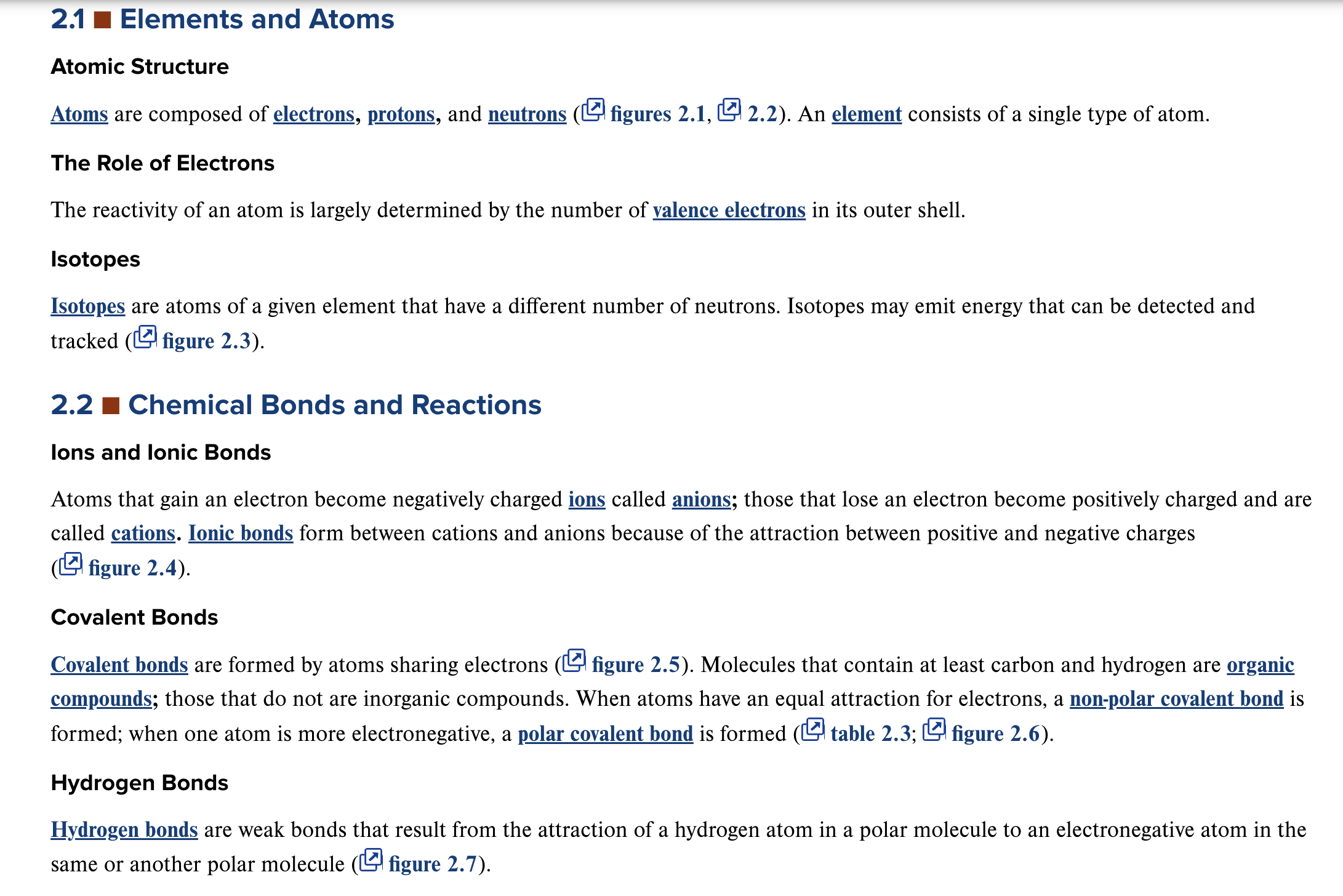
2.16 Elements and Atoms Atomic Structure Atoms are composed of electrons, protons, and neutrons (@ figures 2.1, (S/ 2.2). An element consists of a single type of atom. The Role of Electrons The reactivity of an atom is largely determined by the number of valence electrons in its outer shell. Isotopes Isotopes are atoms of a given element that have a different number of neutrons. Isotopes may emit energy that can be detected and tracked @ figure 2.3). 2.2 m Chemical Bonds and Reactions lons and lonic Bonds Atoms that gain an electron become negatively charged ions called anions; those that lose an electron become positively charged and are called cations. Ionic bonds form between cations and anions because of the attraction between positive and negative charges (G) figure 2.4). Covalent Bonds Covalent bonds are formed by atoms sharing electrons & figure 2.5). Molecules that contain at least carbon and hydrogen are organic compounds; those that do not are inorganic compounds. When atoms have an equal attraction for electrons, a non-polar covalent bond is formed; when one atom is more electronegative, a polar covalent bond is formed (Gg table 2.3; & figure 2.6). Hydrogen Bonds Hydrogen bonds are weak bonds that result from the attraction of a hydrogen atom in a polar molecule to an electronegative atom in the same or another polar molecule (ie) figure 2.7)

Step by Step Solution

There are 3 Steps involved in it

1 Expert Approved Answer
Step: 1 Unlock blur-text-image

Question Has Been Solved by an Expert!

Get step-by-step solutions from verified subject matter experts

Step: 2 Unlock
Step: 3 Unlock

Students Have Also Explored These Related Business Writing Questions!