







Question: Ring Ideals Suppose that R = ( R, +, * ) is any ring . A ring ideal of & is any subring S of


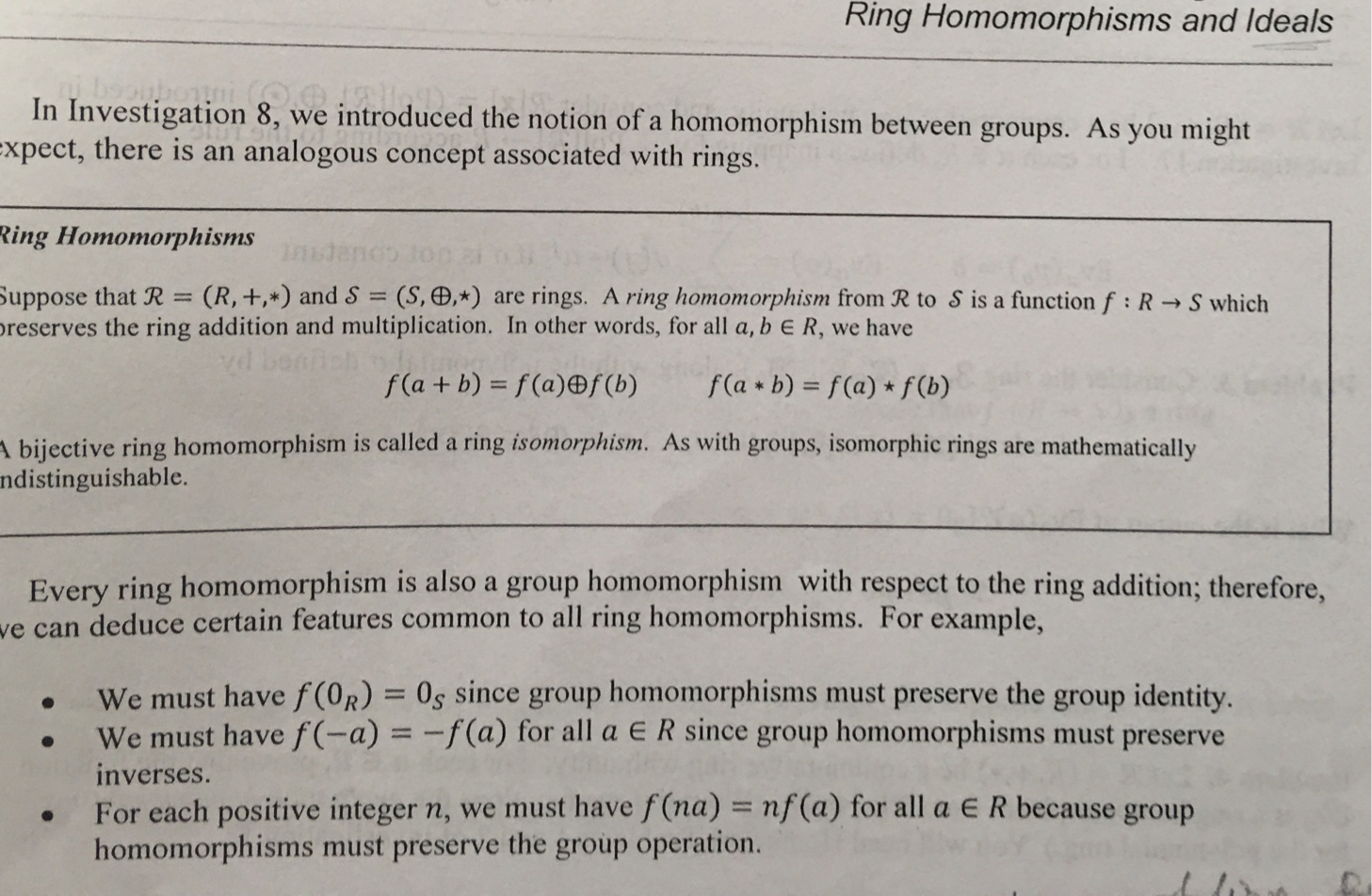
Ring Ideals Suppose that R = ( R, +, * ) is any ring . A ring ideal of & is any subring S of the ring & with the property that as [ S and Sa CS for all a ER.Ring Ideals Suppose that R = ( R, +, * ) is any ring . A ring ideal of & is any subring S of the ring & with the property that as [ S and Sa CS for all a ER.Ring Homomorphisms and Ideals In Investigation & , we introduced the notion of a homomorphism between groups . As you might xpect , there is an analogous concept associated with rings . Ring Homomorphisms iodenies toget tobe suppose that R = ( R , +, * ) and S = ( S, Q, * ) are rings. A ring homomorphism from & to S is a function F : R _ S which reserves the ring addition and multiplication . In other words , for all a , b ER , we have f ( a t b ) = f ( a ) Of ( b ) `` f ( a * b ) = f ( a ) * f ( b ) I bijective ring homomorphism is called a ring isomorphism . As with groups , isomorphic rings are mathematically indistinguishable . Every ring homomorphism is also a group homomorphism with respect to the ring addition ; therefore , re can deduce certain features common to all ring homomorphisms . For example , We must have f ( OR ) = Os since group homomorphisms must preserve the group identity . We must have f ( - a ) = - f ( a ) for all a ER since group homomorphisms must preserve inverses . For each positive integer n , we must have f ( na ) = n f ( a ) for all a ER because group homomorphisms must preserve the group operation
Step by Step Solution
There are 3 Steps involved in it

Get step-by-step solutions from verified subject matter experts
 Study Help