



Question: Romboski, LLC, has identified the following two mutually exclusive projects: Year Cash Flow (A) Cash Flow (B) -$ 69,000 -$ 69,000 45,000 31,100 39,000 35,100
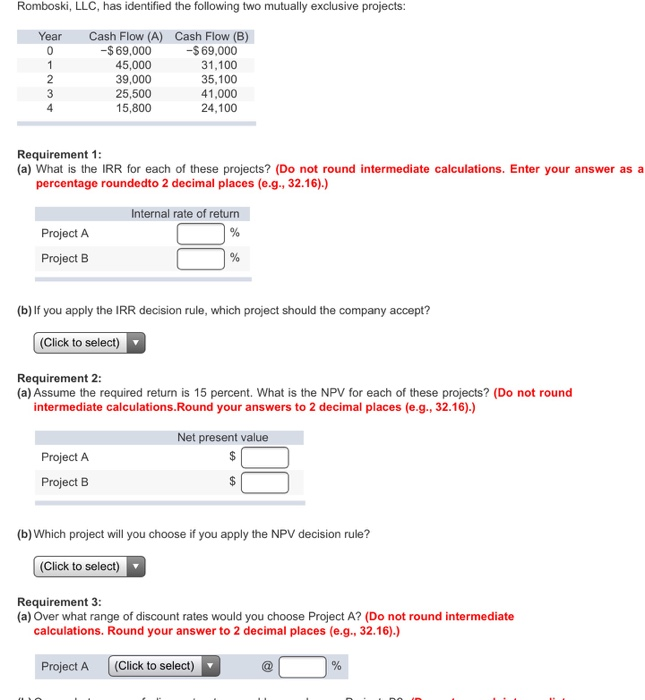
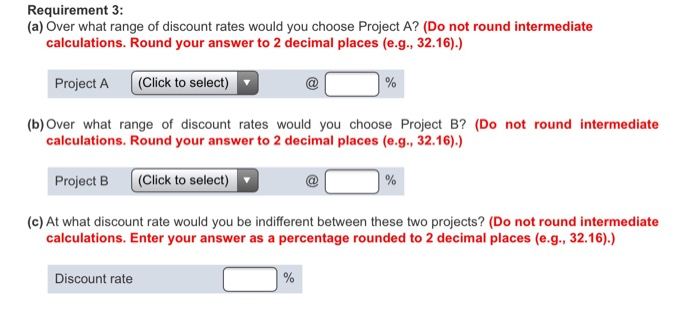
Romboski, LLC, has identified the following two mutually exclusive projects: Year Cash Flow (A) Cash Flow (B) -$ 69,000 -$ 69,000 45,000 31,100 39,000 35,100 25,500 41,000 15,800 24,100 Requirement 1: (a) What is the IRR for each of these projects? (Do not round intermediate calculations. Enter your answer as a percentage roundedto 2 decimal places (e.g., 32.16).) Internal rate of return Project A Project B (b) If you apply the IRR decision rule, which project should the company accept? (Click to select) Requirement 2: (a) Assume the required return is 15 percent. What is the NPV for each of these projects? (Do not round intermediate calculations.Round your answers to 2 decimal places (e.g., 32.16).) Net present value Project A Project B $ (b) Which project will you choose if you apply the NPV decision rule? (Click to select) Requirement 3: (a) Over what range of discount rates would you choose Project A? (Do not round intermediate calculations. Round your answer to 2 decimal places (e.g., 32.16).) Project A (Click to select) @ % Requirement 3: (a) Over what range of discount rates would you choose Project A? (Do not round intermediate calculations. Round your answer to 2 decimal places (e.g., 32.16).) Project A (Click to select) @ % (b) Over what range of discount rates would you choose Project B? (Do not round intermediate calculations. Round your answer to 2 decimal places (e.g., 32.16).) Project B (Click to select) @ % (c) At what discount rate would you be indifferent between these two projects? (Do not round intermediate calculations. Enter your answer as a percentage rounded to 2 decimal places (e.g., 32.16).) Discount rate 0 %
Step by Step Solution
There are 3 Steps involved in it

Get step-by-step solutions from verified subject matter experts