



Question: Rotations Exploration 10 2 3 4 5 6 7 1. Label the points from the pre-image ABC given and connect the points in order. A
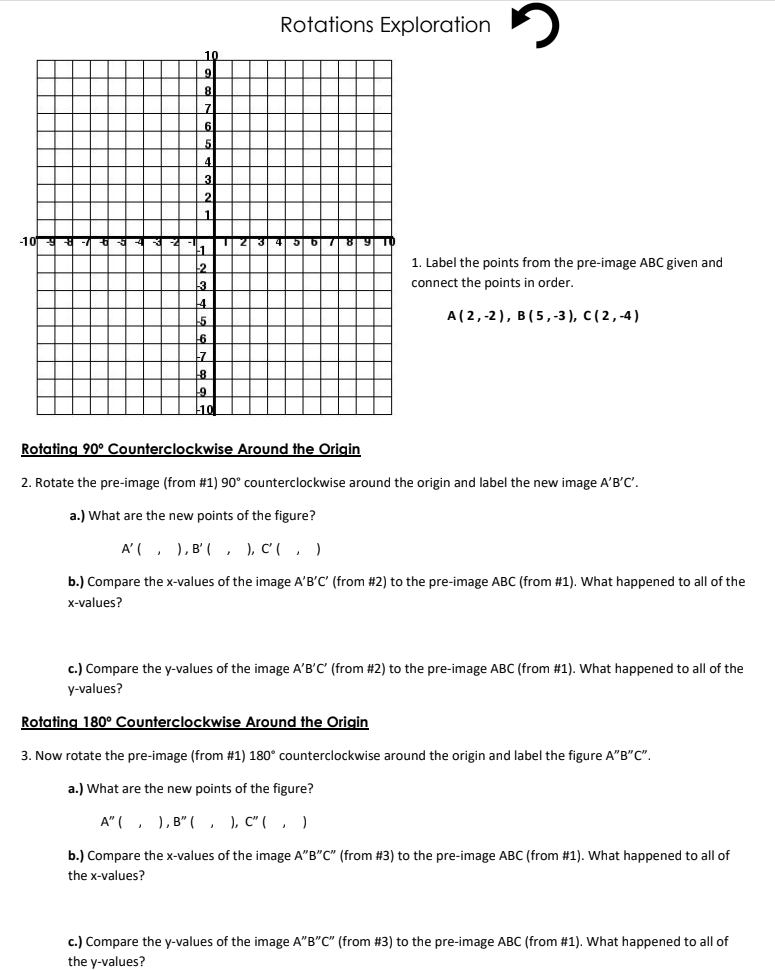
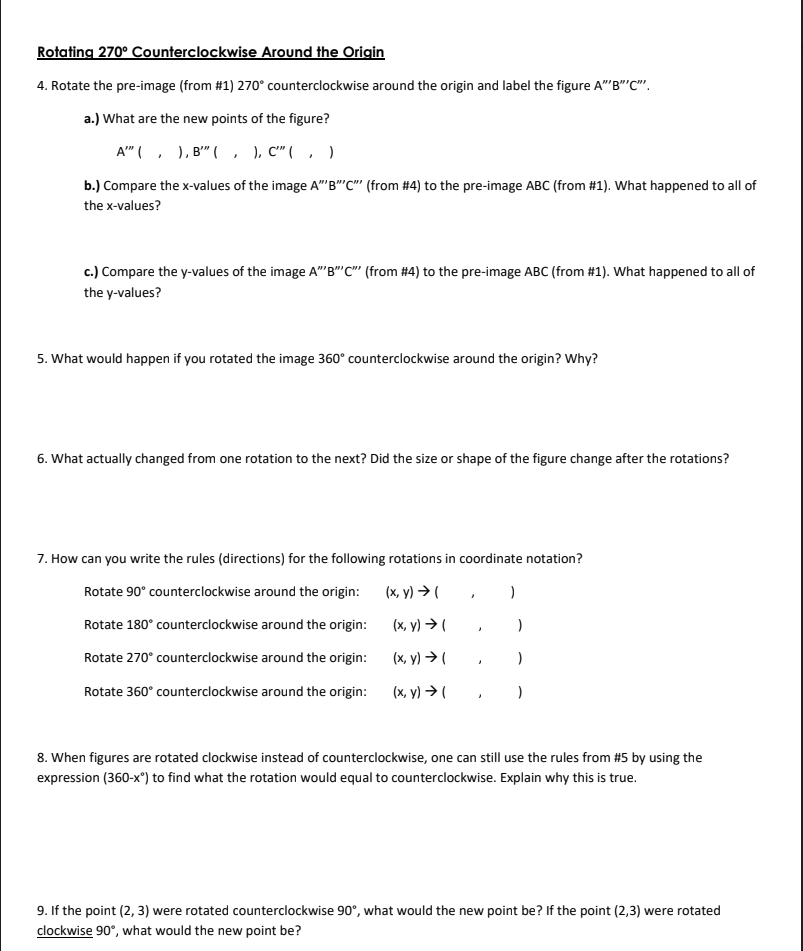
Rotations Exploration 10 2 3 4 5 6 7 1. Label the points from the pre-image ABC given and connect the points in order. A ( 2, -2), B (5, -3), C(2, -4) Rotating 90 Counterclockwise Around the Origin 2. Rotate the pre-image (from #1) 90" counterclockwise around the origin and label the new image A'B'C'. a.) What are the new points of the figure? A'( , ), B'( , ),C( , ) b.) Compare the x-values of the image A'B'C' (from #2) to the pre-image ABC (from #1). What happened to all of the x-values? c.) Compare the y-values of the image A'B'C' (from #2) to the pre-image ABC (from #1). What happened to all of the y-values? Rotating 180' Counterclockwise Around the Origin 3. Now rotate the pre-image (from #1) 180 counterclockwise around the origin and label the figure A"B"C". a.) What are the new points of the figure? A" ( , ), B" ( , ), C" ( . ) b.) Compare the x-values of the image A"B"C" (from #3) to the pre-image ABC (from #1). What happened to all of the x-values? c.) Compare the y-values of the image A"B"C" (from #3) to the pre-image ABC (from #1). What happened to all of the y-values?Rotating 270 Counterclockwise Around the Origin 4. Rotate the pre-image (from #1) 270 counterclockwise around the origin and label the figure A"BC". a.) What are the new points of the figure? A" ( , ), B " ( , ),C" ( . ) b.) Compare the x-values of the image A"B"C" (from #4) to the pre-image ABC (from #1). What happened to all of the x-values? c.) Compare the y-values of the image A"B"C" (from #4) to the pre-image ABC (from #1). What happened to all of the y-values? 5. What would happen if you rotated the image 360" counterclockwise around the origin? Why? 6. What actually changed from one rotation to the next? Did the size or shape of the figure change after the rotations? 7. How can you write the rules (directions) for the following rotations in coordinate notation? Rotate 90" counterclockwise around the origin: ( x, v ) > ( Rotate 180 counterclockwise around the origin: ( x, y ) > 1 Rotate 270 counterclockwise around the origin: ( x, y ) > 1 Rotate 360' counterclockwise around the origin: ( x , y ) > 1 8. When figures are rotated clockwise instead of counterclockwise, one can still use the rules from #5 by using the expression (360-x") to find what the rotation would equal to counterclockwise. Explain why this is true. 9. If the point (2, 3) were rotated counterclockwise 90", what would the new point be? If the point (2,3) were rotated clockwise 90", what would the new point be
Step by Step Solution
There are 3 Steps involved in it

Get step-by-step solutions from verified subject matter experts