







Question: Royal Dutch Shell PLC: Identifying differences and similarities between IFRS and GAAP (LO 11-10) Royal Dutch Shell had pre-tax income of $2,047 million, $28,314 million,
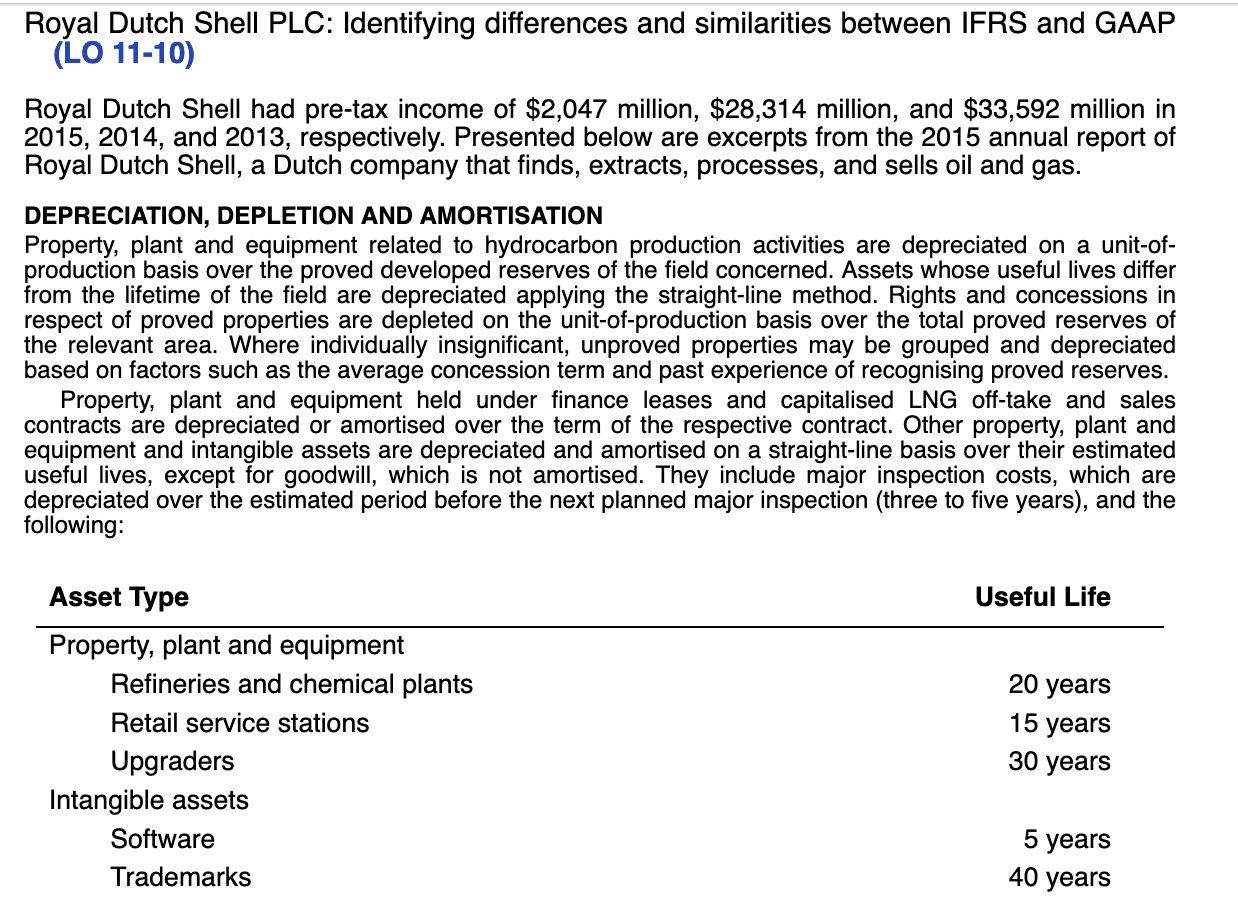
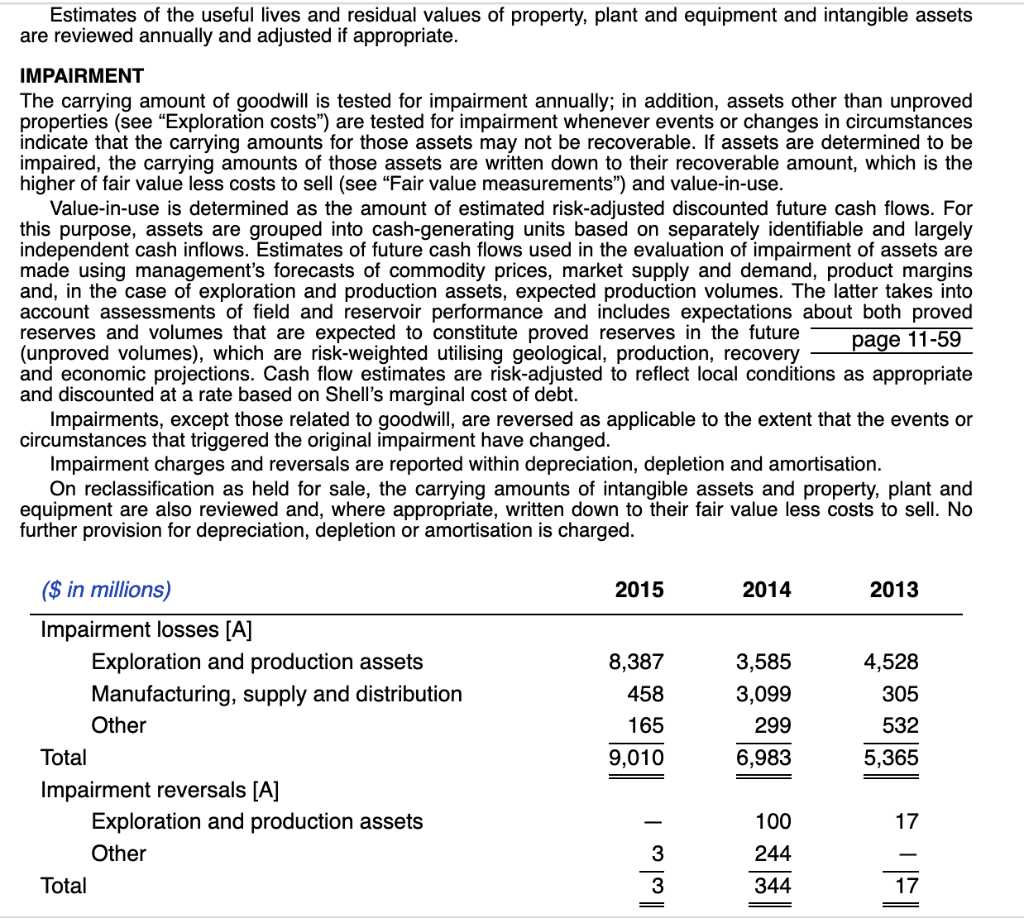
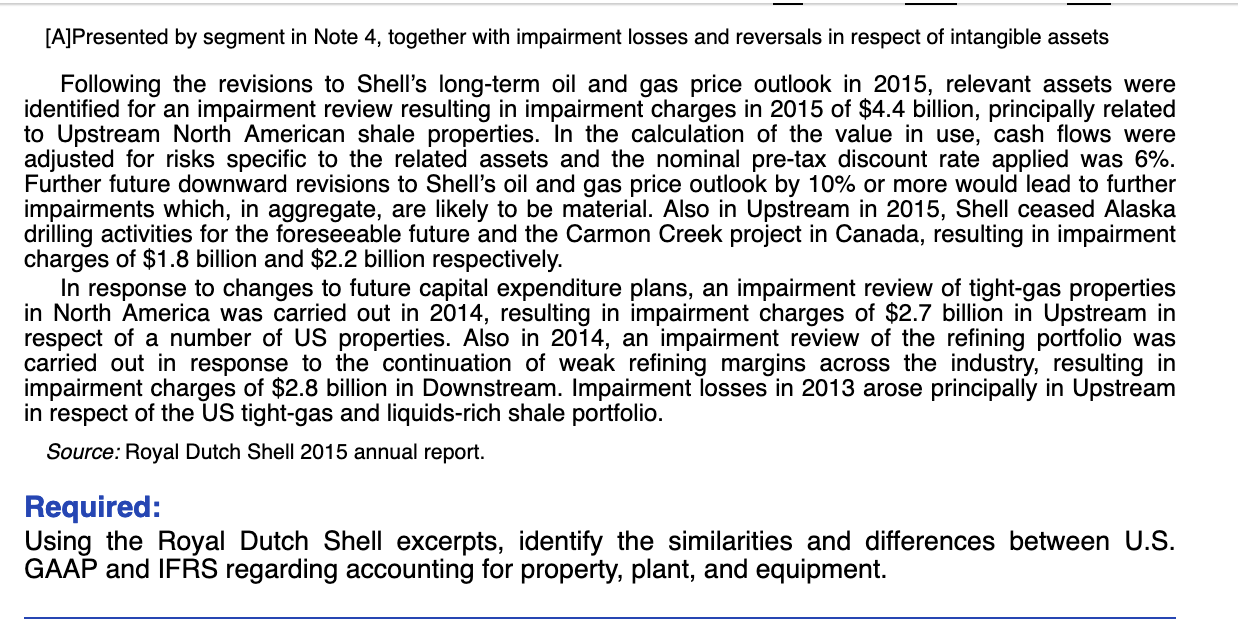
Royal Dutch Shell PLC: Identifying differences and similarities between IFRS and GAAP (LO 11-10) Royal Dutch Shell had pre-tax income of $2,047 million, $28,314 million, and $33,592 million in 2015, 2014, and 2013, respectively. Presented below are excerpts from the 2015 annual report of Royal Dutch Shell, a Dutch company that finds, extracts, processes, and sells oil and gas. DEPRECIATION, DEPLETION AND AMORTISATION Property, plant and equipment related to hydrocarbon production activities are depreciated on a unit-of- production basis over the proved developed reserves of the field concerned. Assets whose useful lives differ from the lifetime of the field are depreciated applying the straight-line method. Rights and concessions in respect of proved properties are depleted on the unit-of-production basis over the total proved reserves of the relevant area. Where individually insignificant, unproved properties may be grouped and depreciated based on factors such as the average concession term and past experience of recognising proved reserves. Property, plant and equipment held under finance leases and capitalised LNG off-take and sales contracts are depreciated or amortised over the term of the respective contract. Other property, plant and equipment and intangible assets are depreciated and amortised on a straight-line basis over their estimated useful lives, except for goodwill, which is not amortised. They include major inspection costs, which are depreciated over the estimated period before the next planned major inspection (three to five years), and the following: Useful Life Asset Type Property, plant and equipment 20 years Refineries and chemical plants 15 years Retail service stations 30 years Upgraders Intangible assets 5 years Software 40 years Trademarks Estimates of the useful lives and residual values of property, plant and equipment and intangible assets are reviewed annually and adjusted if appropriate. IMPAIRMENT The carrying amount of goodwill is tested for impairment annually; in addition, assets other than unproved properties (see "Exploration costs") are tested for impairment whenever events or changes in circumstances indicate that the carrying amounts for those assets may not be recoverable. If assets are determined to be impaired, the carrying amounts of those assets are written down to their recoverable amount, which is the higher of fair value less costs to sell (see "Fair value measurements") and value-in-use. Value-in-use is determined as the amount of estimated risk-adjusted discounted future cash flows. For this purpose, assets are grouped into cash-generating units based on separately identifiable and largely independent cash inflows. Estimates of future cash flows used in the evaluation of impairment of assets are made using management's forecasts of commodity prices, market supply and demand, product margins and, in the case of exploration and production assets, expected production volumes. The latter takes into account assessments of field and reservoir performance and includes expectations about both proved reserves and volumes that are expected to constitute proved reserves in the future (unproved volumes), which are risk-weighted utilising geological, production, recovery page 11-59 and economic projections. Cash flow estimates are risk-adjusted to reflect local conditions as appropriate and discounted at a rate based on Shell's marginal cost of debt. Impairments, except those related to goodwill, are reversed as applicable to the extent that the events or circumstances that triggered the original impairment have changed. Impairment charges and reversals are reported within depreciation, depletion and amortisation. On reclassification as held for sale, the carrying amounts of intangible assets and property, plant and equipment are also reviewed and, where appropriate, written down to their fair value less costs to sell. No further provision for depreciation, depletion or amortisation is charged. ($ in millions) 2015 2014 2013 Impairment losses [A] 8,387 3,585 4,528 Exploration and production assets Manufacturing, supply and distribution Other 458 3,099 305 165 299 532 9,010 6,983 5,365 Exploration and production assets 100 17 Other 244 344 17 Total Impairment reversals [A] Total || 3 [A]Presented by segment in Note 4, together with impairment losses and reversals in respect of intangible assets Following the revisions to Shell's long-term oil and gas price outlook in 2015, relevant assets were identified for an impairment review resulting in impairment charges in 2015 of $4.4 billion, principally related to Upstream North American shale properties. In the calculation of the value in use, cash flows were adjusted for risks specific to the related assets and the nominal pre-tax discount rate applied was 6%. Further future downward revisions to Shell's oil and gas price outlook by 10% or more would lead to further impairments which, in aggregate, are likely to be material. Also in Upstream in 2015, Shell ceased Alaska drilling activities for the foreseeable future and the Carmon Creek project in Canada, resulting in impairment charges of $1.8 billion and $2.2 billion respectively. In response to changes to future capital expenditure plans, an impairment review of tight-gas properties in North America was carried out in 2014, resulting in impairment charges of $2.7 billion in Upstream in respect of a number of US properties. Also in 2014, an impairment review of the refining portfolio was carried out in response to the continuation of weak refining margins across the industry, resulting in impairment charges of $2.8 billion in Downstream. Impairment losses in 2013 arose principally in Upstream in respect of the US tight-gas and liquids-rich shale portfolio. Source: Royal Dutch Shell 2015 annual report. Required: Using the Royal Dutch Shell excerpts, identify the similarities and differences between U.S. GAAP and IFRS regarding accounting for property, plant, and equipment
Step by Step Solution
There are 3 Steps involved in it

Get step-by-step solutions from verified subject matter experts
 Study Help