







Question: S 2 S 2 4 wk 1 b: Problem 1 4 ( 1 point ) ( Book: 3 . 5 problem 7 ) Each hour
S
Swkb: Problem
point
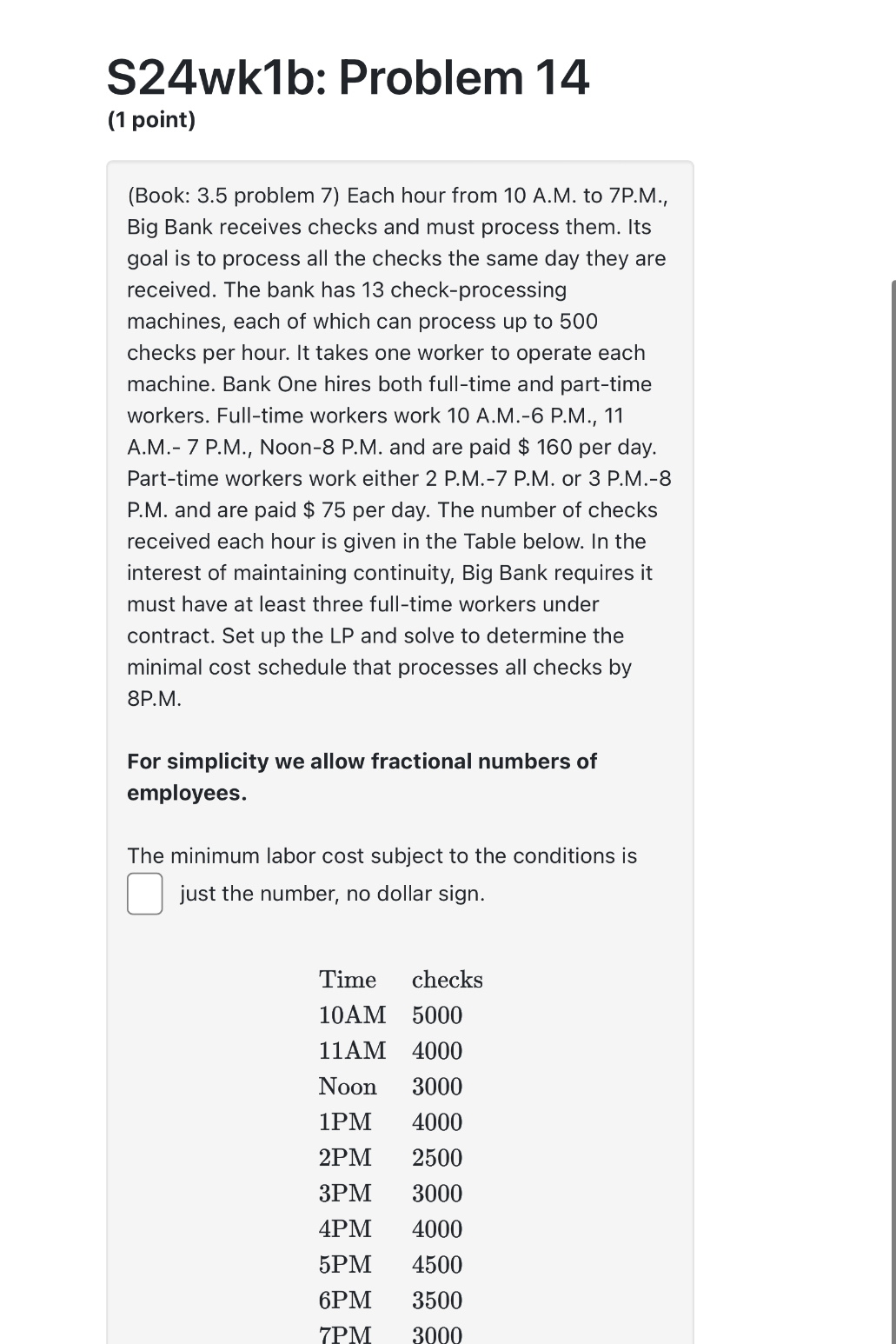
Book: problem Each hour from AM to PM Big Bank receives checks and must process them. Its goal is to process all the checks the same day they are received. The bank has checkprocessing machines, each of which can process up to checks per hour. It takes one worker to operate each machine. Bank One hires both fulltime and parttime workers. Fulltime workers work AM PM AM PM Noon PM and are paid $ per day. Parttime workers work either PM PM or PM PM and are paid $ per day. The number of checks received each hour is given in the Table below. In the interest of maintaining continuity, Big Bank requires it must have at least three fulltime workers under contract. Set up the LP and solve to determine the minimal cost schedule that processes all checks by PM
For simplicity we allow fractional numbers of employees.
The minimum labor cost subject to the conditions is just the number, no dollar sign.
tableTimechecksAMAMNoonPMPMPMPMwkb: Problem
point
Book: problem Each hour from AM to PM Big Bank receives checks and must process them. Its goal is to process all the checks the same day they are received. The bank has checkprocessing machines, each of which can process up to checks per hour. It takes one worker to operate each machine. Bank One hires both fulltime and parttime workers. Fulltime workers work AM PM AM PM Noon PM and are paid $ per day. Parttime workers work either PM PM or PM PM and are paid $ per day. The number of checks received each hour is given in the Table below. In the interest of maintaining continuity, Big Bank requires it must have at least three fulltime workers under contract. Set up the LP and solve to determine the minimal cost schedule that processes all checks by PM
For simplicity we allow fractional numbers of employees.
The minimum labor cost subject to the conditions is just the number, no dollar sign.
tableTimechecksAMAMNoonPMPMPMPM
This one needs a hint: the decision variables need to be at a minimum a variable for how many fulltime employees start at each permitted starting time and similarly for parttime employees. This will already give your cost objective function. But, to more easily express the many constraints, it is helpful and perfectly allowed to introduce many other decision variable. For example, let denote the number of checks that get processed in the hour starting at time Also let for inventory denote the number of checks that have arrived up to and including time i that have not yet been processed. We don't need but notice that would be one of the constraints, and for all is a constraint. Another constraint is that the number of checks processed depends on how many employees are working.
Since it is pretty hard, here are my AM and AM constraints:
: ;
: ;
: ;
: ;
: ;
: ;
etc. Note that we do not restrict ourselves to at most employees per hour because, although likely, it's not strictly required, so we let the solver work this out itself. It would be easy to find similar problems where you might have to have more than employees, eg If there were only two shifts and then we'd almost certainly have to have more than on "duty" from
also don't forget that in each hour you have checks left over from previous hour
Step by Step Solution
There are 3 Steps involved in it
1 Expert Approved Answer
Step: 1 Unlock

Question Has Been Solved by an Expert!
Get step-by-step solutions from verified subject matter experts
Step: 2 Unlock
Step: 3 Unlock
 Study Help