







Question: S o l v e t h e f o ll o w in g q u es t i o n s : The
Solvethefollowingquestions:
The demand for money is Md/P = L(Y, i), where L(Y, i) is an increasing function of real income Y. For i > 0, money demand is decreasing in the nominal interest rate i. Money demand becomes perfectly interest elastic at i = 0. The price level is P.
(a) [2 marks] Give a brief justification of each of the properties of the money demand function assumed above.
The LM curve represents money market equilibrium (Md = Ms). Assume the central bank targets a constant money supply Ms and that the price level P is fixed.
(b) [3marks]Show how the LM curve is derived from money-market equilibrium. Illustrate the LM curve, taking account of its shape where i = 0.
Suppose that owing to tighter lending criteria, firms' investment demand is lower (treat this as affecting the autonomous component of investment demand).
(c) [3marks]Using the IS-L M model,show how this can result in the interest rate falling to zero. If that happens, explain why the model predicts the economy enters a liquidity trap where conventional monetary policy is ineffective.
Now consider the AD-AS model where nominal wages are fixed in the short run at a level where labour demand is less than desired labour supply.
(d) [3 marks] Explain how the shape of the AD curve is affected by the liquidity trap. Following the negative shock to investment demand, can lower prices P mitigate the fall in real GDP found in part (c)?
The Fisher equation that links the real interest rate r to the nominal interest rate i and expected future inflation e is i = r + e.
(e) [3 marks] Analyse the effects of higher inflation expectations e using the IS-LM model and deduce the impact on the AD curve.
In August 2020, the Federal Reserve Board announced that it would now pursue a policy of average inflation targeting. This means where current inflation under- shoots its target value, the Fed would aim for a higher rate of future inflation to make up for it. Assuming this policy is credible, suppose that inflation expecta- tions e adjust so that ( + e)/2 remains constant.
(f) [4 marks] How would adopting the average inflation targeting policy affect the shape of the AD curve?
Would it lead to a better outcome for real GDP following the shock to investment demand compared to part (d)? Explain.
(g) [2marks]AccordingtotheAD-ASmodel,if the economy remains in aliquidity trap in the future, would the Fed be able to ensure the average inflation target is met?
What are the implications for the credibility of this policy?
![level is P. (a) [2 marks] Give a brief justification of each](https://s3.amazonaws.com/si.experts.images/answers/2024/06/666a71f327dad_019666a71f3127b7.jpg)
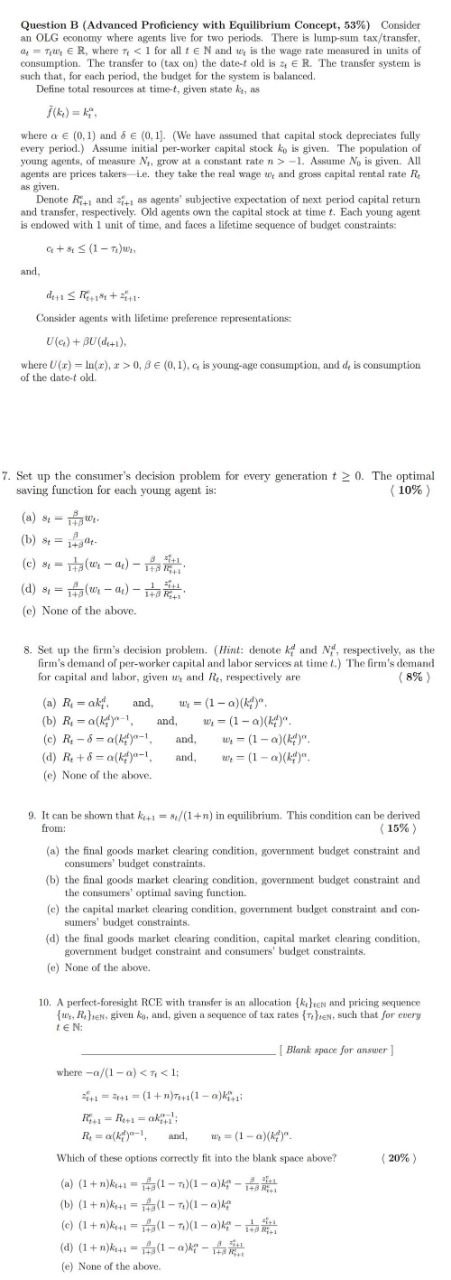
Problem 1 Juniper Corporation provided the following summary balance sheet information: DEC. 31, 201KB Dec. 31, 20X?) Total Assets $2,500,000 $3,300,000 Total Liabilities 900,000 1,300,000 Compute net income for the year ending December 31, 20x9, under each of the following independent scenarios: a) Juniper paid no dividends, and no additional capital was raised via share issuances. b) Juniper paid $300,000 in dividends, and no additional capital was raised via share issuanees. c} Juniper paid no dividends, but raised $1,500,000 via issuance-s of additional shares of stool; d) Juniper paid $300,000 in dividends, and raised $1,150,000 via issuances of additional shares of stock. Worksheet 1 Dec. 31, 20X8 Dec. 31, 20x9 Total Asaets $2,500,000 $3,800,000 Total Liabilities 900,000 1,300,000 Total Equity Ending Equityr Total Uabllltlels Total Equity a} Juniper paid no dividends, and no additional capital was raised via share issuances. b) Juniper paid $300,000 in dividends, and no additional capital was raised via share issuanees. e) Juniper paid no dividends, but raised $1,500,000 via issuances of additional shares of stock 1. CONSIDER A COMPETITIVE INDUSTRY (I.E., PERFECT COMPETITION). THE MARKET DEMAND EQUATION IS GIVEN AS: P = 1,000 - 20, WHERE Q IS THE MARKET QUANTITY. THE MARKET SUPPLY EQUATION IS GIVEN AS: P = 100 + Q. A REPRESENTATIVE FIRM HAS A TOTAL COST FUNCTION; TC = 100 + Q2 + Q, WHERE Q IS THE OUTPUT PRODUCED BY THE FIRM. 1. A) FIND THE EQUILIBRIUM MARKET QUANTITY (Q) AND PRICE (P). 2. ). IS THIS A SHORT- OR LONG-RUN EQUILIBRIUM? - EXPLAIN YOUR ANSWER.IIB) FIND THE REPRESENTATIVE FIRM'S PROFIT MAXIMIZING (OR EQUILIBRIUM) LEVEL OF OUTPUT (Q), TOTAL REVENUE (TR), TOTAL COST (TC) AND PROFIT ( 3. C) GIVEN YOUR ANSWER IN B), WHAT DO YOU EXPECT TO HAPPEN NEXT?Question B (Advanced Proficiency with Equilibrium Concept, 53%) Consider an OLG economy where agents live for two periods. There is lump-sum tax/transfer, at = Tum, E R, where r -1. Assume No is given. All agents are prices takers-Le. they take the real wage in, and gross capital rental rate R as given. Denote Ri+, and 2+, as agents' subjective expectation of next period capital return and transfer, respectively. Old agents own the capital stock at time f. Each young agent is endowed with 1 unit of time, and faces a lifetime sequence of budget constraints: a + s S (1- n)wh and Consider agents with lifetime preference representations: U(q) + BU(di+1). where U(x) = In(x), x > 0, BE (0, 1), c, is young-age consumption, and d is consumption of the date-t old. 7. Set up the consumer's decision problem for every generation t 2 0. The optimal saving function for each young agent is: ( 10%) (a) 81 - TW. (b) 8 = 14904- (c) so - Ha (e - at) - ajit (d) s, = fa(w - at) - at (e) None of the above. 8. Set up the firm's decision problem. (Hint: denote & and MY, respectively, as the firm's demand of per-worker capital and labor services at time .) The firm's demand for capital and labor, given w and Re, respectively are (8%) (a) Ri = akl. and, wy = (1-a)(k;)". (b) R. = a(ky-1, and, w, = (1 - a)(k). (c) R. - 6 - a(k)-1. and, w = (1- a)(k)". (d) Re +6 = a(k;)-1. and, we = (1 - a)(k)". (e) None of the above. 9. It can be shown that ke+1 = s/(1 +n) in equilibrium. This condition can be derived from: ( 15% ) (a) the final goods market clearing condition, government budget constraint and consumers' budget constraints. (b) the final goods market clearing condition, government budget constraint and the consumers' optimal saving function. (e) the capital market clearing condition, government budget constraint and con- sumers' budget constraints. (d) the final goods market clearing condition, capital market clearing condition, government budget constraint and consumers' budget constraints. (e) None of the above. 10. A perfect-foresight RCE with transfer is an allocation {keen and pricing sequence fun, RyJEN, given ko, and, given a sequence of tax rates (new, such that for every LEN: [ Blank space for answer ] where -a/(1- a)
Step by Step Solution
There are 3 Steps involved in it

Get step-by-step solutions from verified subject matter experts
 Study Help