



Question: sampling theory Q4: A school desires to estimate the average score that may be obtained on a reading comprehension exam for students in the sixth
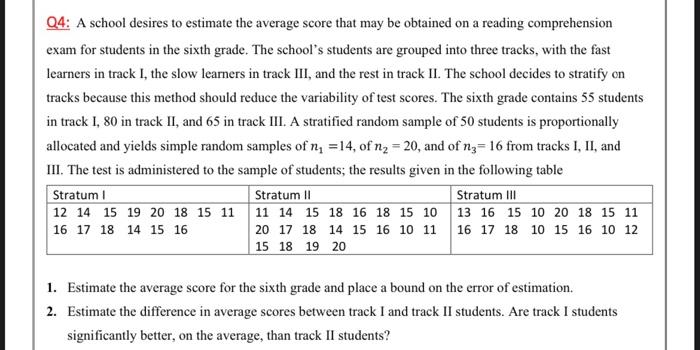
Q4: A school desires to estimate the average score that may be obtained on a reading comprehension exam for students in the sixth grade. The school's students are grouped into three tracks, with the fast learners in track I, the slow learners in track III, and the rest in track II. The school decides to stratify on tracks because this method should reduce the variability of test scores. The sixth grade contains 55 students in track I, 80 in track II, and 65 in track III. A stratified random sample of 50 students is proportionally allocated and yields simple random samples of n1=14, of n2=20, and of n3=16 from tracks I, II, and III. The test is administered to the sample of students; the results given in the following table 1. Estimate the average score for the sixth grade and place a bound on the error of estimation. 2. Estimate the difference in average scores between track I and track II students. Are track I students significantly better, on the average, than track II students? Q4: A school desires to estimate the average score that may be obtained on a reading comprehension exam for students in the sixth grade. The school's students are grouped into three tracks, with the fast learners in track I, the slow learners in track III, and the rest in track II. The school decides to stratify on tracks because this method should reduce the variability of test scores. The sixth grade contains 55 students in track I, 80 in track II, and 65 in track III. A stratified random sample of 50 students is proportionally allocated and yields simple random samples of n1=14, of n2=20, and of n3=16 from tracks I, II, and III. The test is administered to the sample of students; the results given in the following table 1. Estimate the average score for the sixth grade and place a bound on the error of estimation. 2. Estimate the difference in average scores between track I and track II students. Are track I students significantly better, on the average, than track II students
Step by Step Solution
There are 3 Steps involved in it

Get step-by-step solutions from verified subject matter experts