







Question: Saving for the Future Sarah Wells is an entrepreneur and has operated a series of businesses since graduate school. She has often credited her success
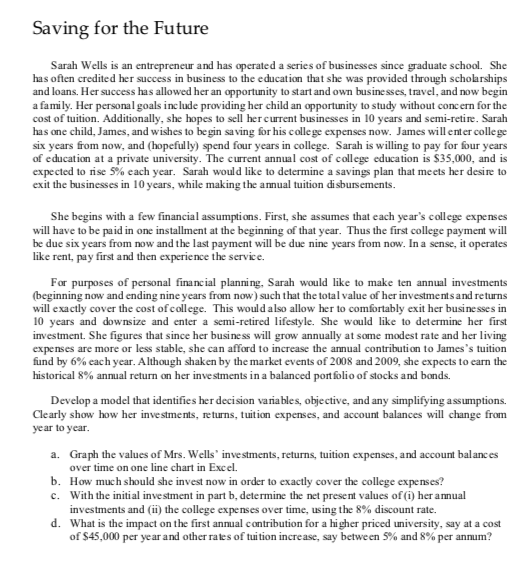
Saving for the Future Sarah Wells is an entrepreneur and has operated a series of businesses since graduate school. She has often credited her success in business to the education that she was provided through scholarships and loans. Her success has allowed her an opportunity to start and own businesses, travel, and now begin a family. Her personal goals include providing her child an opportunity to study without concern for the cost of tuition. Additionally, she hopes to sell her current businesses in 10 years and semi-retire. Sarah has one child, James, and wishes to begin saving for his college expenses now. James will enter college six years from now, and (hopefully) spend four years in college. Sarah is willing to pay for four years of education at a private university. The current annual cost of college education is $35,000, and is expected to rise 5% each year. Sarah would like to determine a savings plan that meets her desire to exit the businesses in 10 years, while making the amual tuition disbursements. She begins with a few financial assumptions. First, she assumes that each year's college expenses will have to be paid in one installment at the beginning of that year. Thus the first college payment will be due six years from now and the last payment will be due nine years from now. In a sense, it operates like rent, pay first and then experience the service. For purposes of personal financial planning, Sarah would like to make ten annual investments (beginning now and ending nine years from now) such that the total value of her investments and returns will exactly cover the cost of college. This would also allow her to comfortably exit her businesses in 10 years and downsize and enter a semi-retired lifestyle. She would like to determine her first investment. She figures that since her business will grow annually at some modest rate and her living expenses are more or less stable, she can afford to increase the annual contribution to James's tuition fund by 6% each year. Although shaken by the market events of 2008 and 2009, she expects to earn the historical 8% annual return on her investments in a balanced portfolio of stocks and bonds. Develop a model that identifies her decision variables, objective, and any simplifying assumptions. Clearly show how her investments, returns, tuition expenses, and account balances will change from year to year. a. Graph the values of Mrs. Wells' investments, returns, tuition expenses, and account balances over time on one line chart in Excel. b. How much should she invest now in order to exactly cover the college expenses? c. With the initial investment in part b, determine the net present values of (i) her amual investments and (ii) the college expenses over time, using the 8% discount rate. d. What is the impact on the first annual contribution for a higher priced university, say at a cost of $45,000 per year and other rates of tuition increase, say between 5% and 8% per annum
Step by Step Solution
There are 3 Steps involved in it

Get step-by-step solutions from verified subject matter experts
 Study Help