







Question: Scenario: Soil Compaction It is conjectured that when fields are overgrazed by cattle there will be a substantial reduction in the available grass during the
Scenario: Soil Compaction
It is conjectured that when fields are overgrazed by cattle there will be a substantial reduction in the available grass during the subsequent grazing season due to the compaction of the soil.A horticulturist at the state agricultural experiment station designs a study to evaluate the conjecture.Twenty-one plots of land of nearly the same soil texture and suitable for grazing are selected for the study.Three grazing regimens selected for evaluation are randomly assigned to 7 plots each.The three grazing regimens are Continuous grazing, Three-week grazing and then one-week no grazing, and Two-week grazing and two-week no grazing. After the 21 plots are subjected to the grazing regimens for four months, the researcher randomly selects 10 soil cores from each plot and measures the bulk density (g/cm3) in each soil core.The mean soil density of the 10 cores from each plot is given in the following table:
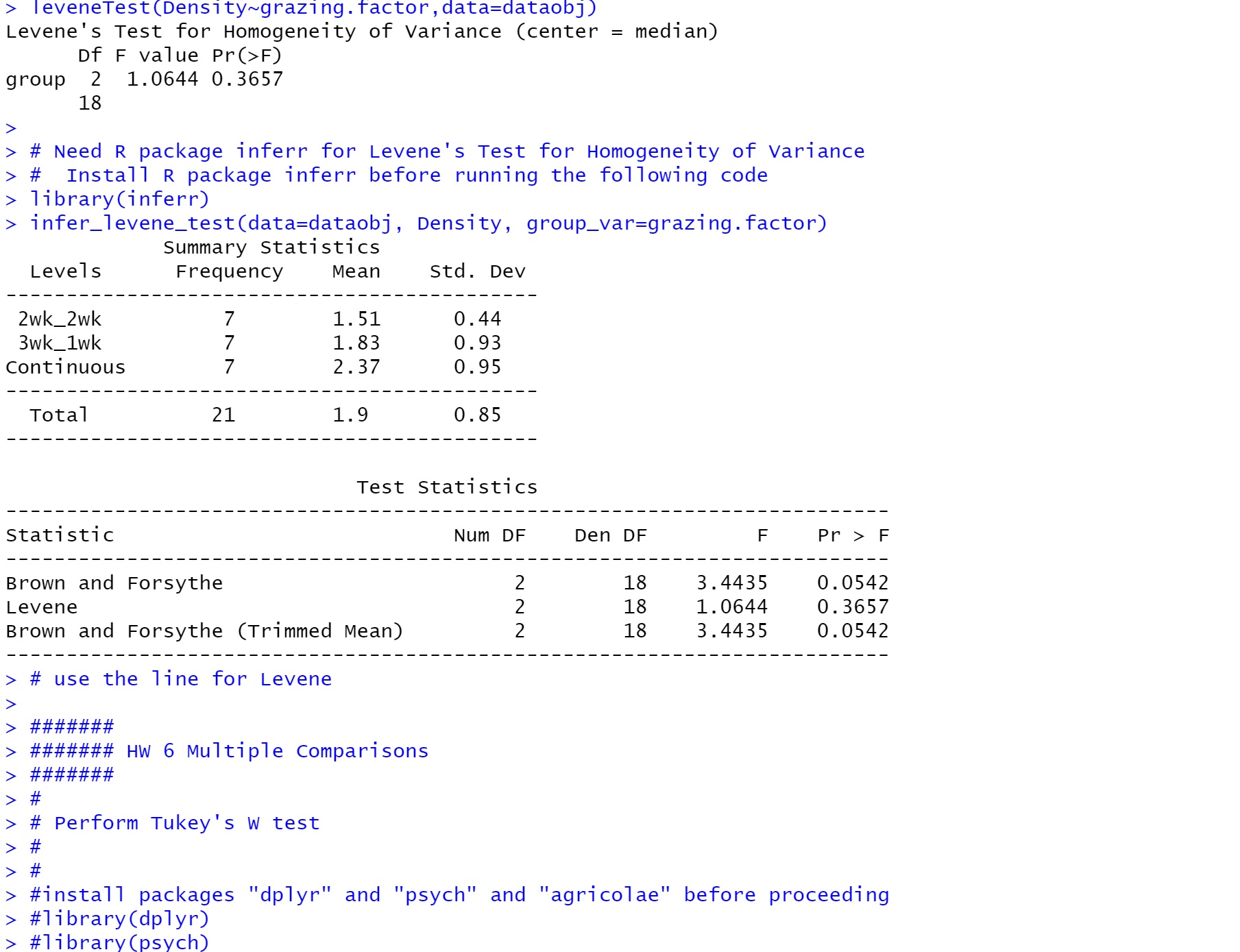
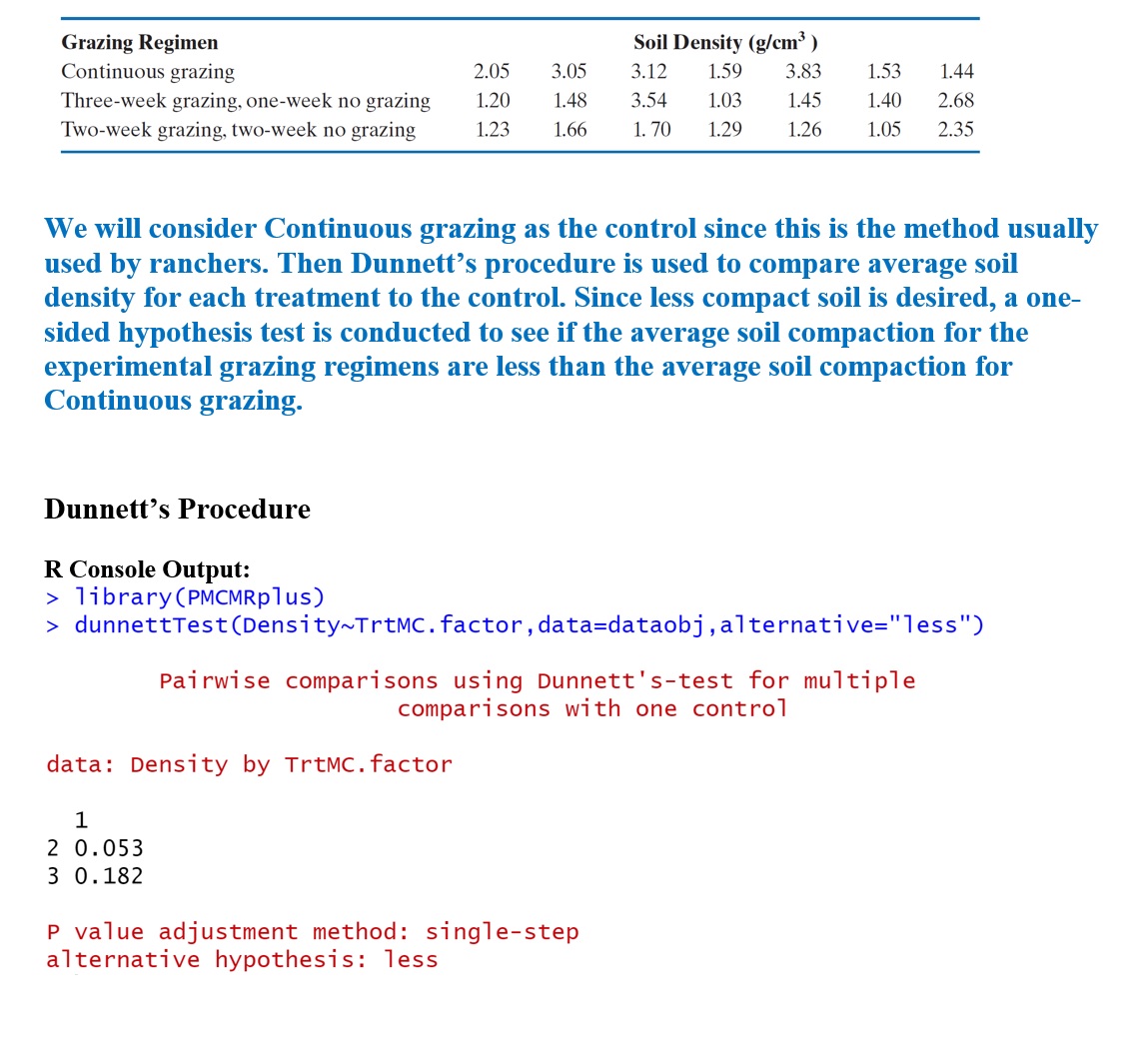
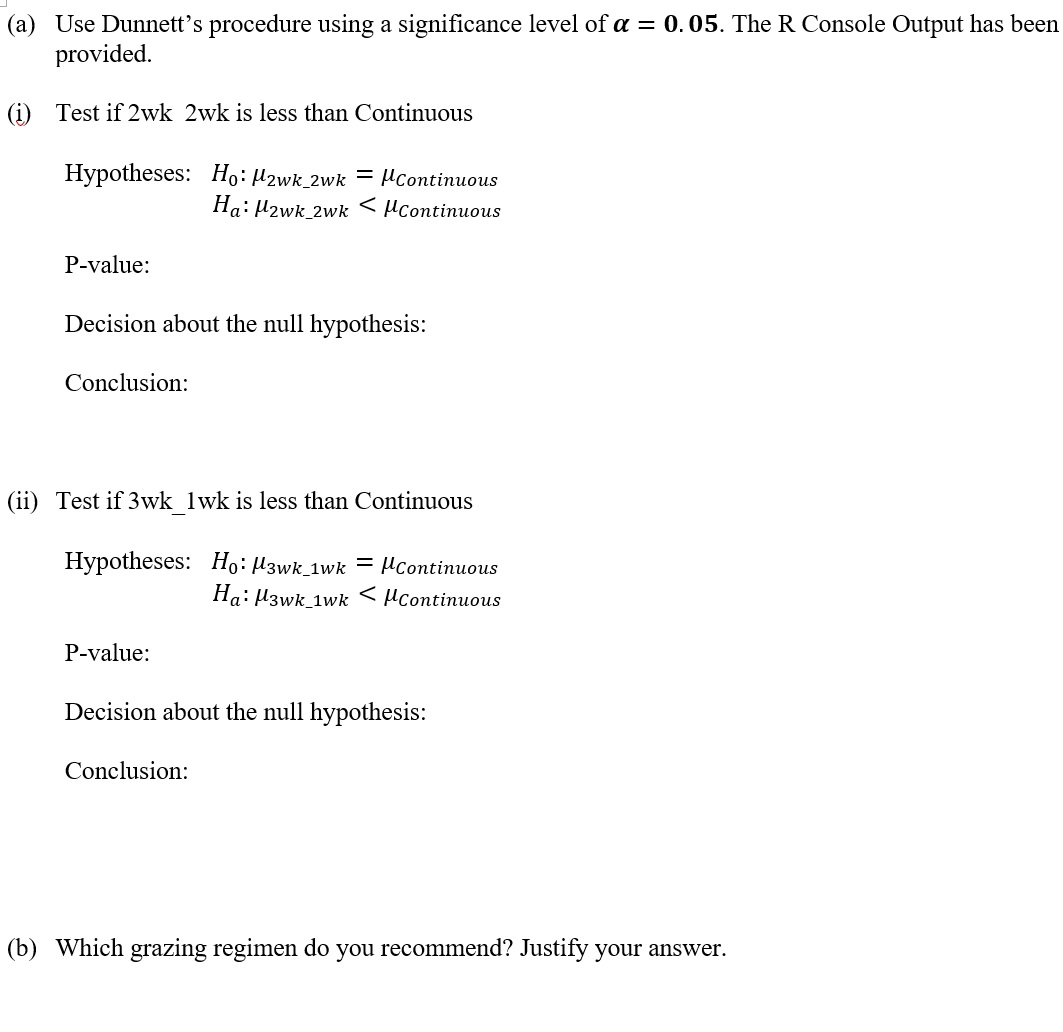
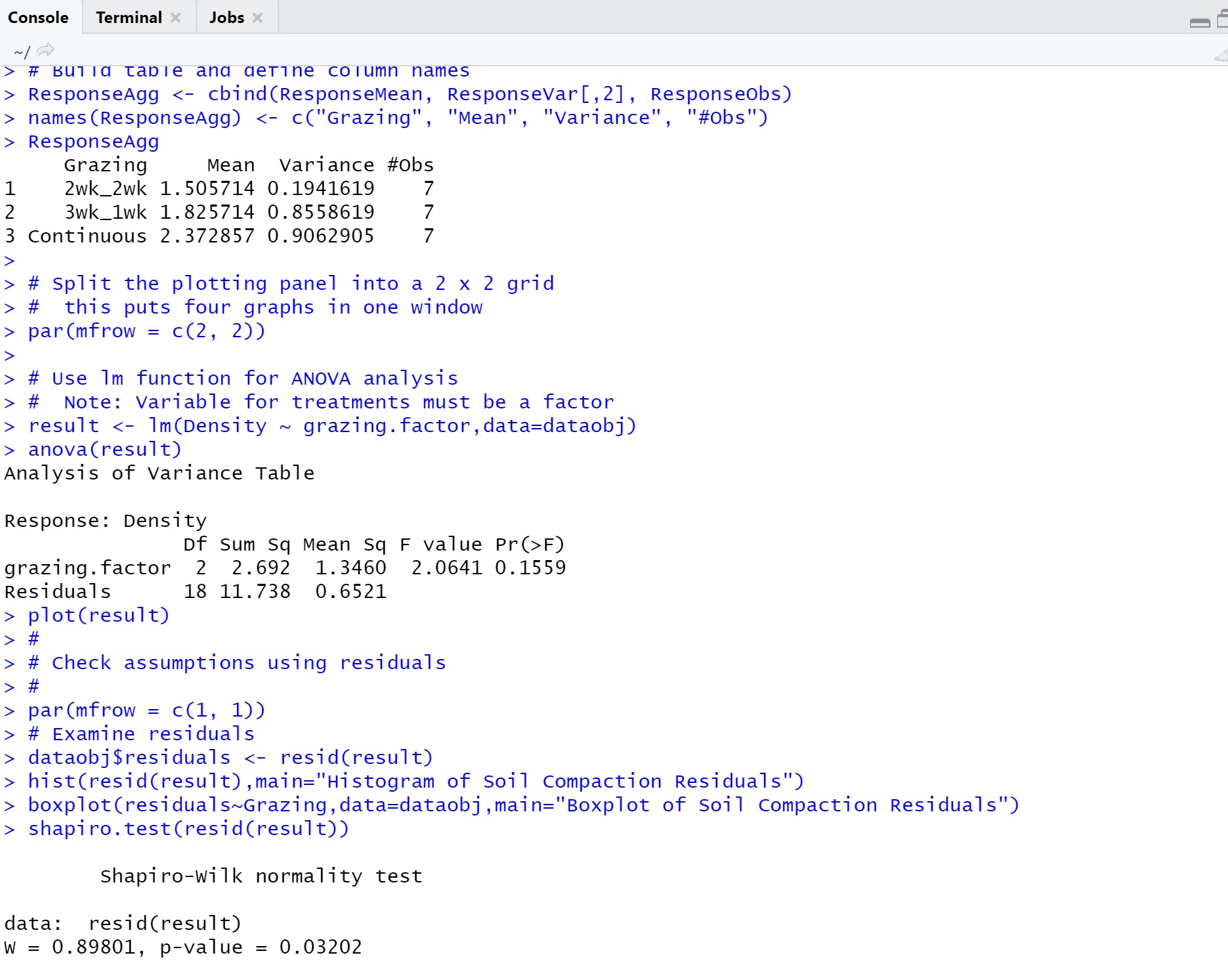
> leveneTest (Density~grazing . factor , data=dataobj) Levene's Test for Homogeneity of Variance (center = median) of F value Pr(>F) group 2 1. 0644 0. 3657 18 > # Need R package inferr for Levene's Test for Homogeneity of Variance # library (inferr) Install R package inferr before running the following code > infer_levene_test(data=dataobj, Density, group_var=grazing . factor) Summary Statistics Levels Frequency Mean Std. Dev 2wk_2wk VVV 1. 51 0. 44 3wk_1wk 1.83 0. 93 Continuous 2. 37 0. 95 Total 21 1.9 0. 85 Test Statistics Statistic Num DF Den DF F Pr > F Brown and Forsythe NNN 18 3. 4435 0. 0542 Levene 18 1. 0644 0. 3657 Brown and Forsythe (Trimmed Mean) 18 3. 4435 0. 0542 > # use the line for Levene > # # # # # # # ####### HW 6 Multiple Comparisons > # # # # # # # > # > # Perform Tukey's W test > # # #install packages "dplyr" and "psych" and "agricolae" before proceeding #library (dplyr) #library (psych)Grazing Regimen Soil Density (gl'ern3 ) Continuous grazing 2.05 3.05 3.12 1.59 3.83 1.53 1.44 Threeweek grazing, oneAweek no grazing 1.20 1.48 3.54 1.03 1.45 1.40 2.68 Two-week grazing, two-week no grazing 1.23 1.66 1. 70 1.29 1.26 1.05 2.35 We will consider Continuous grazing as the control since this is the method usually used by ranchers. Then Dunnett's procedure is used to compare average soil density for each treatment to the control. Since less compact soil is desired, a one sided hypothesis test is conducted to see if the average soil compaction for the experimental grazing regimens are less than the average soil compaction for Continuous grazing. Dunnett's Procedure R Console Output: > libraryCPMCMRpl us) > dunnettTestCDensity~TrtMC.factor,data=dataobj,alternative="less") Pairwise comparisons using Dunnett'stest for multiple comparisons with one control data: Density by TrtMC.factor OCH 2 .053 3 .182 P value adjustment method: singlestep alternative hypothesis: less (a) Use Dunnett's procedure using a significance level of a = 0. 05. The R Console Output has been provided. (i) Test if 2wk 2wk is less than Continuous Hypotheses: Ho: Hawk_2wk = MContinuous Ha: Hawk 2wk F) grazing . factor 2 2. 692 1. 3460 2. 0641 0. 1559 Residuals 18 11. 738 0. 6521 > plot (result) > # # Check assumptions using residuals # par (mfrow = c(1, 1)) # Examine residuals dataobj$residuals
Step by Step Solution
There are 3 Steps involved in it

Get step-by-step solutions from verified subject matter experts
 Study Help