





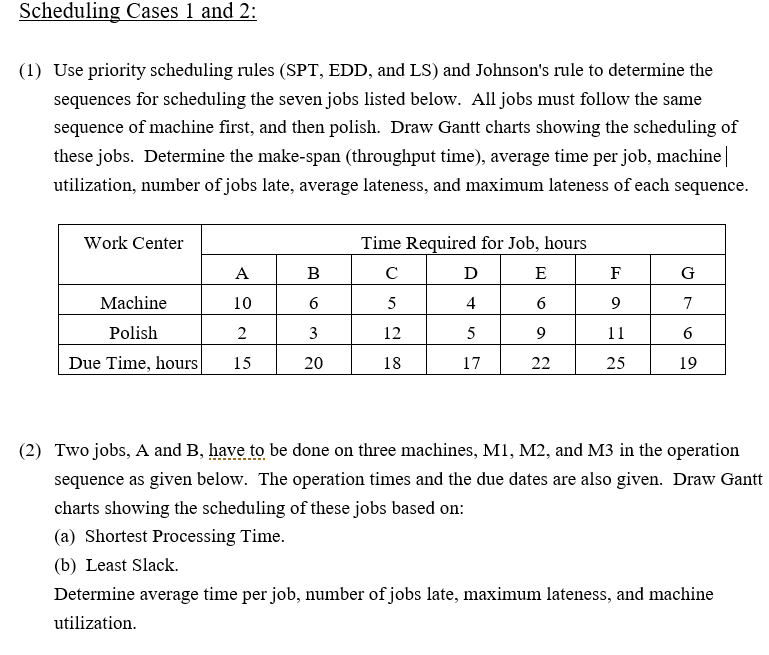
Question: Scheduling Cases 1 and 2: (1) Use priority scheduling rules (SPT, EDD, and LS) and Johnson's rule to determine the sequences for scheduling the seven
Scheduling Cases 1 and 2: (1) Use priorityScheduling Cases 1 and 2: (1) Use priorityScheduling Cases 1 and 2: (1) Use priority

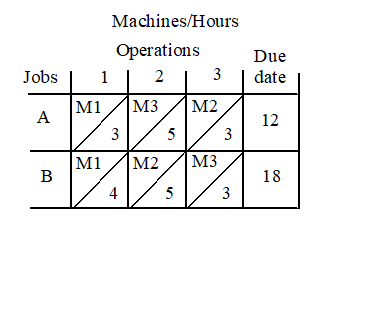
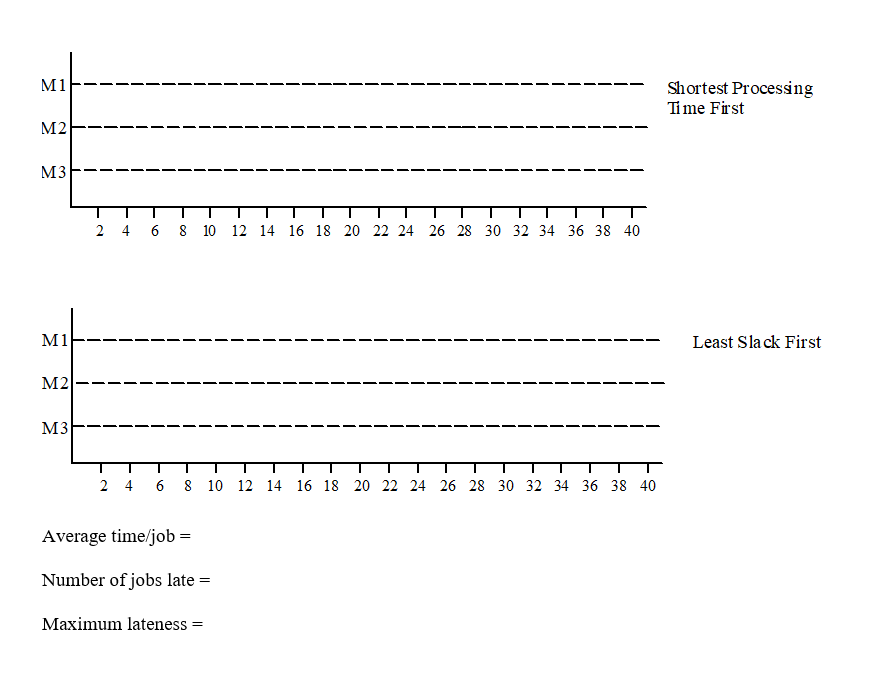
Scheduling Cases 1 and 2: (1) Use priority scheduling rules (SPT, EDD, and LS) and Johnson's rule to determine the sequences for scheduling the seven jobs listed below. All jobs must follow the same sequence of machine first, and then polish. Draw Gantt charts showing the scheduling of these jobs. Determine the make-span (throughput time), average time per job, machine | utilization, number of jobs late, average lateness, and maximum lateness of each sequence. Work Center Time Required for Job, hours D E A B F G 10 6 5 4 6 9 7 Machine Polish Due Time, hours 2 3 12 5 9 11 6 15 20 18 17 22 25 19 (2) Two jobs, A and B, have to be done on three machines, M1, M2, and M3 in the operation sequence as given below. The operation times and the due dates are also given. Draw Gantt charts showing the scheduling of these jobs based on: (a) Shortest Processing Time. (b) Least Slack. Determine average time per job, number of jobs late, maximum lateness, and machine utilization. Machines/Hours Operations 1 2 3 Due date Jobs A 12 M1 M3 M2 35 3 M1 M2 M3 B 18 4 5 3 M1 Shortest Processing Time First M2 M3 2 4 4 6 8 10 12 14 16 18 20 22 24 26 28 30 32 34 36 38 40 M1 Least Slack First M2 1 M3 2 4 6 8 10 12 14 16 18 20 22 24 26 28 30 32 34 36 38 40 Average time/job = Number of jobs late = Maximum lateness =
Step by Step Solution

There are 3 Steps involved in it

1 Expert Approved Answer
Step: 1 Unlock blur-text-image

Question Has Been Solved by an Expert!

Get step-by-step solutions from verified subject matter experts

Step: 2 Unlock
Step: 3 Unlock

Students Have Also Explored These Related General Management Questions!