







Question: Schiit Audo case : from this case please calculate the gross margin for Amazon sales Jason Stoddard was having a hectic but interesting summer. In
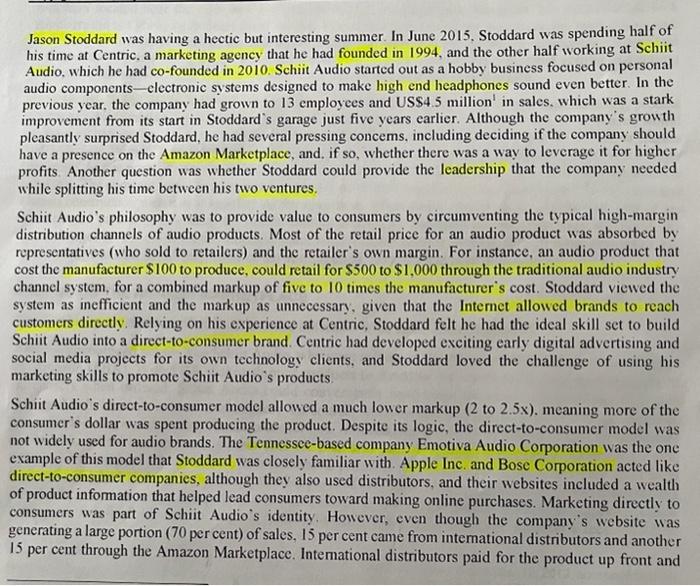
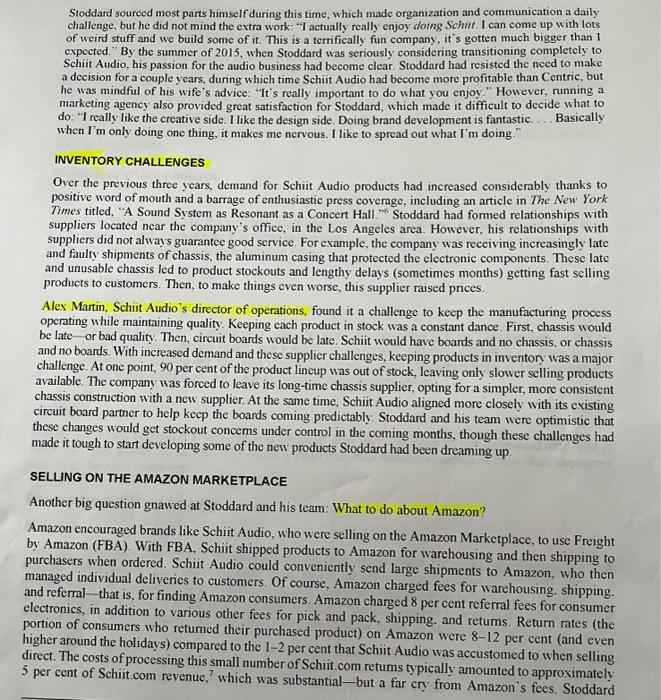
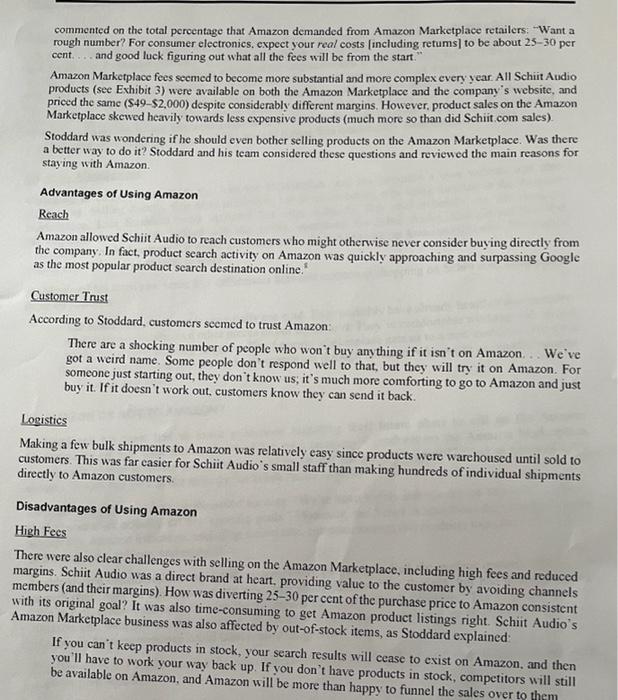
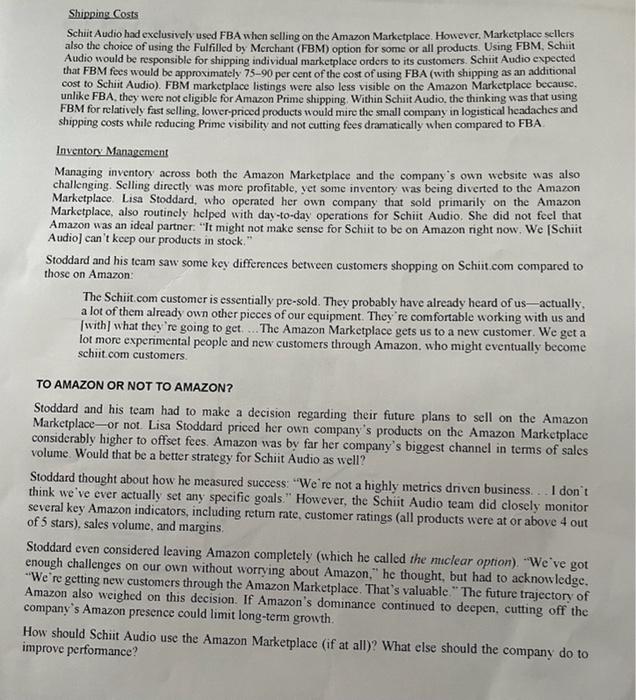
Jason Stoddard was having a hectic but interesting summer. In June 2015. Stoddard was spending half of his time at Centric. a marketing agency that he had founded in 1994, and the other half working at Schiit Audio, which he had co-founded in 2010. Schiit Audio started out as a hobby business focused on personal audio components - electronic systems designed to make high end headphones sound even better. In the previous year, the company had grown to 13 employees and US\$4.5 million' in sales, which was a stark improvement from its start in Stoddard's garage just five years earlier. Although the company's growth pleasantly surprised Stoddard, he had several pressing concems, including deciding if the company should have a presence on the Amazon Marketplace, and. if so, whether there was a way to leverage it for higher profits. Another question was whether Stoddard could provide the leadership that the company needed while splitting his time between his two ventures. Schiit Audio's philosophy was to provide value to consumers by circumventing the typical high-margin distribution channels of audio products. Most of the retail price for an audio product was absorbed by representatives (who sold to retailers) and the retailer's own margin. For instance, an audio product that cost the manufacturer $100 to produce, could retail for $500 to $1,000 through the traditional audio industry channel system, for a combined markup of five to 10 times the manufacturer's cost. Stoddard viewed the system as inefficient and the markup as unnecessary, given that the Internet allowed brands to reach customers directly. Relying on his experience at Centric, Stoddard felt he had the ideal skill set to build Schiit Audio into a direct-to-consumer brand. Centric had developed exciting early digital advertising and social media projects for its own technology clients, and Stoddard loved the challenge of using his marketing skills to promote Schit Audio's products. Schit Audio's direct-to-consumer model allowed a much lower markup (2 to 2.5x ). meaning more of the consumer's dollar was spent producing the product. Despite its logic, the direct-to-consumer model was not widely used for audio brands. The Tennessec-based company Emotiva Audio Corporation was the one example of this model that Stoddard was closely familiar with. Apple Inc. and Bose Corporation acted like direct-to-consumer companies, although they also used distributors, and their websites included a wealth of product information that helped lead consumers toward making online purchases. Marketing directly to consumers was part of Schiit Audio's identity. However, even though the company's website was generating a large portion ( 70 per cent) of sales, 15 per cent came from intemational distributors and another 15 per cent through the Amazon Marketplace. Intemational distributors paid for the product up front and Stoddard sourced most parts himself during this time, which made organization and communication a daily challenge, but he did not mind the extra work: "I actually really enjoy doing Schit. I can come up with lots of weird stuff and we build some of it. This is a terrifically fun company, it's gotten much bigger than I expected. "By the summer of 2015 , when Stoddard was seriously considering transitioning completely to Schiit Audio, his passion for the audio business had become clear. Stoddard had resisted the need to make a decision for a couple years, dunng which time Schiit Audio had become more profitable than Centric, but he was mindful of his wife's advice: "It's really important to do what you enjoy. "However, running a marketing agency also provided great satisfaction for Stoddard, which made it difficult to decide what to do: "I really like the creative side. I like the design side. Doing brand development is fantastic... Basically when l'm only doing one thing, it makes me nervous. I like to spread out what I'm doing." INVENTORY CHALLENGES Over the previous three years, demand for Schiit Audio products had increased considerably thanks to positive word of mouth and a barrage of enthusiastic press coverage, including an article in The New York Times titled, "A Sound System as Resonant as a Concert Hall." Stoddard had formed relationships with suppliers located near the company's office, in the Los Angeles area. However. his relationships with suppliers did not always guarantee good service. For example, the company was receiving increasingly late and faulty shipments of chassis, the aluminum casing that protected the electronic components. These late and unusable chassis led to product stockouts and lengthy delays (sometimes months) getting fast selling products to customers. Then, to make things even worse, this supplier raised prices. Alex Martin, Schit Audio's director of operations, found it a challenge to keep the manufacturing process operating while maintaining quality. Keeping each product in stock was a constant dance. First, chassis would be late - or bad quality. Then, circuit boards would be late. Schiit would have boards and no chassis, or chassis and no boards. With increased demand and these supplier challenges, keeping products in inventory was a major challenge. At one point, 90 per cent of the product lineup was out of stock, leaving only slower selling products available. The company was forced to leave its long-time chassis supplier, opting for a simpler, more consistent chassis construction with a new supplier. At the same time, Schiit Audio aligned more closely with its cxisting circuit board partner to help kecp the boards coming predictably. Stoddard and his team were optimistic that these changes would get stockout concems under control in the coming months, though these challenges had made it tough to start developing some of the new products Stoddard had been dreaming up. SELLING ON THE AMAZON MARKETPLACE Another big question gnawed at Stoddard and his team: What to do about Amazon? Amazon encouraged brands like Schiit Audio, who were selling on the Amazon Marketplace, to use Freight by Amazon (FBA). With FBA, Schiit shipped products to Amazon for warehousing and then shipping to purchasers when ordered. Schiit Audio could conveniently send large shipments to Amazon, who then managed individual deliveries to customers. Of course, Amazon charged fees for warehousing. shipping. and referral - that is, for finding Amazon consumers. Amazon charged 8 per cent referral fees for consumer electronics, in addition to various other fees for pick and pack, shipping. and retums. Return rates (the portion of consumers who retumed their purchased product) on Amazon were 8 - 12 per cent (and even higher around the holidays) compared to the 1-2 per cent that Schiit Audio was accustomed to when selling direct. The costs of processing this small number of Schiit.com retums typically amounted to approximately per cent of Schiit com revenue, 7 which was substantial-but a far cry from Amazon's fees. Stoddard commented on the total percentage that Amazon demanded from Amazon Marketplace retailers: Want a rough number? For consumer electronics, expect your real costs [including retums] to be about 25-30 per cent. ... and good luck figuring out what all the fees will be from the start. Amazon Marketplace fees seemed to become more substantial and more complex every year All Schiit Audio products (see Exhibit 3) were available on both the Amazon Marketplace and the company's website, and priced the same (\$49-\$2,000) despite considerably different margins. However. product sales on the Amazon Marketplace skewed heavily towards less expensive products (much more so than did Schiit.com sales). Stoddard was wondering if he should even bother selling products on the Amazon Marketplace. Was there a better way to do it? Stoddard and his team considered these questions and roviewed the main reasons for staying with Amazon. Advantages of Using Amazon Reach Amazon allowed Schiit Audio to reach customers who might otherwise never consider buying directly from the company. In fict, product search activity on Amazon was quickly approaching and surpassing Google as the most popular product search destination online." Customer Trust According to Stoddard, customers seemed to trust Amazon: There are a shocking number of people who won't buy anything if it isn't on Amazon. . We 've got a weird name. Some people don't respond well to that, but they will try it on Amazon. For someone just starting out, they don't know us; it's much more comforting to go to Amazon and just buy it. If it doesn't work out, customers know they can send it back. Logistics Making a few bulk shipments to Amazon was relatively easy since products were warehoused until sold to customers. This was far easier for Schiit Audio's small staff than making hundreds of individual shipments directly to Amazon customers. Disadvantages of Using Amazon High Fecs There were also clear challenges with selling on the Amazon Marketplace, including high fees and reduced margins. Schiit Audio was a direct brand at heart, providing value to the customer by avoiding channels members (and their margins). How was diverting 2530 per cent of the purchase price to Amazon consistent with its original goal? It was also time-consuming to get Amazon product listings right. Schiit Audio's Amazon Marketplace business was also affected by out-of-stock items, as Stoddard explained If you can't keep products in stock, your search results will cease to exist on Amazon, and then you'll have to work your way back up. If you don't have products in stock, competitors will still be available on Amazon, and Amazon will be more than happy to funnel the sales over to them Shipping Costs Schiit Audio had exclusively used FBA when selling on the Amazon Marketplace. However. Marketplace sellers also the choice of using the Fulfilled by Merchant (FBM) option for some or all products. Using. FBM, Schit Audio would be responsible for shipping individual marketplace orders to its customers. Schiit Audio expected that FBM fees would be approximately 75-90 per cent of the cost of using FBA (with shipping as an additional cost to Schiit Audio). FBM marketplace listings were also less visible on the Amazon Marketplace because. unlike FBA, they were not cligible for Amazon Prime shipping. Within Schit Audio, the thinking was that using FBM for relatively fast selling. lower-priced products would mare the small company in logistical headaches and shipping costs while reducing Prime visibility and not cutting fees dramatically when compared to FBA. Inventory Management Managing inventory across both the Amazon Marketplace and the company's own website was also challenging. Selling directly was more profitable, yet some inventory was being diverted to the Amazon Marketplace. Lisa Stoddard, who operated her own company that sold primarily on the Amazon Marketplace, also routinely helped with day-to-day operations for Schiit Audio. She did not feel that Amazon was an ideal partner: "It might not make sense for Schiit to be on Amazon right now. We ISchiit Audio] can't keep our products in stock., Stoddard and his tcam saw some key differenees between customers shopping on Schiit.com compared to those on Amazon: The Schiit. com customer is essentially pre-sold. They probably have already heard of us-actually. a lot of them already own other pieces of our equipment. They re comfortable working with us and [with] what they"re going to get. ... The Amazon Marketplace gets us to a new customer. We get a lot more experimental people and new customers through Amazon. who might cventually become schiit.com customers. TO AMAZON OR NOT TO AMAZON? Stoddard and his team had to make a decision regarding their future plans to sell on the Amazon Marketplace-or not. Lisa Stoddard priced her own company's products on the Amazon Marketplace considerably higher to offset fees. Amazon was by far her company's biggest channel in terms of sales volume. Would that be a better strategy for Schiit Audio as well? Stoddard thought about how he measured success: "We' re not a highly metrics driven business. . I don't think we ve ever actually set any specific goals." However, the Schiit Audio team did closely monitor several key Amazon indicators, including retum rate, customer ratings (all products were at or above 4 out of 5 stars), sales volume, and margins. Stoddard even considered leaving Amazon completely (which he called the muclear option). "We ve got enough challenges on our own without worrying about Amazon," he thought, but had to acknowledge. "We're getting new customers through the Amazon Marketplace. That's valuable." The future trajectory of Amazon also weighed on this decision. If Amazon's dominance continued to deepen, cutting off the company's Amazon presence could limit long-term growth. How should Schiit Audio use the Amazon Marketplace (if at all)? What else should the company do to improve perfomance? Jason Stoddard was having a hectic but interesting summer. In June 2015. Stoddard was spending half of his time at Centric. a marketing agency that he had founded in 1994, and the other half working at Schiit Audio, which he had co-founded in 2010. Schiit Audio started out as a hobby business focused on personal audio components - electronic systems designed to make high end headphones sound even better. In the previous year, the company had grown to 13 employees and US\$4.5 million' in sales, which was a stark improvement from its start in Stoddard's garage just five years earlier. Although the company's growth pleasantly surprised Stoddard, he had several pressing concems, including deciding if the company should have a presence on the Amazon Marketplace, and. if so, whether there was a way to leverage it for higher profits. Another question was whether Stoddard could provide the leadership that the company needed while splitting his time between his two ventures. Schiit Audio's philosophy was to provide value to consumers by circumventing the typical high-margin distribution channels of audio products. Most of the retail price for an audio product was absorbed by representatives (who sold to retailers) and the retailer's own margin. For instance, an audio product that cost the manufacturer $100 to produce, could retail for $500 to $1,000 through the traditional audio industry channel system, for a combined markup of five to 10 times the manufacturer's cost. Stoddard viewed the system as inefficient and the markup as unnecessary, given that the Internet allowed brands to reach customers directly. Relying on his experience at Centric, Stoddard felt he had the ideal skill set to build Schiit Audio into a direct-to-consumer brand. Centric had developed exciting early digital advertising and social media projects for its own technology clients, and Stoddard loved the challenge of using his marketing skills to promote Schit Audio's products. Schit Audio's direct-to-consumer model allowed a much lower markup (2 to 2.5x ). meaning more of the consumer's dollar was spent producing the product. Despite its logic, the direct-to-consumer model was not widely used for audio brands. The Tennessec-based company Emotiva Audio Corporation was the one example of this model that Stoddard was closely familiar with. Apple Inc. and Bose Corporation acted like direct-to-consumer companies, although they also used distributors, and their websites included a wealth of product information that helped lead consumers toward making online purchases. Marketing directly to consumers was part of Schiit Audio's identity. However, even though the company's website was generating a large portion ( 70 per cent) of sales, 15 per cent came from intemational distributors and another 15 per cent through the Amazon Marketplace. Intemational distributors paid for the product up front and Stoddard sourced most parts himself during this time, which made organization and communication a daily challenge, but he did not mind the extra work: "I actually really enjoy doing Schit. I can come up with lots of weird stuff and we build some of it. This is a terrifically fun company, it's gotten much bigger than I expected. "By the summer of 2015 , when Stoddard was seriously considering transitioning completely to Schiit Audio, his passion for the audio business had become clear. Stoddard had resisted the need to make a decision for a couple years, dunng which time Schiit Audio had become more profitable than Centric, but he was mindful of his wife's advice: "It's really important to do what you enjoy. "However, running a marketing agency also provided great satisfaction for Stoddard, which made it difficult to decide what to do: "I really like the creative side. I like the design side. Doing brand development is fantastic... Basically when l'm only doing one thing, it makes me nervous. I like to spread out what I'm doing." INVENTORY CHALLENGES Over the previous three years, demand for Schiit Audio products had increased considerably thanks to positive word of mouth and a barrage of enthusiastic press coverage, including an article in The New York Times titled, "A Sound System as Resonant as a Concert Hall." Stoddard had formed relationships with suppliers located near the company's office, in the Los Angeles area. However. his relationships with suppliers did not always guarantee good service. For example, the company was receiving increasingly late and faulty shipments of chassis, the aluminum casing that protected the electronic components. These late and unusable chassis led to product stockouts and lengthy delays (sometimes months) getting fast selling products to customers. Then, to make things even worse, this supplier raised prices. Alex Martin, Schit Audio's director of operations, found it a challenge to keep the manufacturing process operating while maintaining quality. Keeping each product in stock was a constant dance. First, chassis would be late - or bad quality. Then, circuit boards would be late. Schiit would have boards and no chassis, or chassis and no boards. With increased demand and these supplier challenges, keeping products in inventory was a major challenge. At one point, 90 per cent of the product lineup was out of stock, leaving only slower selling products available. The company was forced to leave its long-time chassis supplier, opting for a simpler, more consistent chassis construction with a new supplier. At the same time, Schiit Audio aligned more closely with its cxisting circuit board partner to help kecp the boards coming predictably. Stoddard and his team were optimistic that these changes would get stockout concems under control in the coming months, though these challenges had made it tough to start developing some of the new products Stoddard had been dreaming up. SELLING ON THE AMAZON MARKETPLACE Another big question gnawed at Stoddard and his team: What to do about Amazon? Amazon encouraged brands like Schiit Audio, who were selling on the Amazon Marketplace, to use Freight by Amazon (FBA). With FBA, Schiit shipped products to Amazon for warehousing and then shipping to purchasers when ordered. Schiit Audio could conveniently send large shipments to Amazon, who then managed individual deliveries to customers. Of course, Amazon charged fees for warehousing. shipping. and referral - that is, for finding Amazon consumers. Amazon charged 8 per cent referral fees for consumer electronics, in addition to various other fees for pick and pack, shipping. and retums. Return rates (the portion of consumers who retumed their purchased product) on Amazon were 8 - 12 per cent (and even higher around the holidays) compared to the 1-2 per cent that Schiit Audio was accustomed to when selling direct. The costs of processing this small number of Schiit.com retums typically amounted to approximately per cent of Schiit com revenue, 7 which was substantial-but a far cry from Amazon's fees. Stoddard commented on the total percentage that Amazon demanded from Amazon Marketplace retailers: Want a rough number? For consumer electronics, expect your real costs [including retums] to be about 25-30 per cent. ... and good luck figuring out what all the fees will be from the start. Amazon Marketplace fees seemed to become more substantial and more complex every year All Schiit Audio products (see Exhibit 3) were available on both the Amazon Marketplace and the company's website, and priced the same (\$49-\$2,000) despite considerably different margins. However. product sales on the Amazon Marketplace skewed heavily towards less expensive products (much more so than did Schiit.com sales). Stoddard was wondering if he should even bother selling products on the Amazon Marketplace. Was there a better way to do it? Stoddard and his team considered these questions and roviewed the main reasons for staying with Amazon. Advantages of Using Amazon Reach Amazon allowed Schiit Audio to reach customers who might otherwise never consider buying directly from the company. In fict, product search activity on Amazon was quickly approaching and surpassing Google as the most popular product search destination online." Customer Trust According to Stoddard, customers seemed to trust Amazon: There are a shocking number of people who won't buy anything if it isn't on Amazon. . We 've got a weird name. Some people don't respond well to that, but they will try it on Amazon. For someone just starting out, they don't know us; it's much more comforting to go to Amazon and just buy it. If it doesn't work out, customers know they can send it back. Logistics Making a few bulk shipments to Amazon was relatively easy since products were warehoused until sold to customers. This was far easier for Schiit Audio's small staff than making hundreds of individual shipments directly to Amazon customers. Disadvantages of Using Amazon High Fecs There were also clear challenges with selling on the Amazon Marketplace, including high fees and reduced margins. Schiit Audio was a direct brand at heart, providing value to the customer by avoiding channels members (and their margins). How was diverting 2530 per cent of the purchase price to Amazon consistent with its original goal? It was also time-consuming to get Amazon product listings right. Schiit Audio's Amazon Marketplace business was also affected by out-of-stock items, as Stoddard explained If you can't keep products in stock, your search results will cease to exist on Amazon, and then you'll have to work your way back up. If you don't have products in stock, competitors will still be available on Amazon, and Amazon will be more than happy to funnel the sales over to them Shipping Costs Schiit Audio had exclusively used FBA when selling on the Amazon Marketplace. However. Marketplace sellers also the choice of using the Fulfilled by Merchant (FBM) option for some or all products. Using. FBM, Schit Audio would be responsible for shipping individual marketplace orders to its customers. Schiit Audio expected that FBM fees would be approximately 75-90 per cent of the cost of using FBA (with shipping as an additional cost to Schiit Audio). FBM marketplace listings were also less visible on the Amazon Marketplace because. unlike FBA, they were not cligible for Amazon Prime shipping. Within Schit Audio, the thinking was that using FBM for relatively fast selling. lower-priced products would mare the small company in logistical headaches and shipping costs while reducing Prime visibility and not cutting fees dramatically when compared to FBA. Inventory Management Managing inventory across both the Amazon Marketplace and the company's own website was also challenging. Selling directly was more profitable, yet some inventory was being diverted to the Amazon Marketplace. Lisa Stoddard, who operated her own company that sold primarily on the Amazon Marketplace, also routinely helped with day-to-day operations for Schiit Audio. She did not feel that Amazon was an ideal partner: "It might not make sense for Schiit to be on Amazon right now. We ISchiit Audio] can't keep our products in stock., Stoddard and his tcam saw some key differenees between customers shopping on Schiit.com compared to those on Amazon: The Schiit. com customer is essentially pre-sold. They probably have already heard of us-actually. a lot of them already own other pieces of our equipment. They re comfortable working with us and [with] what they"re going to get. ... The Amazon Marketplace gets us to a new customer. We get a lot more experimental people and new customers through Amazon. who might cventually become schiit.com customers. TO AMAZON OR NOT TO AMAZON? Stoddard and his team had to make a decision regarding their future plans to sell on the Amazon Marketplace-or not. Lisa Stoddard priced her own company's products on the Amazon Marketplace considerably higher to offset fees. Amazon was by far her company's biggest channel in terms of sales volume. Would that be a better strategy for Schiit Audio as well? Stoddard thought about how he measured success: "We' re not a highly metrics driven business. . I don't think we ve ever actually set any specific goals." However, the Schiit Audio team did closely monitor several key Amazon indicators, including retum rate, customer ratings (all products were at or above 4 out of 5 stars), sales volume, and margins. Stoddard even considered leaving Amazon completely (which he called the muclear option). "We ve got enough challenges on our own without worrying about Amazon," he thought, but had to acknowledge. "We're getting new customers through the Amazon Marketplace. That's valuable." The future trajectory of Amazon also weighed on this decision. If Amazon's dominance continued to deepen, cutting off the company's Amazon presence could limit long-term growth. How should Schiit Audio use the Amazon Marketplace (if at all)? What else should the company do to improve perfomance
Step by Step Solution
There are 3 Steps involved in it

Get step-by-step solutions from verified subject matter experts
 Study Help