







Question: Second derivatives are difficult to calculate numerically with high accuracy. Therefore, if both the fields and the potentials (Lorenz gauge) are of interest, a
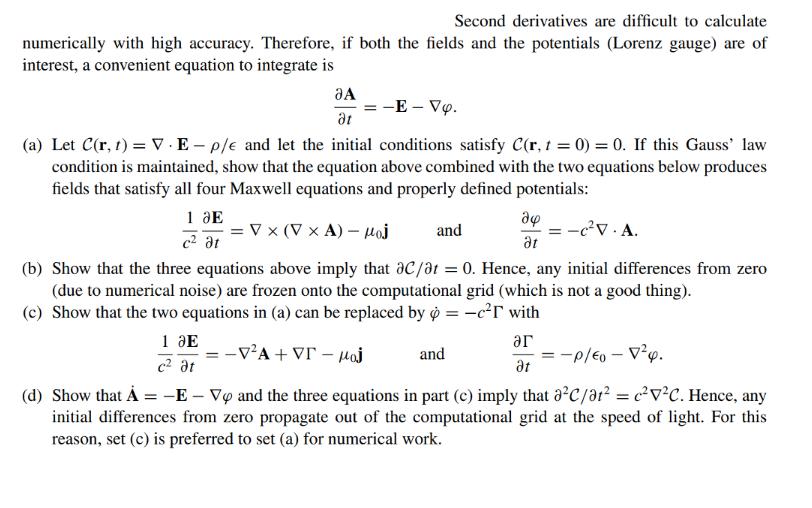
Second derivatives are difficult to calculate numerically with high accuracy. Therefore, if both the fields and the potentials (Lorenz gauge) are of interest, a convenient equation to integrate is -E V. r (a) Let C(r, t) = V.E - p/e and let the initial conditions satisfy C(r, 1 = 0) = 0. If this Gauss' law condition is maintained, show that the equation above combined with the two equations below produces fields that satisfy all four Maxwell equations and properly defined potentials: 1 JE = V x (V x A)- Hoj c2 at -c?v. A. and r (b) Show that the three equations above imply that aC/at = 0. Hence, any initial differences from zero (due to numerical noise) are frozen onto the computational grid (which is not a good thing). (c) Show that the two equations in (a) can be replaced by = -cr with 1 JE -vA + Vr Haj = -p/e0 V?o. and c2 at r (d) Show that = -E - Vo and the three equations in part (c) imply that a C/ar? = cvC. Hence, any initial differences from zero propagate out of the computational grid at the speed of light. For this reason, set (c) is preferred to set (a) for numerical work.
Step by Step Solution
3.30 Rating (153 Votes )
There are 3 Steps involved in it
To solve this problem we need to demonstrate several relationships and implications based on the giv... View full answer

Get step-by-step solutions from verified subject matter experts
 Study Help