







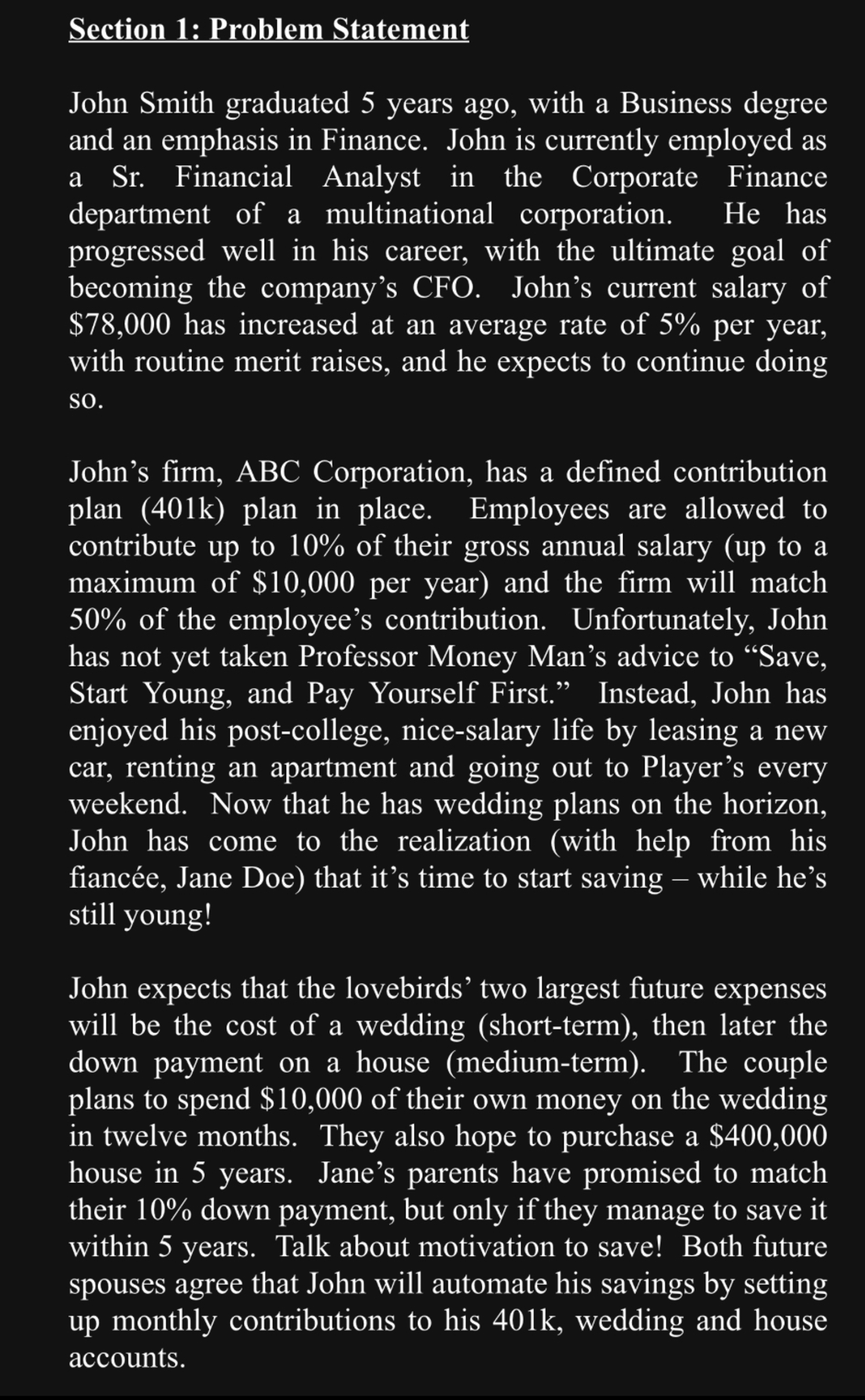
Question: Section 1 : Problem Statement John Smith graduated 5 years ago, with a Business degree and an emphasis in Finance. John is currently employed as
Section : Problem Statement
John Smith graduated years ago, with a Business degree
and an emphasis in Finance. John is currently employed as
a Sr Financial Analyst in the Corporate Finance
department of a multinational corporation. He has
progressed well in his career, with the ultimate goal of
becoming the company's CFO. John's current salary of
$ has increased at an average rate of per year,
with routine merit raises, and he expects to continue doing
so
John's firm, ABC Corporation, has a defined contribution
plan k plan in place. Employees are allowed to
contribute up to of their gross annual salary up to a
maximum of $ per year and the firm will match
of the employee's contribution. Unfortunately, John
has not yet taken Professor Money Man's advice to "Save,
Start Young, and Pay Yourself First." Instead, John has
enjoyed his postcollege, nicesalary life by leasing a new
car, renting an apartment and going out to Player's every
weekend. Now that he has wedding plans on the horizon,
John has come to the realization with help from his
fiance Jane Doe that it's time to start saving while he's
still young!
John expects that the lovebirds' two largest future expenses
will be the cost of a wedding shortterm then later the
down payment on a house mediumterm The couple
plans to spend $ of their own money on the wedding
in twelve months. They also hope to purchase a $
house in years. Jane's parents have promised to match
their down payment, but only if they manage to save it
within years. Talk about motivation to save! Both future
spouses agree that John will automate his savings by setting
up monthly contributions to his k wedding and house
accounts. Section : Calculations Needed
Your assignment should begin with a "Data" section,
documenting all of the numerical assumptions provided
in both sections of this assignment.
Your calculations will require the use of a spreadsheet
and a financial calculator. Please provide your detailed
calculations, stepbystep, including calculator
functions, in order to receive maximum credit.
Remember to put your name and date on your
assignment submission!
If John Smith had fully taken advantage of his
employer's k plan and company match, what would be
his current k balance based on his historical last five
years salary and contributions? Assume that John made
the maximum contribution every year, with a annual
return compounded annually. Second part, what would be
his current k balance, had he taken more risk and
achieved an annual return of
You can't change the past. John will save better in the
future. Assuming he starts in January of next year at age
and contributes the maximum to his k what will be
his account balance at age years later Second part,
what if John decides to retire early at age years later
what will be his account balance? For both calculations,
assume an annual rate of return of compounded
annually. John's fiance Jane Doe, is adamant about getting
married in the next year. She is insisting that John makes
saving towards the $ needed a top priority. John
recalls that Professor Money Man says "not to invest in
longterm investments with shortterm money." Therefore,
he plans to keep the wedding account in the bank and buy
shortterm under year maturity CDs Assuming John
stays continuously invested in CDs yielding annual
yield for the duration of each monthly deposit from the
beginning month Month how much will he have to
contribute to the wedding fund every month for the next
months?
Jane does acknowledge that saving for a home down
payment is not as big of a priority. But both future spouses
agree that they should start putting money away towards
the goal of $ within five years. John recalls that a
mediumterm investing plan should not take as much risk,
so he will plan to earn annually with a conservative
strategy for their house fund. How much money will he
have to save every month for the next months?
Dreaming of early retirement at age how much could
John start withdrawing from his k per month, if
planning for a life expectancy of years? Assume a more
moderate rate of return of annually, compounded
annually, during his retirement years.
Step by Step Solution
There are 3 Steps involved in it
1 Expert Approved Answer
Step: 1 Unlock

Question Has Been Solved by an Expert!
Get step-by-step solutions from verified subject matter experts
Step: 2 Unlock
Step: 3 Unlock
 Study Help