







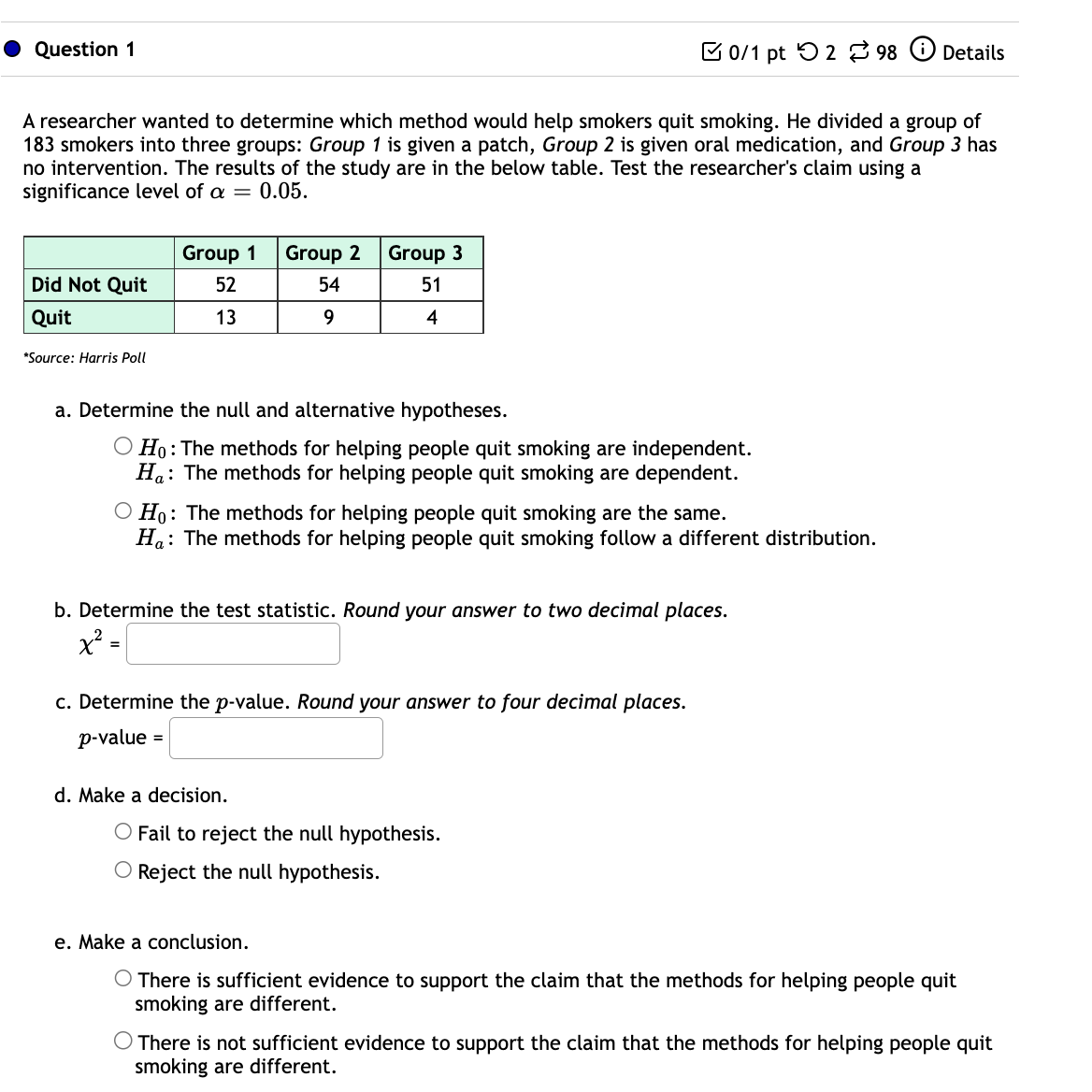
Question: Section 11.4 I Question 1 B 0!1 pt '0 2 8 98 0 Details A researcher wanted to determine which method would help smokers quit
Section 11.4
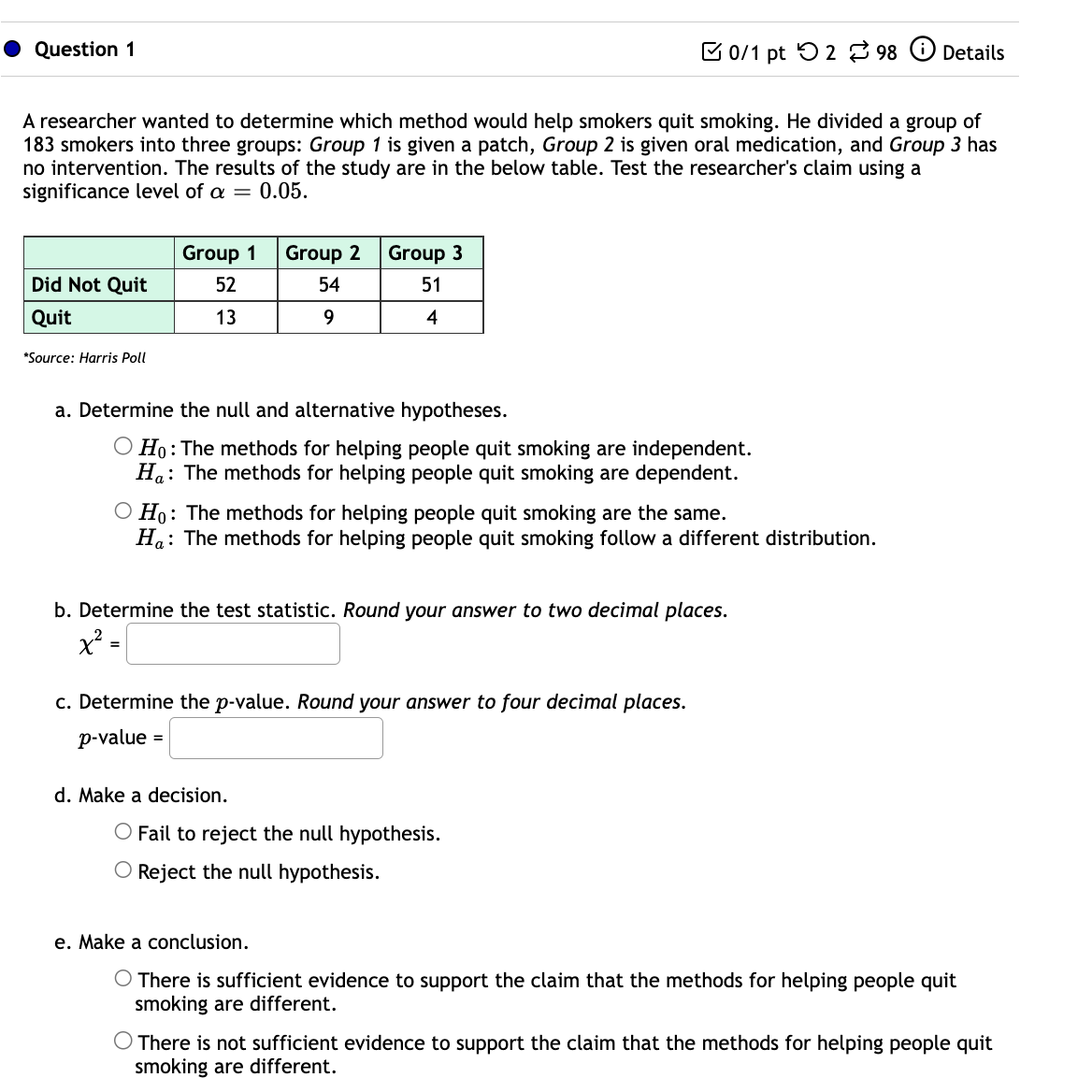
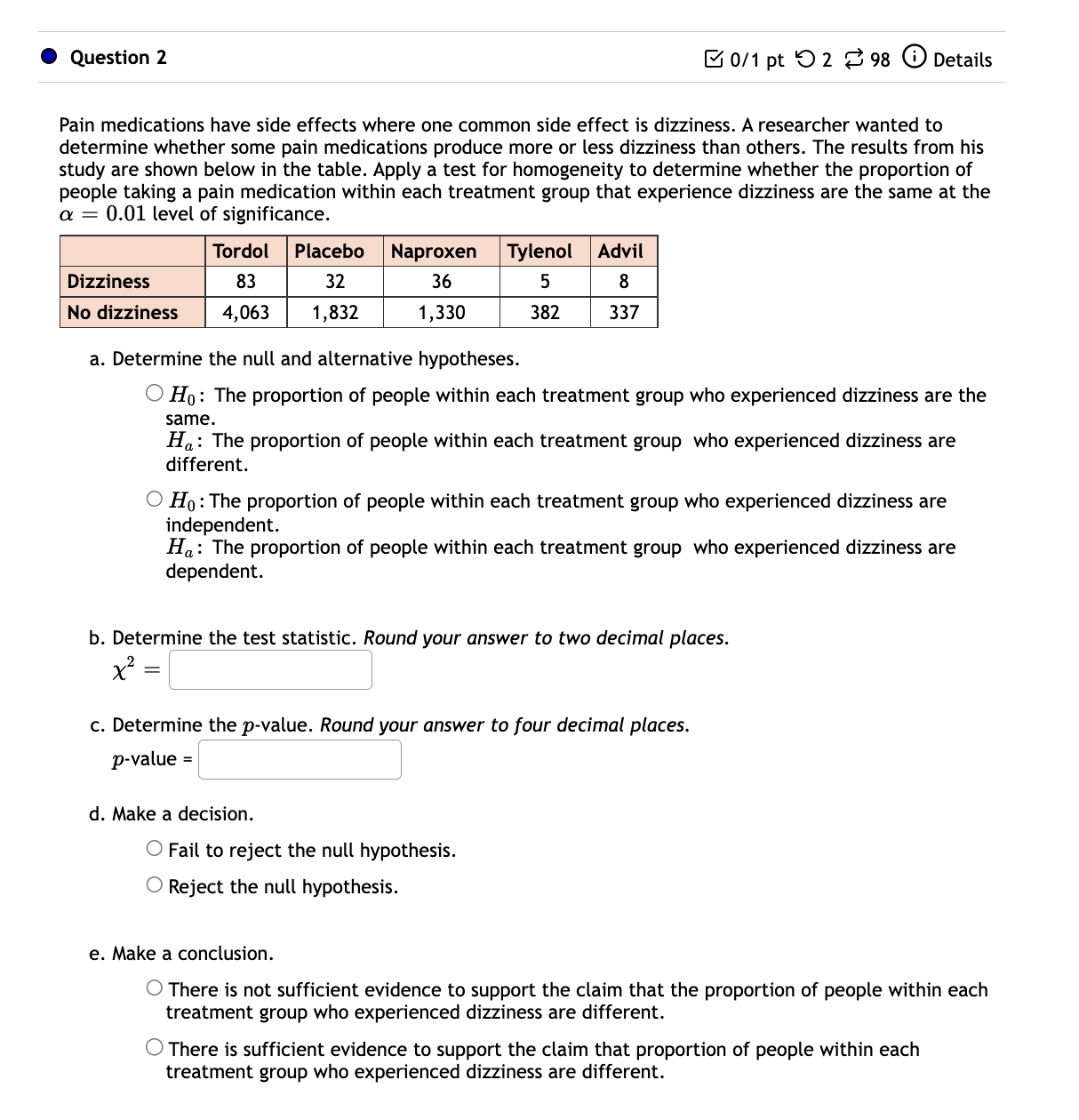
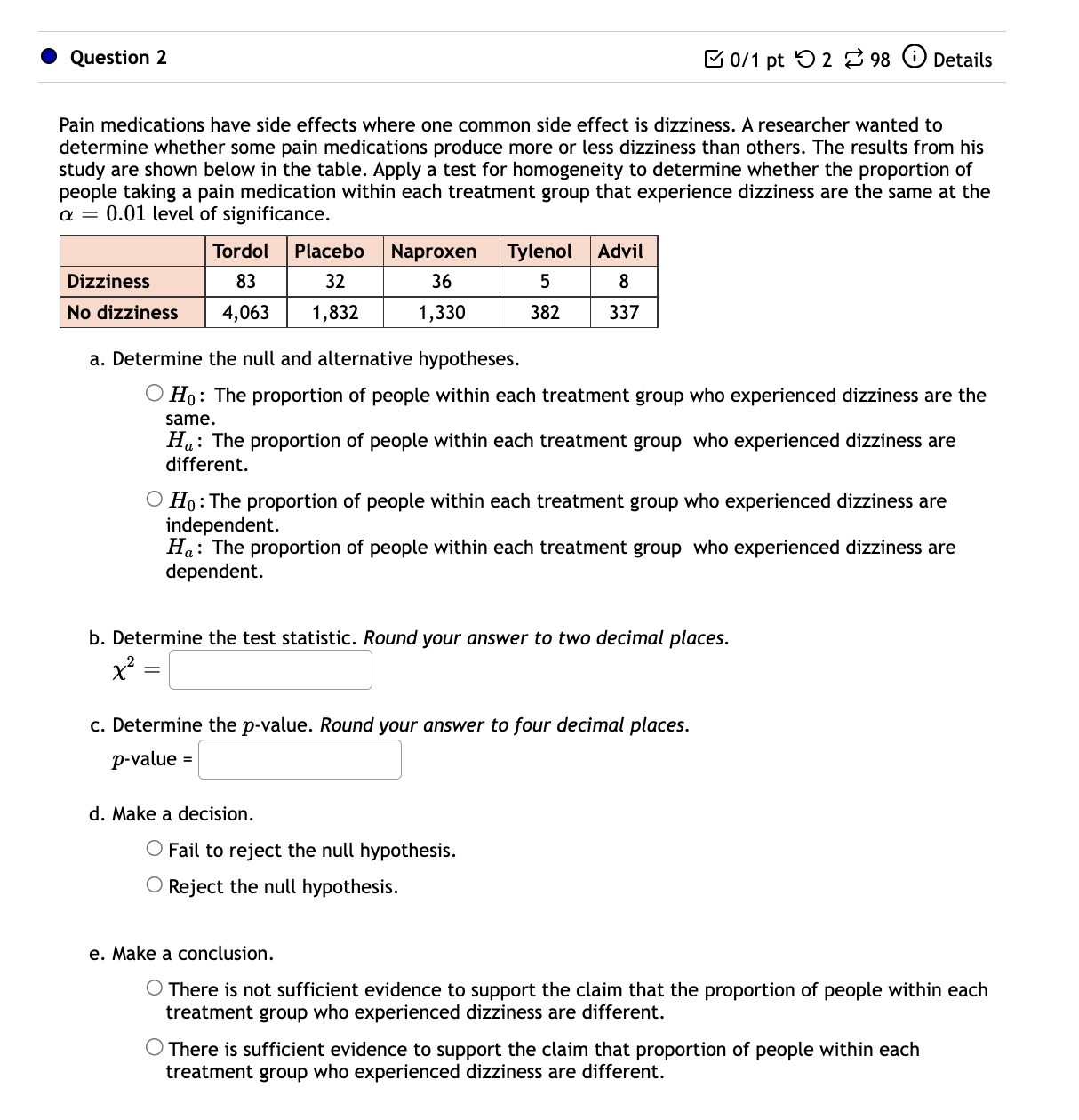
I Question 1 B 0!1 pt '0 2 8 98 0 Details A researcher wanted to determine which method would help smokers quit smoking. He divided a group of 183 smokers into three groups: Group 1 is given a patch, Group 2 is given oral medication, and Group 3 has no intervention. The results of the study are in the below table. Test the researcher's claim using a significance level of a = 0.05. Group 1 Did Not Quit 52 Quit 13 'Source: Harris Poll a. Determine the null and alternative hypotheses. O Ho : The methods for helping people quit smoking are independent. Ha: The methods for helping people quit smoking are dependent. O Ho: The methods for helping people quit smoking are the same. Ha: The methods for helping people quit smoking follow a different distribution. b. Determine the test statistic. Round your answer to two decimal places. 2 x =:] c. Determine the p-value. Round your answer to four decimal places. d. Make a decision. 0 Fail to reject the null hypothesis. 0 Reject the null hypothesis. e. Make a conclusion. 0 There is sufficient evidence to support the claim that the methods for helping people quit smoking are different. 0 There is not sufficient evidence to support the claim that the methods for helping people quit smoking are different. 0 Question 2 E on pt '0 2 8 98 G) Details Pain medications have side effects where one common side effect is dizziness. A researcher wanted to determine whether some pain medications produce more or less dizziness than others. The results from his study are shown below in the table. Apply a test for homogeneity to determine whether the proportion of people taking a pain medication within each treatment group that experience dizziness are the same at the a = 0.01 level of significance. Tordol Placebo Naproxen Dizziness 83 32 36 NO dizziness 4,063 1,832 1,330 382 337 a. Determine the null and alternative hypotheses. O H0: The proportion of people within each treatment group who experienced dizziness are the same. Ha: The proportion of people within each treatment group who experienced dizziness are different. O HO : The proportion of people within each treatment group who experienced dizziness are independent. Ha: The proportion of people within each treatment group who experienced dizziness are dependent. b. Determine the test statistic. Round your answer to two decimal places. c. Determine the p-value. Round your answer to four decimal places. d. Make a decision. 0 Fail to reject the null hypothesis. 0 Reject the null hypothesis. e. Make a conclusion. 0 There is not sufficient evidence to support the claim that the proportion of people within each treatment group who experienced dizziness are different. OThere is sufficient evidence to support the claim that proportion of people within each treatment group who experienced dizziness are different
Step by Step Solution
There are 3 Steps involved in it

Get step-by-step solutions from verified subject matter experts
 Study Help