







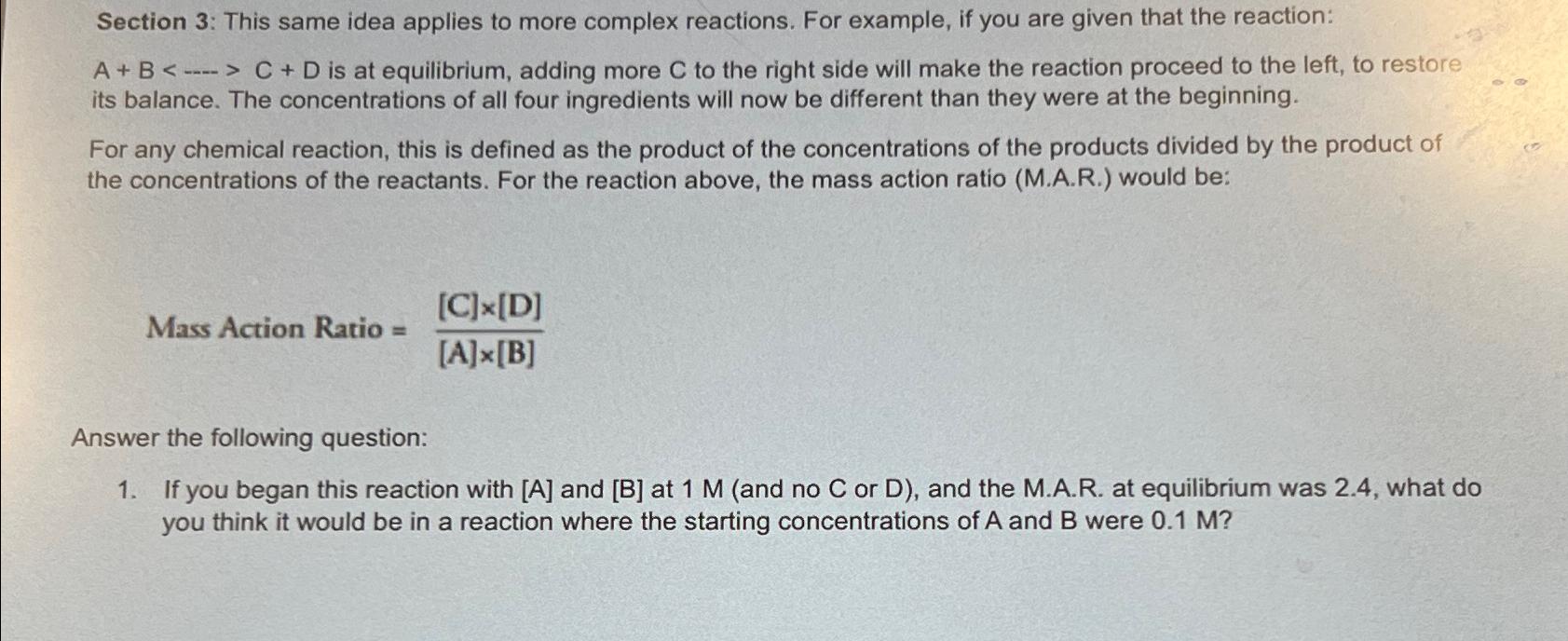
Question: Section 3 : This same idea applies to more complex reactions. For example, if you are given that the reaction: A + B C +
Section : This same idea applies to more complex reactions. For example, if you are given that the reaction:
is at equilibrium, adding more to the right side will make the reaction proceed to the left, to restore its balance. The concentrations of all four ingredients will now be different than they were at the beginning.
For any chemical reaction, this is defined as the product of the concentrations of the products divided by the product of the concentrations of the reactants. For the reaction above, the mass action ratio MAR would be:
Mass Action Ratio
Answer the following question:
If you began this reaction with A and at and no or and the MAR at equilibrium was what do you think it would be in a reaction where the starting concentrations of A and were
Step by Step Solution
There are 3 Steps involved in it
1 Expert Approved Answer
Step: 1 Unlock

Question Has Been Solved by an Expert!
Get step-by-step solutions from verified subject matter experts
Step: 2 Unlock
Step: 3 Unlock
 Study Help