





Question: Section (3): True or False Questions. (Justification is must) 1. Forecasting techniques generally assume an existing causal relation that will continue to exist in the
Section (3): True or False Questions.
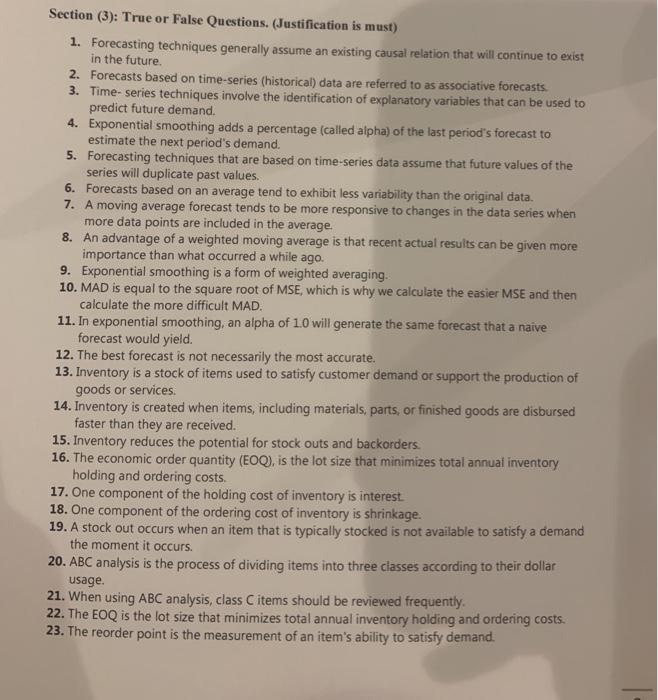
Section (3): True or False Questions. (Justification is must) 1. Forecasting techniques generally assume an existing causal relation that will continue to exist in the future. 2. Forecasts based on time series (historical) data are referred to as associative forecasts. 3. Time series techniques involve the identification of explanatory variables that can be used to predict future demand. 4. Exponential smoothing adds a percentage (called alpha) of the last period's forecast to estimate the next period's demand. 5. Forecasting techniques that are based on time-series data assume that future values of the series will duplicate past values. 6. Forecasts based on an average tend to exhibit less variability than the original data. 7. A moving average forecast tends to be more responsive to changes in the data series when more data points are included in the average. 8. An advantage of a weighted moving average is that recent actual results can be given more importance than what occurred a while ago. 9. Exponential smoothing is a form of weighted averaging. 10. MAD is equal to the square root of MSE, which is why we calculate the easier MSE and then calculate the more difficult MAD. 11. In exponential smoothing, an alpha of 1.0 will generate the same forecast that a naive forecast would yield. 12. The best forecast is not necessarily the most accurate. 13. Inventory is a stock of items used to satisfy customer demand or support the production of goods or services. 14. Inventory is created when items, including materials, parts, or finished goods are disbursed faster than they are received. 15. Inventory reduces the potential for stock outs and backorders. 16. The economic order quantity (EOQ), is the lot size that minimizes total annual inventory holding and ordering costs. 17. One component of the holding cost of inventory is interest 18. One component of the ordering cost of inventory is shrinkage. 19. A stock out occurs when an item that is typically stocked is not available to satisfy a demand the moment it occurs. 20. ABC analysis is the process of dividing items into three classes according to their dollar usage. 21. When using ABC analysis, class Citems should be reviewed frequently. 22. The EOQ is the lot size that minimizes total annual inventory holding and ordering costs. 23. The reorder point is the measurement of an item's ability to satisfy demand

Step by Step Solution

There are 3 Steps involved in it

1 Expert Approved Answer
Step: 1 Unlock blur-text-image

Question Has Been Solved by an Expert!

Get step-by-step solutions from verified subject matter experts

Step: 2 Unlock
Step: 3 Unlock

Students Have Also Explored These Related General Management Questions!