







Question: SECTION A [40 MARKS] Read the case study below and answer ALL the questions that follow. THREE MAJOR MISTAKES TIGER BRANDS MADE IN RESPONSE TO
![SECTION A [40 MARKS] Read the case study below and answer](https://dsd5zvtm8ll6.cloudfront.net/si.experts.images/questions/2024/10/671fd8b9ccf9a_345671fd8b94d011.jpg)
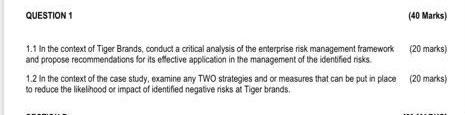
SECTION A [40 MARKS] Read the case study below and answer ALL the questions that follow. THREE MAJOR MISTAKES TIGER BRANDS MADE IN RESPONSE TO THE LISTERIOSIS CRISIS TIER BRANOS, the South Alican lood giant at the centre of the Isteriosis storm engulfing the country, is lacing serious brand erosion as a result of the way it handled the unfolding orisis. It could have responded better. Tiger Brands was thrown into the centre of the isteriosis stom ater South. Africa's National instituse for Communicable Diseases announced that its investigation had traced the origins of the disease to one of the company's biggust meat procussing plasta. The culpeh was identifed as polony from the Enterprise Foods facilty that produces a range of cold meats. Tiger Brands, a \$2.50 Johannesburg Stock Exchange listed business, owns Enterprise Foods among other continent wide popular food brands. South Africa has been struggling with the listeriosis outbreak for 14 months. Unable to find the source of the affected products, the outereak developed into the worst case of listeriosis in the world. By the end of February 2018, health authorities had conflimed 948 cases with 180 fatalities. The repercussion was aways going to be unforgiving. But Tiger Brands has not helped the sibation, it has overlocked several of the accepted protocols of handling a crisis of this nature. As a result, the company's brand equity is laking serious strain. Tiger Brands compromised its brand equity in three key aress. Response speed: An organisation's survival in a crisis, particularly when lives are at risk, depends encrmousty on the speed of its responses. Tiger Brands could hsve been more rapid in is responses. The source of the listeriosis outbreak was announced by South Africa's Heath Minister, Aaron Motscaledf, at midday on Sunday 4 March 2018. He announced that Tiger Brands had been issued with satesy recall nobices. But the company only held a medla briefing a day laser. Given that the minister would have given the company atvanced warning (even belore the official media briefing), its response was far too slow. Continued strategic engagement: Since the medla conference, the company has engaged in very limited meaninghu communicaton that would hive hebed it reclaim some brand equity. Organisations need to understand that in a crisis, they are compeling with every form of media - including social media - to tell their stary. If organisations dont heep engaging with stakeholders, others in the media fil the vacuim, it also leaves the door wide open for speculason and innuendo. The lack of engagement ineviably rases concerns about how transparent the company has been in handling this crisis. Compassion: in ts scant communication Tiger Brands taled to show compassion - an essental ingrodient for navigating a crisis of Bis magritude. Uniess the organisation acknowledges how its audience is feeling. Which Tiger Brands falied to do. any organisation in crisis is figting an uphil batte. The company's lack of compassion meant that the company came across as cold and unsympathetic. By showing compassion, an orgatisation creates a bond and puts audiences in a receptive stake, key components to any successtul communication. Tiger Brands will be remembered for trying to deny responsicity and refusing to apologise. This impression was created by litadvised comments made by the company's CEO Lawrence MacDougall when he was griled by journalists in one response be said: "There has been no direct correlation between our products and the deaths yet, so we ant unaware of any direct ink." The tact that the crisis had led to 180 deaths called for a dose of compassion, not a delensive response. What now for Tiger Brands? Tiger Brands wil have to embark on serious brand whab. To achieve that it wil have to be botily transparent in the management of the crisis, engage strategically with stakeholders and be mindtul of the tone of iss engagement. The company wilt have to become more visible and must be seen to be a critical part of solutions. But r s also important to point out that the listeriosis crisis goes beyond Tiger Brands. It iser just a crisis for the company. The oultoreak has had a major impact on food oufets - big and small - in the county. It has also alfected companies and consumers beyond South Africa's borders, so much so that the crisis could do long lasting damage to the country's cold meats industry. Al stakeholders related to the listeriosis crisis, including the South African govemment, the National Insitute for Communicable Diseases and the processed meat industry, should step away from trying to face the crisis on thri- They should also stop tying to shift responsibilfy. Instaad, they should think of working together. This calls for different approach to brand rehab after a crisis. II cals for a systems approach that envisages all the altected understanding that they are intertonnected. In a cooperative, integrated system like this the equity of the one: brand is linked with the equity of other brands and instictions in the system. QUESTION 1 (40 Marks) 1.1 in the context of Tiger Brands, conduct a critical analysis of the enterprise risk management framework (20 marks) and propose recommendations for its etlective application in the management of the identified risks. 1.2 in the context of the case study, examine any TWO strategies and or measures that can be put in place (20 marks) to reduce the likelihood or impact of identified negative risks at Tiger brands
Step by Step Solution
There are 3 Steps involved in it

Get step-by-step solutions from verified subject matter experts
 Study Help