







Question: SECTION A ANSWER THIS QUESTION The brewing industry across Europe had developed from a long tradition of brewing across most of Europe. Indeed, in aggregate,
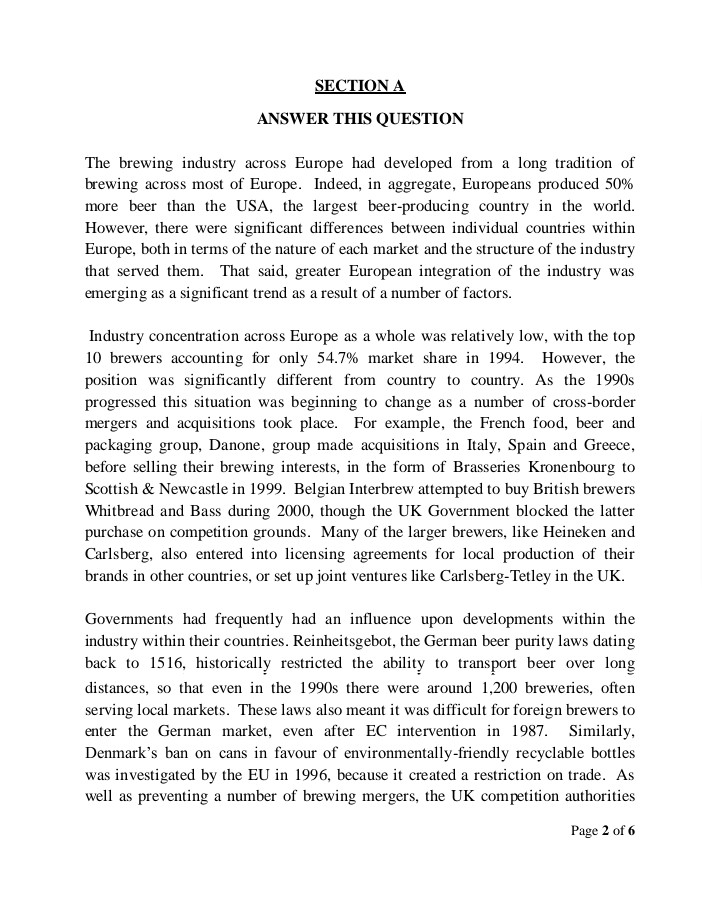
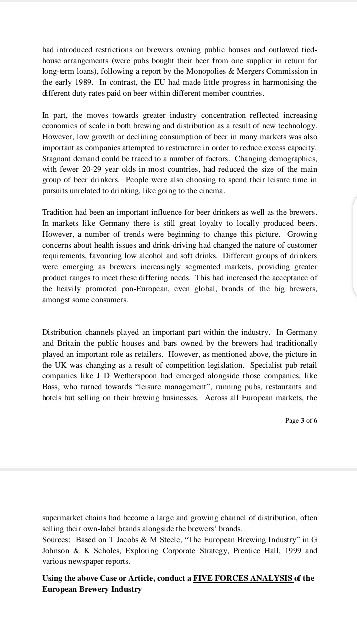
SECTION A ANSWER THIS QUESTION The brewing industry across Europe had developed from a long tradition of brewing across most of Europe. Indeed, in aggregate, Europeans produced 50% more beer than the USA, the largest beer-producing country in the world. However, there were significant differences between individual countries within Europe, both in terms of the nature of each market and the structure of the industry that served them. That said, greater Europe an integration of the industry was emerging as a significant trend as a result of a number of factors. Industry concentration across Europe as a whole was relatively low, with the top 10 brewers accounting for only 54.7% market share in 1994. However, the position was significantly different from country to country. As the 1990s progressed this situation was beginning to change as a number of cross-border mergers and acquisitions took place. For example, the French food, beer and packaging group, Danone, group made acquisitions in Italy, Spain and Greece, before selling their brewing interests, in the form of Brasseries Kronenbourg to Scottish & Newcastle in 1999. Belgian Interbrew attempted to buy British brewers Whitbread and Bass during 2000, though the UK Government blocked the latter purchase on competition grounds. Many of the larger brewers, like Heineken and Carlsberg, also entered into licensing agreements for local production of their brands in other countries, or set up joint ventures like Carlsberg-Tetley in the UK. Governments had frequently had an influence upon developments within the industry within their countries. Reinheitsgebot, the German beer purity laws dating back to 1516, historically restricted the ability to transport beer over long distances, so that even in the 1990s there were around 1,200 breweries, often serving local markets. These laws also meant it was difficult for foreign brewers to enter the German market, even after EC intervention in 1987. Similarly, Denmark's ban on cans in favour of environmentally-friendly recyclable bottles was investigated by the EU in 1996, because it created a restriction on trade. As well as preventing a number of brewing mergers, the UK competition authorities Page 2 of 6 had introduced resunctions alles wainghia hames and caraclit hamarra nga Cremas pirtier her from anle applia ill return far bony term loans). Following a report by the Monopolies & Mergers Commission in the early 1989. In contrast, the l'hai made little progress in harmonising the Eferent duty rates puid on beer within different member countries. In part, the moves liwack greater Industry concentration rellected increasing ceanamics of scale in the wing and district as a result of technology Hauser,kaw pawhar declining consumption oclo il many markera was also imparas companies artem cores marcin order to retas execs capacity Stagitant med mld be at 102 mmler af factors. Changing sages, with fewer 201-29 year olds in most countries, had reduced the size of the main goles dunkers Haple wciela chasing a pod their care nici pris located to drinking like gang to the cama. Tradition has been an important iniluence for beer irinkers as well as the brewers. In markets like Germany there is still great lovelty to locally produced beers. Ilowever, a number of trends were beginning to change this picture. Growing concerns about health issues and drink driving lai changed the nature of customer requirements taxoming or alcol and soft drinks irrere af drinkers were emerging : locis cicas nely mental markets, onde greater product ranges face these differing nexis This had increased the exams ar the leasily pramcalanEncapsul. global, and the highrewers, langs same canner Distribution channels played an important part within the industry. In Germany ani Britain the public houses and bar owned by the brewers hi traditionally played an important role as retailers. Ilowever, as mentioned above, the picture in the UK was changing as a result of competition legislation. Specialist pub relail comparties like I 1) Werterhad act alongside these complices like Hass, whanury twards are manager", numing Nha, restaurants and ad mit selling on their hewing sitesses Across all markets. The Pakej oro mpmarket chat had bezsame a large and prawie chain of distribution, often Balling their wn-lahal brands langs de the newers' land. Sources: Based on 1 Jacsaha & Stes, "The Lureau Brewing Industry in di bahison & K Schales, Exploring Canne Starczy, Pentice Hall, 1999 2nd various newspaper reports. Using the above Case or ride, caduct a FIVE FORCES INILYSIS be European Brewery Industry
Step by Step Solution
There are 3 Steps involved in it
1 Expert Approved Answer
Step: 1 Unlock

Question Has Been Solved by an Expert!
Get step-by-step solutions from verified subject matter experts
Step: 2 Unlock
Step: 3 Unlock
 Study Help