Question: Section A is a case study for 30 Marks. Read it carefully and respond to all the questions that follow. SECTION A 30 MARKS ANSWER
Section A is a case study for 30 Marks. Read it carefully and respond to all the questions that follow.
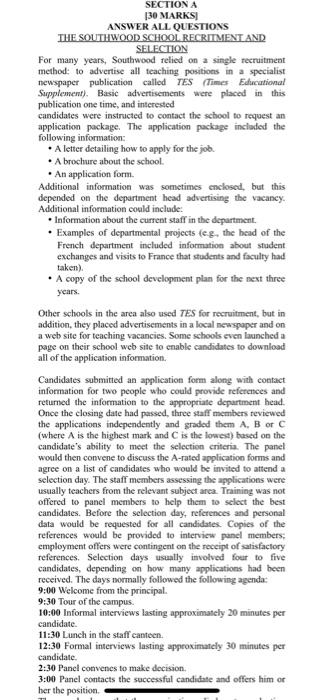
SECTION A 30 MARKS ANSWER ALL QUESTIONS THE SOUTHWOOD SCHOOL RECRITMENT AND SELECTION For many years, Southwood relied on a single recruitment method to advertise all teaching positions in a specialist newspaper publication called TES (Times Educational Supplement). Basic advertisements were placed in this publication one time, and interested candidates were instructed to contact the school to request an application package. The application package included the following information: A letter detailing how to apply for the job A brochure about the school. An application form. Additional information was sometimes enclosed, but this depended on the department head advertising the vacancy. Additional information could include: Information about the current staff in the department, Examples of departmental projects (eg, the head of the French department included information about student exchanges and visits to France that students and faculty had taken) A copy of the school development plan for the next three years. Other schools in the area also used TES for recruitment, but in addition, they placed advertisements in a local newspaper and on a web site for teaching vacancies. Some schools even launched a page on their school web site to enable candidates to download all of the application information Candidates submitted an application form along with contact information for two people who could provide references and returned the information to the appropriate department head. Once the closing date had passed three staff members reviewed the applications independently and graded them A, B or C (where A is the highest mark and C is the lowest) based on the candidate's ability to meet the selection criteria. The panel would then convene to discuss the A-rated application forms and agree on a list of candidates who would be invited to attend a selection day. The staff members assessing the applications were usually teachers from the relevant subject arca. Training was not offered to panel members to help them to select the best candidates. Before the selection day, references and personal data would be requested for all candidates. Copies of the references would be provided to interview panel members, employment offers were contingent on the receipt of satisfactory references. Selection days usually involved four to five candidates, depending on how many applications had been received. The days normally followed the following agenda: 9:00 Welcome from the principal 9:30 Tour of the campus 10:00 Informal interviews lasting approximately 20 minutes per candidate 11:30 Lunch in the staff canteen 12:30 Formal interviews lasting approximately 30 minutes per candidate 2:30 Panel convenes to make decision 3:00 Panel contacts the successful candidate and offers him or her the position The agenda shows that the organization relied on two selection methods for all of their teaching vacancies an informal and formal interview. The first (informal) interview was led by the principal and an administrator, this was used to learn basic information about the candidate and to review the information on the application form. The second interview was more detailed and explored a wide range of issues with the candidates. The panel consisted of the following staff members. Principal HR manager Department head Senior teacher Due to time constraints, panel members were usually unable to meet in advance, so they developed their interview questions independently. Although the principal chaired the interviews, they were rarely carried out in the same manner and there was not a high level of consistency with the questions. No formal scoring system was used. At the end of the interviews, there was a panel vote to see which candidate should be offered the job. This often led to a heated debate about candidate strengths and weaknesses. Candidates usually remained at the school until a decision was reached so they could be informed personally of the outcome. If they were unable to wait for the outcome, they were phoned later that day with the decision. Unsuccessful candidates received some brief verbal feedback but were not asked for comments on their interview experience. Unsuccessful candidates would sometimes contact the school and ask for further written feedback: this was usually provided by the principal a. With evidence from the passage, explain two of the three goals of recruitment. (6 marks) b. What source of recruitment did Southwood adopt? (2 mark) c. Mention and explain one advantage and disadvantage each of the source of recruitment in question 2. (4 marks) d. Apart from interview, mention two other methods of selection Southwood used to get its candidates. (2 marks) e. Using evidence from the passage mention and explain two types of interviews the school used. (6 marks) f. Is the use of interview appropriate for the selection of the teachers Southwood needs? If yes, why? If no why, and suggest an appropriate method of selection (5 marks) g. Mention two deficiencies that can be identified with Southwood's recruitment and selection and explain their detrimental effects for the organization. (5 marks) SECTION A 30 MARKS ANSWER ALL QUESTIONS THE SOUTHWOOD SCHOOL RECRITMENT AND SELECTION For many years, Southwood relied on a single recruitment method to advertise all teaching positions in a specialist newspaper publication called TES (Times Educational Supplement). Basic advertisements were placed in this publication one time, and interested candidates were instructed to contact the school to request an application package. The application package included the following information: A letter detailing how to apply for the job A brochure about the school. An application form. Additional information was sometimes enclosed, but this depended on the department head advertising the vacancy. Additional information could include: Information about the current staff in the department, Examples of departmental projects (eg, the head of the French department included information about student exchanges and visits to France that students and faculty had taken) A copy of the school development plan for the next three years. Other schools in the area also used TES for recruitment, but in addition, they placed advertisements in a local newspaper and on a web site for teaching vacancies. Some schools even launched a page on their school web site to enable candidates to download all of the application information Candidates submitted an application form along with contact information for two people who could provide references and returned the information to the appropriate department head. Once the closing date had passed three staff members reviewed the applications independently and graded them A, B or C (where A is the highest mark and C is the lowest) based on the candidate's ability to meet the selection criteria. The panel would then convene to discuss the A-rated application forms and agree on a list of candidates who would be invited to attend a selection day. The staff members assessing the applications were usually teachers from the relevant subject arca. Training was not offered to panel members to help them to select the best candidates. Before the selection day, references and personal data would be requested for all candidates. Copies of the references would be provided to interview panel members, employment offers were contingent on the receipt of satisfactory references. Selection days usually involved four to five candidates, depending on how many applications had been received. The days normally followed the following agenda: 9:00 Welcome from the principal 9:30 Tour of the campus 10:00 Informal interviews lasting approximately 20 minutes per candidate 11:30 Lunch in the staff canteen 12:30 Formal interviews lasting approximately 30 minutes per candidate 2:30 Panel convenes to make decision 3:00 Panel contacts the successful candidate and offers him or her the position The agenda shows that the organization relied on two selection methods for all of their teaching vacancies an informal and formal interview. The first (informal) interview was led by the principal and an administrator, this was used to learn basic information about the candidate and to review the information on the application form. The second interview was more detailed and explored a wide range of issues with the candidates. The panel consisted of the following staff members. Principal HR manager Department head Senior teacher Due to time constraints, panel members were usually unable to meet in advance, so they developed their interview questions independently. Although the principal chaired the interviews, they were rarely carried out in the same manner and there was not a high level of consistency with the questions. No formal scoring system was used. At the end of the interviews, there was a panel vote to see which candidate should be offered the job. This often led to a heated debate about candidate strengths and weaknesses. Candidates usually remained at the school until a decision was reached so they could be informed personally of the outcome. If they were unable to wait for the outcome, they were phoned later that day with the decision. Unsuccessful candidates received some brief verbal feedback but were not asked for comments on their interview experience. Unsuccessful candidates would sometimes contact the school and ask for further written feedback: this was usually provided by the principal a. With evidence from the passage, explain two of the three goals of recruitment. (6 marks) b. What source of recruitment did Southwood adopt? (2 mark) c. Mention and explain one advantage and disadvantage each of the source of recruitment in question 2. (4 marks) d. Apart from interview, mention two other methods of selection Southwood used to get its candidates. (2 marks) e. Using evidence from the passage mention and explain two types of interviews the school used. (6 marks) f. Is the use of interview appropriate for the selection of the teachers Southwood needs? If yes, why? If no why, and suggest an appropriate method of selection (5 marks) g. Mention two deficiencies that can be identified with Southwood's recruitment and selection and explain their detrimental effects for the organization









 Study Help