





Question: SECTION A QUESTION 1 a) What do you understand about Information Gain? [2] b) Distinguish between Gini impurity and Entropy [6] You are in the
SECTION A QUESTION 1 a) What do you understandSECTION A QUESTION 1 a) What do you understandSECTION A QUESTION 1 a) What do you understand
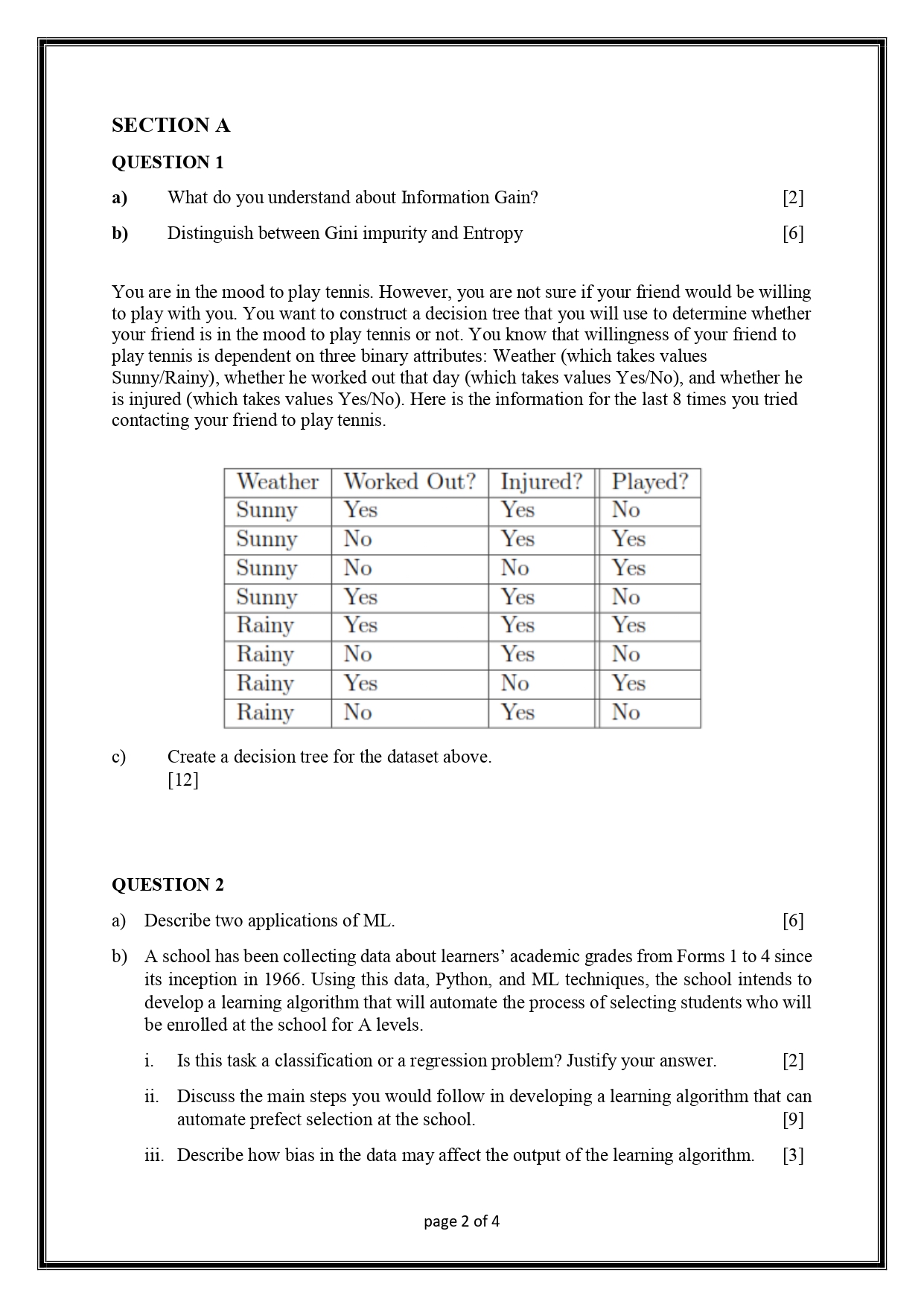
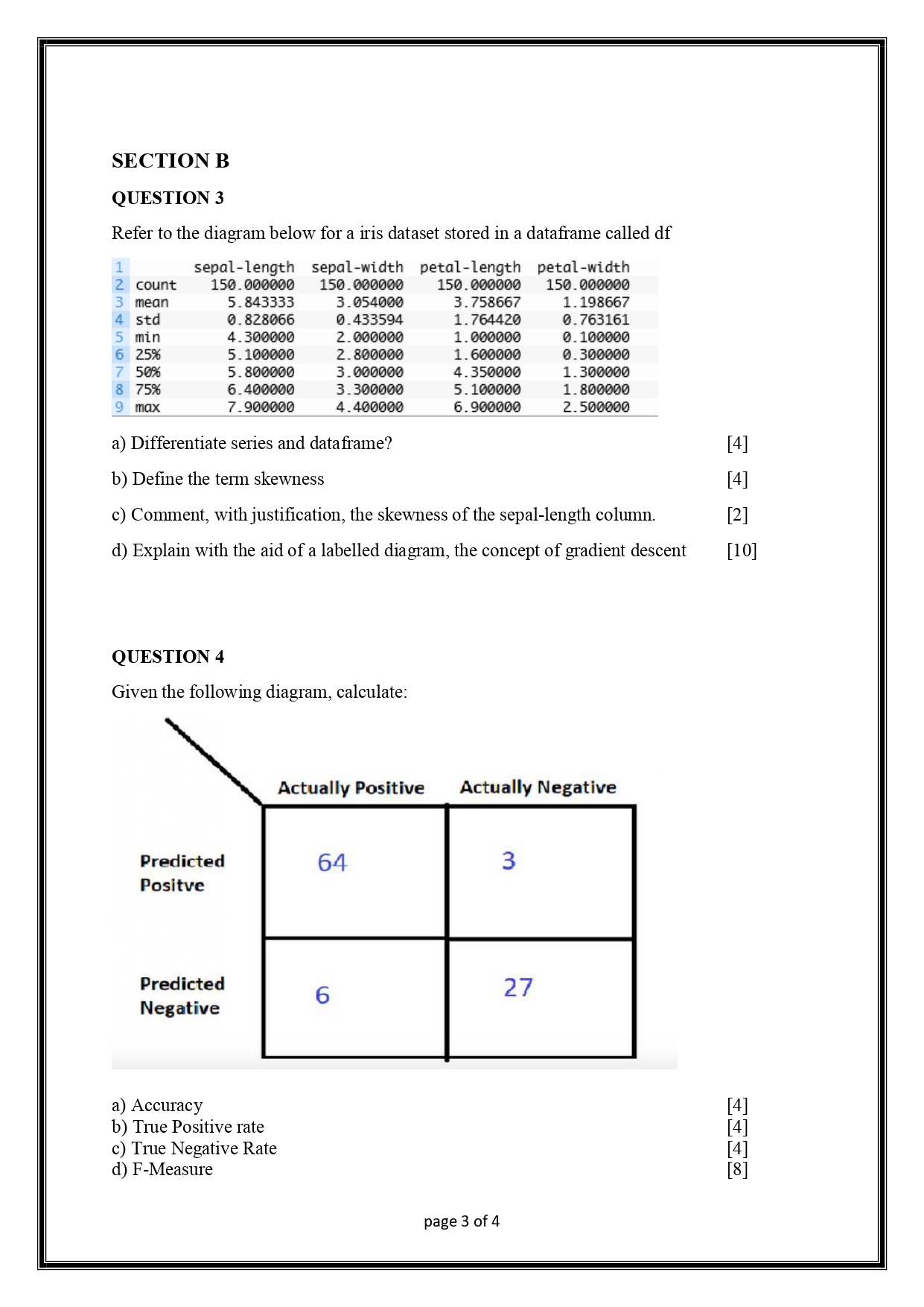
SECTION A QUESTION 1 a) What do you understand about Information Gain? [2] b) Distinguish between Gini impurity and Entropy [6] You are in the mood to play tennis. However, you are not sure if your friend would be willing to play with you. You want to construct a decision tree that you will use to determine whether your friend is in the mood to play tennis or not. You know that willingness of your friend to play tennis is dependent on three binary attributes: Weather (which takes values Sunny/Rainy), whether he worked out that day (which takes values Yes/No), and whether he is injured (which takes values Yes/No). Here is the information for the last 8 times you tried contacting your friend to play tennis. Weather | Worked Out? | Injured? || Played? Sunny Yes Yes | No Sunny Yes | Yes Sunny I No Yes Sunny Yes Yes No Rainy Yes Yes | Yes Rainy No Yes | No Rainy Yes No Yes Rainy No Yes | No c) Create a decision tree for the dataset above. [12] QUESTION 2 a) Describe two applications of ML. [6] b) A school has been collecting data about learners' academic grades from Forms | to 4 since its inception in 1966. Using this data, Python, and ML techniques, the school intends to develop a learning algorithm that will automate the process of selecting students who will be enrolled at the school for A levels. 1. Is this task a classification or a regression problem? Justify your answer. [2] il. Discuss the main steps you would follow in developing a learning algorithm that can automate prefect selection at the school. ili. Describe how bias in the data may affect the output of the learning algorithm. page 2 of 4 SECTION B QUESTION 3 Refer to the diagram below for a iris dataset stored in a dataframe called df sepal-length sepal-width petal-length petal-width count 150.000000 150. 000000 150. 000000 150. 000000 mean 5. 843333 3.054000 3. 758667 1. 198667 4 std 0. 828066 0. 433594 1. 764420 0. 763161 min 4.300000 2. 000000 1. 000000 0. 100000 25% 5.100000 2. 800000 1. 600000 0. 300000 50% 5.800000 3. 000000 4.350000 1. 300000 8 6. 400000 3.300000 5. 100000 1. 800000 max 7.900000 4.400000 6. 900000 2. 500000 a) Differentiate series and dataframe? [4] b) Define the term skewness [4] c) Comment, with justification, the skewness of the sepal-length column. [2] d) Explain with the aid of a labelled diagram, the concept of gradient descent [10] QUESTION 4 Given the following diagram, calculate: Actually Positive Actually Negative Predicted 64 3 Positve Predicted 6 27 Negative a) Accuracy b) True Positive rate c) True Negative Rate d) F-Measure page 3 of 4QUESTION 5 a) What is data cleaning [2] b) Explain why it is important to clean data before using it for training a model [4] c) Draw a fully connected and labeled Neural Network diagram with the following specifications: e 3 Inputs 3 Hidden Layers * 2 outputs [8] d) Write Python code that encodes the Color column in the left pane so that it appears as shown in the right pane. [6] QUESTION 6 Describe the use of the following Python libraries in Machine learning: a) Pandas b) Numpy c) Matplotlib d) Sklearn ===== END OF PAPER === page 4 of 4
Step by Step Solution

There are 3 Steps involved in it

1 Expert Approved Answer
Step: 1 Unlock blur-text-image

Question Has Been Solved by an Expert!

Get step-by-step solutions from verified subject matter experts

Step: 2 Unlock
Step: 3 Unlock

Students Have Also Explored These Related Accounting Questions!