





Question: SECTION A Read the extract below and answer the questions that follow. (40) Haddock populations on Georges Bank fluctuated about relatively stable levels between 1930
SECTION A Read the extract below and answer the
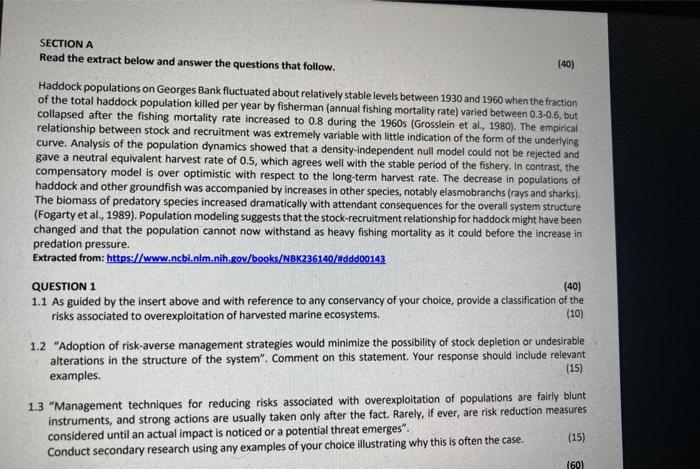
SECTION A Read the extract below and answer the questions that follow. (40) Haddock populations on Georges Bank fluctuated about relatively stable levels between 1930 and 1960 when the fraction of the total haddock population killed per year by fisherman (annual fishing mortality rate) varied between 0.3-0.6, but collapsed after the fishing mortality rate increased to 0.8 during the 1960s (Grosslein et al., 1980). The empirical relationship between stock and recruitment was extremely variable with little indication of the form of the underlying curve. Analysis of the population dynamics showed that a density-independent null model could not be rejected and gave a neutral equivalent harvest rate of 0.5, which agrees well with the stable period of the fishery. In contrast, the compensatory model is over optimistic with respect to the long-term harvest rate. The decrease in populations of haddock and other groundfish was accompanied by increases in other species, notably elasmobranchs (rays and sharks). The biomass of predatory species increased dramatically with attendant consequences for the overall system structure (Fogarty et al., 1989). Population modeling suggests that the stock-recruitment relationship for haddock might have been changed and that the population cannot now withstand as heavy fishing mortality as it could before the increase in predation pressure. Extracted from: https://www.ncbi.nlm.nih.gov/books/NBK236140/#ddd00143 QUESTION 1 (40) 1.1 As guided by the insert above and with reference to any conservancy of your choice, provide a classification of the risks associated to overexploitation of harvested marine ecosystems. (10) 1.2 "Adoption of risk-averse management strategies would minimize the possibility of stock depletion or undesirable alterations in the structure of the system". Comment on this statement. Your response should include relevant examples. (15) 1.3 "Management techniques for reducing risks associated with overexploitation of populations are fairly blunt instruments, and strong actions are usually taken only after the fact. Rarely, if ever, are risk reduction measures considered until an actual impact is noticed or a potential threat emerges". Conduct secondary research using any examples of your choice illustrating why this is often the case. (15) 1601

Step by Step Solution

There are 3 Steps involved in it

1 Expert Approved Answer
Step: 1 Unlock blur-text-image

Question Has Been Solved by an Expert!

Get step-by-step solutions from verified subject matter experts

Step: 2 Unlock
Step: 3 Unlock

Students Have Also Explored These Related General Management Questions!