







Question: Section B (25 marks) 1. Question a-j: Select (A) for Debit and (B) for Credit Under a double-entry system, show how the entry in
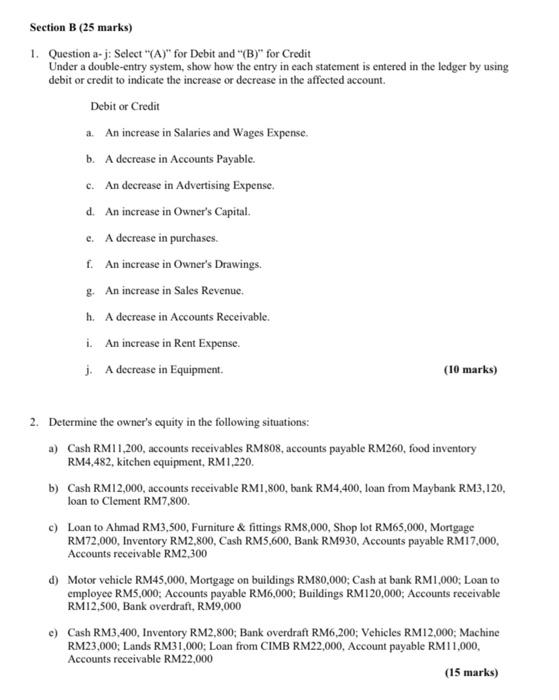
Section B (25 marks) 1. Question a-j: Select "(A)" for Debit and "(B)" for Credit Under a double-entry system, show how the entry in each statement is entered in the ledger by using debit or credit to indicate the increase or decrease in the affected account. Debit or Credit a. An increase in Salaries and Wages Expense. b. A decrease in Accounts Payable. c. An decrease in Advertising Expense. d. An increase in Owner's Capital. e. A decrease in purchases. f. An increase in Owner's Drawings. g. An increase in Sales Revenue. h. A decrease in Accounts Receivable. i. An increase in Rent Expense. j. A decrease in Equipment. (10 marks) 2. Determine the owner's equity in the following situations: a) Cash RM11,200, accounts receivables RM808, accounts payable RM260, food inventory RM4,482, kitchen equipment, RM1,220. b) Cash RM12,000, accounts receivable RM1,800, bank RM4,400, loan from Maybank RM3,120, loan to Clement RM7,800. c) Loan to Ahmad RM3,500, Furniture & fittings RM8,000, Shop lot RM65,000, Mortgage RM72,000, Inventory RM2,800, Cash RM5,600, Bank RM930, Accounts payable RM17,000, Accounts receivable RM2,300 d) Motor vehicle RM45,000, Mortgage on buildings RM80,000; Cash at bank RM1,000; Loan to employee RM5,000; Accounts payable RM6,000; Buildings RM120,000; Accounts receivable RM12,500, Bank overdraft, RM9,000 e) Cash RM3,400, Inventory RM2,800; Bank overdraft RM6,200; Vehicles RM12,000; Machine RM23,000; Lands RM31,000; Loan from CIMB RM22,000, Account payable RM11,000, Accounts receivable RM22,000 (15 marks)
Step by Step Solution
There are 3 Steps involved in it

Get step-by-step solutions from verified subject matter experts
 Study Help