







Question: Section B (answer ALL the questions from this section) Q3. (a) Compare in details, the merits and limitations of providing dynamic and static smoke control
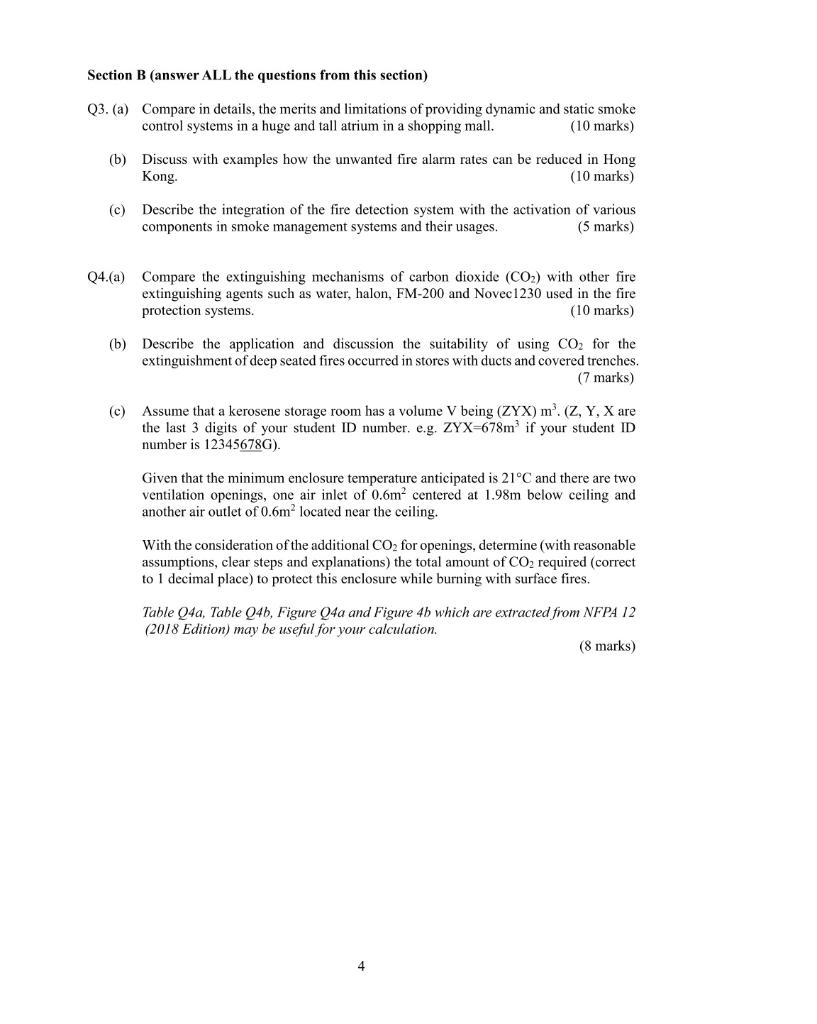
Section B (answer ALL the questions from this section) Q3. (a) Compare in details, the merits and limitations of providing dynamic and static smoke control systems in a huge and tall atrium in a shopping mall. (10 marks) (b) Discuss with examples how the unwanted fire alarm rates can be reduced in Hong Kong. (10 marks) (c) Describe the integration of the fire detection system with the activation of various components in smoke management systems and their usages. (5 marks) Q4.(a) Compare the extinguishing mechanisms of carbon dioxide (CO2) with other fire extinguishing agents such as water, halon, FM-200 and Novec 1230 used in the fire protection systems. (10 marks) (b) Describe the application and discussion the suitability of using CO2 for the extinguishment of deep seated fires occurred in stores with ducts and covered trenches. (7 marks) (c) Assume that a kerosene storage room has a volume V being (ZYX)m3.(Z,Y,X are the last 3 digits of your student ID number, e.g. ZYX=678m3 if your student ID number is 12345678G ). Given that the minimum enclosure temperature anticipated is 21C and there are two ventilation openings, one air inlet of 0.6m2 centered at 1.98m below ceiling and another air outlet of 0.6m2 located near the ceiling. With the consideration of the additional CO2 for openings, determine (with reasonable assumptions, clear steps and explanations) the total amount of CO2 required (correct to 1 decimal place) to protect this enclosure while burning with surface fires. Table Q4a, Table Q4b, Figure Q4a and Figure 4b which are extracted from NFPA 12 (2018 Edition) may be useful for your calculation. (8 marks)
Step by Step Solution
There are 3 Steps involved in it

Get step-by-step solutions from verified subject matter experts
 Study Help