







Question: Section B: Solution to Heat Conduction Problem Consider a long, thin bar of constant cross - section made of a bomogeneons heat - conducting material
Section B: Solution to Heat Conduction Problem
Consider a long, thin bar of constant crosssection made of a bomogeneons heatconducting material
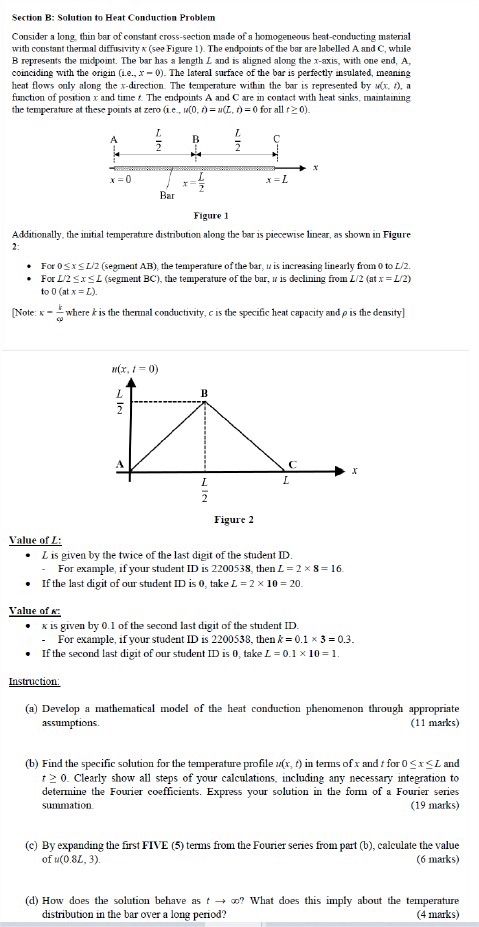
with constant thermal diffusivity see Figure The endpoints of the bar are labelled A and while
B represents the midpoint. The bar has a length and is aligned along the axis, with one end, A
coinciding with the origin ie The lateral surface of the bar is perfectly insulated, meaning
heat flows only along the direction. The temperature within the bar is represented by a
function of position and time The endpoints A and C are in contact with heat sinks maintaining
the temperature at these points at zero ie for all
Additionally, the initial temperature distribution along the bar is piecewise linear, as shown in Figure
:
For segment the temperature of the bar, is increasing linearly from to
For segment the temperature of the bar, in is declining from at
to at
Note: where is the thermal conductivity, is the specific heat capacity and is the density
Value of :
is given by the twice of the last digit of the student ID
For example, if your student ID is then
If the last digit of our student ID is take
Value of :
given by of the second last digit of the student ID
For example, if your student ID is then
If the second last digit of our student ID is take
Instruction:
a Develop a mathematical model of the heat conduction phenomenon through appropriate
assumptions.
marks
b Find the specific solution for the temperature profile in temms of and for and
Clearly show all steps of your calculations, including any necessary integration to
determine the Fourier coefficients. Express your solution in the form of a Fourier series
summation.
matks
c By expanding the first FIVE terms from the Fourier series from part b calculate the value
of
d How does the solution behave as What does this imply about the temperature
distribution in the bar over a long period?
marks
Step by Step Solution
There are 3 Steps involved in it
1 Expert Approved Answer
Step: 1 Unlock

Question Has Been Solved by an Expert!
Get step-by-step solutions from verified subject matter experts
Step: 2 Unlock
Step: 3 Unlock
 Study Help