







Question: Security: High Tech , Return, r^: 9.9%, Risk (Beta): 1.31 Security: Market, Return: 8.0, Beta: 1.00 Security: U.S.Rubber, Return: 7.3, Beta: 0.88 T-bill's: REturn: 3.0,
Security: High Tech , Return, r^: 9.9%, Risk (Beta): 1.31
Security: Market, Return: 8.0, Beta: 1.00
Security: U.S.Rubber, Return: 7.3, Beta: 0.88
T-bill's: REturn: 3.0, Beta: 0.00
Collection's: Return: 1.2, Beta: (0.50)
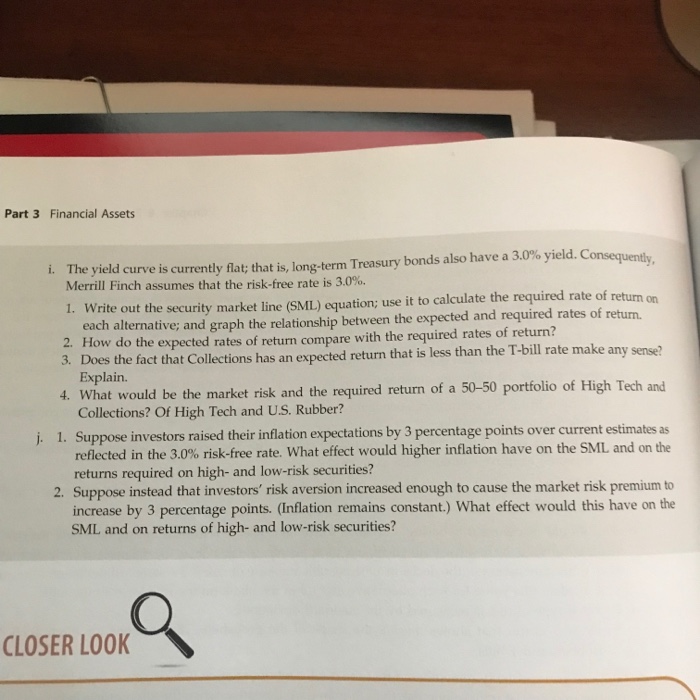
Part 3 Financial Assets The yield curve is currently flat; that is long-term Treasury bonds also have a 30% yield. Consequently Merrill Finch assumes that the risk-free rate is 3.0% i. 1. Write out the security market line (SML) equation; use it to calculate the required rate of return on each alternative; and graph the relationship between the expected and required rates of return. 2. How do the expected rates of return compare with the required rates of return? 3. Does the fact that Collections has an expected return that is less than the T-bill rate make an y sense? 4. What would be the market risk and the required return of a 50-50 portfolio of High Tech and j. 1. Suppose investors raised their inflation expectations by 3 percentage points over current estimates as 2. Suppose instead that investors' risk aversion increased enough to cause the market risk premium to Explain. Collections? Of High Tech and U.S. Rubber? reflected in the 3.0% risk-free rate. What effect would higher inflation have on the SML and on the returns required on high-and low-risk securities? increase by 3 percentage points. (Inflation remains constant.) What effect would this have on the SML and on returns of high- and low-risk securities? CLOSER LOOK
Step by Step Solution
There are 3 Steps involved in it

Get step-by-step solutions from verified subject matter experts
 Study Help