







Question: See the attached article. Please use in-text citations and references in APA format 7th edition. Please do list bullet points as your answer. Think thoughtfully
See the attached article. Please use in-text citations and references in APA format 7th edition. Please do list bullet points as your answer. Think thoughtfully when responding to questions please.
 Compose a short report of at least 250 words to include the following elements:
-
List possible risk reduction strategies aimed at preventing wrong-site surgeries.
-
What are the two strategies you will recommend to prevent a similar event from occurring at the hospital and why?
-
How could healthcare organizations improve patient satisfaction?
-
What is the one strategy you will NOT recommend for prevention of a similar event at the hospital and why?
Please use in-text citations and references in APA format 7th edition. Please do list bullet points as your answer. Think thoughtfully when responding to questions please.
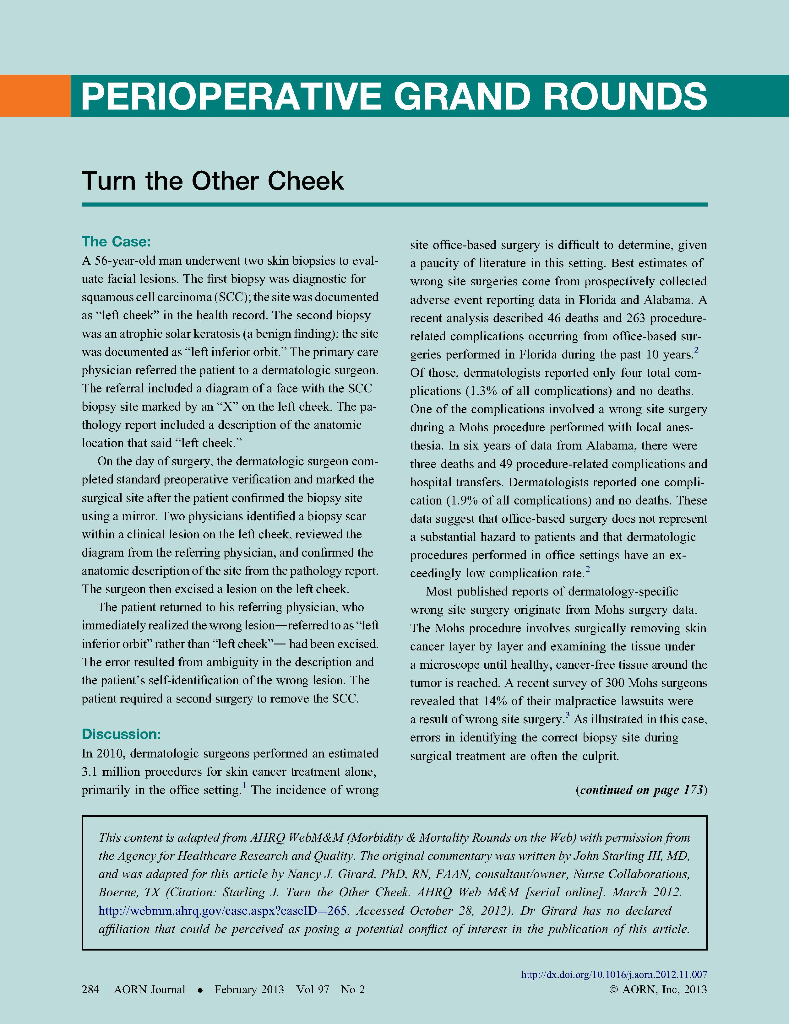
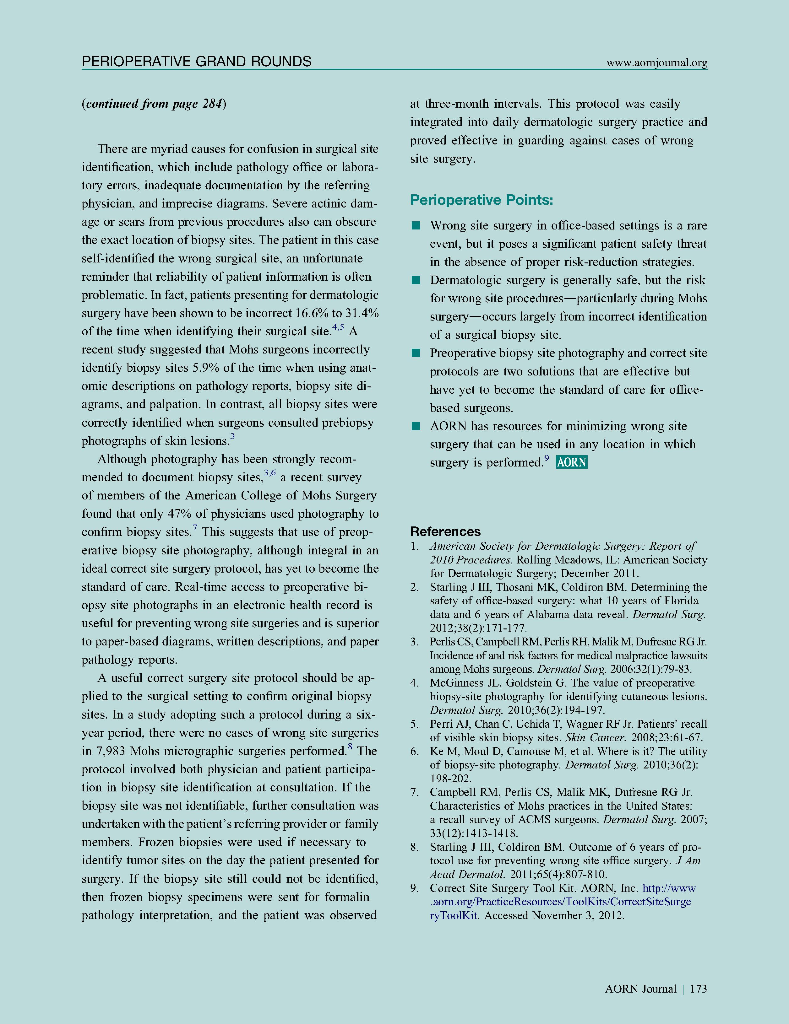
PERIOPERATIVE GRAND ROUNDS Turn the Other Cheek The Case: A 56-year-old man underwenllwo skin biopsies lo eval- ulate facial lesions. The first biopsy was diagnostic for squamous cell carcinoma (SCC); the site was documented as "lef cheek" in the health record. The second biopsy was an atrophic solar keratosis (a benign finding): the site was documented as left inferior orhit." The primary care physician referred the patient to a dermatologic surgeon. The referral included a diagram of a face with the SCO biopsy sile marked by an "X" on the lell cheek. The pa- thology report included a description of the anatomic location that said "left cheek." On the day of surgery, the dermatolog surgeon pleted standard preoperative verification and marked the surgical site after the patient confirmed the biopsy site using a mirror. I'wo physicians identified a biopsy scar within a clinical lesion on the let) cheek, reviewed the Jiagram from the relerring physician, and confirmed the anatomic description of the site from the pathology report. The surgeon then excised a lesion on the left cheek. The patient returned to his referring physician, who immediately realized the wrong lesion-referred to as 'leti inferior orbit" rather than "left cheek" had been excised. The error resulted from ambiguity in the description and the patient's self-identification of the wrong lesion. The patient required a second surgery lo remove the SCC. site office-based surgery is difficult to determine, given a paucity of literature in this setting. Best estimates of wrong site surgeries come from prospectively collected adverse event reporting data in Florida and Alabama. A recent analysis described 46 deaths and 263 procedure- related complications ciecurring from office-lased sur- geries performed in Florida during the past 10 years? of those, dentatologists reported only four lolal com- plications (1.3% of all complications) and no deaths. One of the complications involved a wrong site surgery during a Mohs procedure performed with local anes- thesia. In six years of data from Alabama, there were three deaths and 49 procedure-related complications and hospital transfers. Dermatologists reported one compli- cation (1.9% of all complications) and no deaths. These data suggest that ollice-based surgery does not represent a substantial hazard patients and that dermatologic procedures performed in office settings have an ex- ceedingly low complication rate. Most published reports of dermatology-specilic wruny sile surycry originale lion Muhs surgery dala. The Mahs procedure involves surgically removing skin cancer layer by layer and examining the tissue under a microscope until healthy, cancer-free tissue around the tumor reached recent survey of 300 Mohs surgeons revealed that 14% of their malpractice lawsuits were a result of wrong site surgery. As illustrated in this case, errors in identifying the correct biopsy site during surgical treatment are often the culprit. Discussion: In 2010, dermatologic surgeons performed an estimated 3.1 million procedures for skin cancr rcalnn alonu', primarily in the office setting. The incidence of wrong continued on page 173) This content is alapted from AJIRQ WebM&M Morbidin & Mortality Rounds on the Web) with permission from the Agency for Healthcare Research and Quality. The original commentary was written by John Starling III, MD, was adapred for this article hy Nancy J. Girard. PhD, RN, FAAN, consultandowner, verse Collaborations, Hoerne, 1X (Curion: Starling 1. Turn the Other Cheek. AHRQ Wel MAM /serial online]. March 2012 http://webmn ahrq.gov.case.aspx?cascID265. Accessed October 28, 2012). Dr Girard has no declared affiliation that could be perceived as posing a potential conflict of interest in the publication of this article. h.tp::dx.doi.org/10.1016).100.1.2012.11.07 AORN, Inc, 2013 284 AORN Journal February 2013 Vol 97 No 2 PERIOPERATIVE GRAND ROUNDS www.amjoumal.ory (continued from page 284) al three-month intervals. This protocol was casily integrated into daily dermatologic surgery practice and proved effective in guarding against cases of wrong site surgery Perioperative Points: Wrong site surgery in office-based settings is a rare cvent, but il poses a signilicanl patient safety that in the absence of proper risk-reduction strategies. Dermatologic surgery is generally safe, but the risk for wrong side procedures-particularly during Mohs surgery-occurs largely from incorrect identification of a surgical biopsy site. Preoperative biopsy site photography and correct site protocols are two solutions that are eflective but have yet to become the standard of care for olive- based surgeons. AORN has resources for minimizing wrong site surgery that can he used in any location in which surgery is performed. AORN There are myriad causes for confusion in surgical site identification, which include pathology office or labora- tory errors, inadequate documentation by the referring physician, and imprecise diagrams. Severe actinic dam- age or scurs from previous procedures also can obscuro the exact location of biopsy sites. The patient in this case self-identified the wrong surgical site, an unfortunate reminder thal reliability of palieal inummation is olien problematic. In fact, patients presenting for dermatologic surgery have heen shown to be incorrect 16.2% to 31.4% of the time when identifying their surgical site.4.5 A recent study suggested that Mohs surgeons incorrectly identify biopsy siles 5.9% of the lime when using anal- omic descriptions on pathology reports, biopsy site di- agrams, and palpation. In contrast, all biopsy sites were currectly identified when surgeons consulted prebiopsy photographs of skin lesions." Although photography has been strongly recom- mended to document biopsy sites," a recent survey of members of the American College of Mohs Surgery found that only 47% of physicians used photography lo confirin biopsy sites. This suggests that use of preop- erative biopsy site photography, although integral in an ideal correct site surgery prolovol, has yet to become the standard of cure. Real-time access to preoperative bi- opsy site photographs in an electronic health record is useful for preventing wrong site surgeries and is superior 10 paper-based diagrams, written descriptions, and paper pathology reports. A useful correct surgery site protocol should be ap- plied to the surgical setting to confirm original biopsy sites. In a study adopling such a prolocol during a six- year period, there were no cases of wrong sitc surgeries in 7,983 Mohs micrographic surgeries perfomed. The protocol involved both physician and patient participa- tion in biopsy site identification at consultation. If the biopsy sile was not identifiable, further consultation was undertaken with the patient's rcfcrring provider or family members. Frozen biopsies were used if necessary to identify tumor sites on the day the patient presented for surgery. If the biopsy sile still could not be identified, then frozen biopsy specimens were sent for formalin pathology interpretation, and the patient was observed References 1. American Suciel for Derulologic: Surgery Report of 2010 Procedures, Rolling Meadows, IL: American Society Sur Dertilatulungic Surgery, December 2011 2. Starling J III, Thosani MK, Coldiron BM. Determining the safety of office-based surgery: what 10 years of Flavrida lata d 6 years af Alabarria data reveal. Dernulo Sury. 2012;38(2):171-177 3. Perlis CS. Campbell RM, Perlis RH. Malik M, Dufrcsuc RG.IT. Incilence 13 anul risk fax tar for medical nualpractice lawsuits among Mohs surgeons Dermatol Swy. 2006:32(1):79-83. 1. McGiness JL. Goldstein G. The value of preoperative hivssy-sile photography for identifying cutaneous lesius. Dermalol Surg. 2010,36(2):194-197. 5. Perri Al, Chan C Uchida T, Wagner RF Jr. Patients' recall uf visible skin biopsy sites. Skin Cancer. 2008;23:61-67. Ke M. Muul D, Carkitse M. et al. Where is it? The utility of biopsy-site photography Dermatol Siwg 2010;36(2): 198-202 7. Campbell RM. Perlis CS, Malik MK, Dutiesne RG Jr. Characteristics of Mohs practices in the United States: a recall survey of ACMS surgeurs. Dermawl Surg. 2007; 33(12):1413-1418. Starling ) III, Coldiron BM. Outcome of 6 years of pro- tocol use fior preventing wing site uffice surgery. J Am Acad Dermatol. 2011;65(4):807-810. 4. Correct Site Surgery Tool Kit. AORN, Inc. http://www .TILAHTY PracticeResources Toolkits CuttextSite Surge ry Trukit. Accessed November 3, 2012 6 AORN Journal 173Step by Step Solution
There are 3 Steps involved in it

Get step-by-step solutions from verified subject matter experts
 Study Help