







Question: Select at least one additional peer-reviewed article, that addresses a theory or concept for promoting healthy workplace environments. Briefly describe the theory or concept presented
Select at least one additional peer-reviewed article, that addresses a theory or concept for promoting healthy workplace environments.
Briefly describe the theory or concept presented in the article you selected. Explain how the theory or concept presented in the article relates to the results of your Work Environment Assessment. Explain how your organization could apply the theory or concept highlighted in your selected article to improve organizational health and/or stronger work teams. Be specific and provide examples. NOTE: The response must synthesize and integrate at least two outside resources and two competency-specific resources that fully support the responses provided.
Recommend at least two evidence-based strategies that can be implemented to address any shortcomings revealed in your Work Environment Assessment. Recommend at least two evidence-based strategies that can be implemented to bolster successful practices revealed in your Work Environment Assessment.
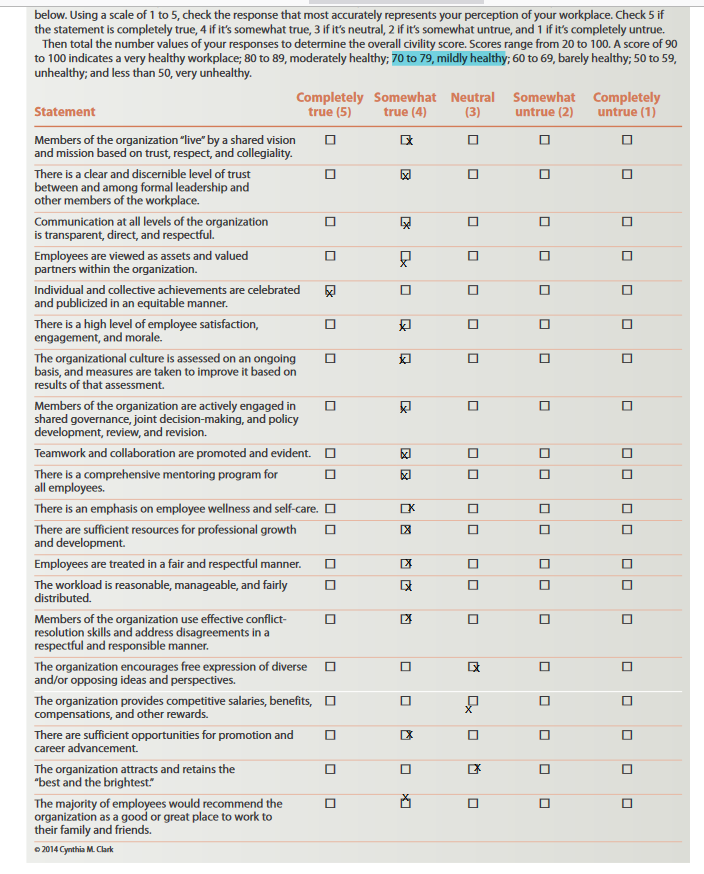
below. Using a scale of 1 to 5, check the response that most accurately represents your perception of your workplace. Check 5 if the statement Is completely true, 4 If it's somewhat true, 3 If it's neutral, 2 if it's somewhat untrue, and 1 if it's completely untrue. Then total the number values of your responses to determine the overall civility score. Scores range from 20 to 100. A score of 90 to 100 indicates a very healthy workplace; 80 to 89, moderately healthy; 70 to 79, mildly healthy; 60 to 69, barely healthy; 50 to 59, unhealthy; and less than 50, very unhealthy. Completely Somewhat Neutral Somewhat Completely Statement true (5) true (4) (3) untrue (2) untrue (1) Members of the organization \"live\" by a shared vision 0 X ] O ] and mission based on trust, respect, and collegiality. There is a clear and discernible level of trust O & O a O between and among formal leadership and ather members of the workplace. Communication at all levels of the organization O Gd O a O is transparent, direct, and respectful. Employees are viewed as assets and valued O EI ] O O partners within the organization. Individual and collective achievements are celebrated b O O O O and publicized in an equitable manner. There s a high level of employee satisfaction, O i O O O engagement, and morale. The organizational culture |5 assessed on an ongoing O ] O a O basis, and measures are taken to improve it based on results of that assessment. Members of the organization are actively engaged in M ] | | 0 ] shared governance, joint decision-making, and policy development, review, and revision. Teamwork and collaboration are promoted and evident. [ kel O o O There ks a comprehensive mentoring program for I} bl O a O all employees. There is an emphasis on employee wellness and self-care. O K O a O There are sufficient resources for professional growth O A O a O and development. Employees are treated in a fair and respectful manner. O =3 ] O O The workload is reasonable, manageable, and fairly O |5 ] O O distributed. Members of the organization use effective conflict- - O O O resolution skills and address disagreements in a respectiul and responsible manner, The organization encourages free expression of diverse [0 E:l X O O and/or opposing ideas and perspectives. The organization provides competitive salaries, benefits, [0 O ch.l O O compensations, and other rewards. There are sufficient opportunities for promotion and O x ] a O career advancement. The organization attracts and retains the O a O O \"best and the brightest\" The majority of employees would recommend the o B O a O organization as a good or great place to work to their family and friends. 3014 Cynthia M. Clark
Step by Step Solution
There are 3 Steps involved in it

Get step-by-step solutions from verified subject matter experts
 Study Help