







Question: Select your a diagnosis from the DSM-5. using your information found through a search of the literature available on your selected diagnosis using appropriate references
Select your a diagnosis from the DSM-5. using your information found through a search of the literature available on your selected diagnosis using appropriate references of peer reviewed journal articles and scholarly textbooks that may be found in DATABASES/LIBRARIES and by searching the internet.
At least 5 peer-reviewed journal articles must be used.
- Briefly describe its major features including the appropriate diagnostic criteria as per DSM 5. Use your own words. Do not regurgitate/copy and paste the DSM.
- Review the "disorder's" creation, history, and development.
- When was it created?
- Did it have a life before the first DSM? Was it known by other names? If yes, discuss.
- Did its fundamental criteria change over time?
- Describe the changes if they occurred and explain the rationales offered for such changes?
- What is the general course of treatment/intervention for this disorder? Include all modalities/options.
- What is significant in terms of diversity/culture? Are minorities/populations at risk over or under diagnosed? Is oppression an issue? In what way does this population need advocacy? Are there ethical issues associated with this particular diagnosis?
- Review the studies if any that claim to establish the reliability and validity of the mental disorder (the two scientific characteristics necessary to claim the reality of hypothesized categories). If none exist please so note. 1. Discuss whether or not the articles establish their reliability or validity claims. 2. Explain how you determined this. Give the reliability coefficients from the articles you reviewed. If you've found no such studies (assuming that you did a thorough review of the literature) speculate how and why they came to be in the DSM nosology.
5. Based on your readings and research discuss what you see as the value and/or difficulty, if any, of this diagnosis within the DSM.
References:
- Gray, S., Zide, M. (2016) Psychopatholgy: A Competency-Based AssessmentModel for Social Workers. (4th ed.). Cengage Learning.
American Psychiatric Association. (2013).Diagnostic and statistical manual of mental disorders(5th ed.)
- DSM-5:https://dsm-psychiatryonline-org.proxy.lib.fsu.edu/doi/book/10.1176/appi.books.9780890425596Links to an external site.
- DSM-5-TR:https://dsm-psychiatryonline-org.proxy.lib.fsu.edu/doi/book/10.1176/appi.books.9780890425787
- Pomeroy, E. (2015). The Clinical Assessment Workbook: Balancing Strengths and Differential Diagnosis. (2nd Ed). Cengage Learning.
Rubric:
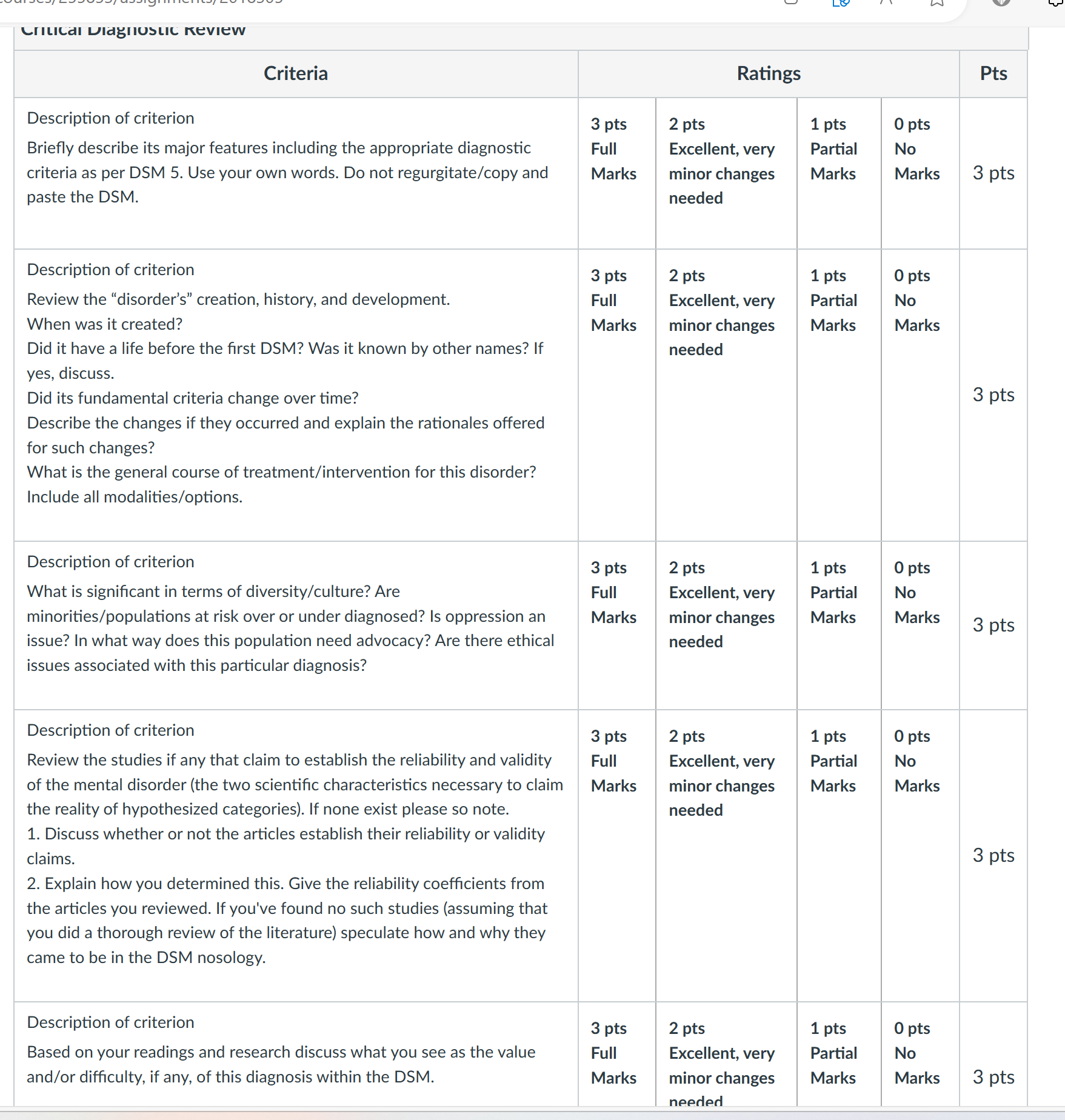
Critical Diagnostic Review Description of criterion Criteria Briefly describe its major features including the appropriate diagnostic criteria as per DSM 5. Use your own words. Do not regurgitate/copy and paste the DSM. 3 Ratings Pts 3 pts 2 pts 1 pts O pts Full Excellent, very Partial Marks minor changes needed Marks No Marks 3 pts Description of criterion Review the "disorder's" creation, history, and development. 3 pts Full 2 pts 1 pts O pts Excellent, very Partial No When was it created? Marks Did it have a life before the first DSM? Was it known by other names? If yes, discuss. minor changes needed Marks Marks Did its fundamental criteria change over time? Describe the changes if they occurred and explain the rationales offered for such changes? What is the general course of treatment/intervention for this disorder? Include all modalities/options. Description of criterion What is significant in terms of diversity/culture? Are minorities/populations at risk over or under diagnosed? Is oppression an issue? In what way does this population need advocacy? Are there ethical issues associated with this particular diagnosis? 3 pts 3 pts Full 2 pts Excellent, very 1 pts O pts Marks minor changes needed Partial Marks No Marks 3 pts 3 pts Full 2 pts Excellent, very minor changes needed 1 pts Partial Marks O pts No Marks Description of criterion Review the studies if any that claim to establish the reliability and validity of the mental disorder (the two scientific characteristics necessary to claim the reality of hypothesized categories). If none exist please so note. 1. Discuss whether or not the articles establish their reliability or validity claims. 2. Explain how you determined this. Give the reliability coefficients from the articles you reviewed. If you've found no such studies (assuming that you did a thorough review of the literature) speculate how and why they came to be in the DSM nosology. Marks 3 pts Description of criterion Based on your readings and research discuss what you see as the value and/or difficulty, if any, of this diagnosis within the DSM. 3 pts Full 2 pts Excellent, very 1 pts Partial O pts No Marks minor changes needed Marks Marks 3 pts
Step by Step Solution
There are 3 Steps involved in it
Major Depressive Disorder MDD Major Features and Diagnostic Criteria Major Depressive Disorder MDD is characterized by persistent sadness or low mood and a lack of interest or pleasure in activities t... View full answer

Get step-by-step solutions from verified subject matter experts
 Study Help