







Question: Sequence Job 1 E 2 E 3 E 4 E 5 E l'e total flow time for the sequence developed using the EDD rule 2
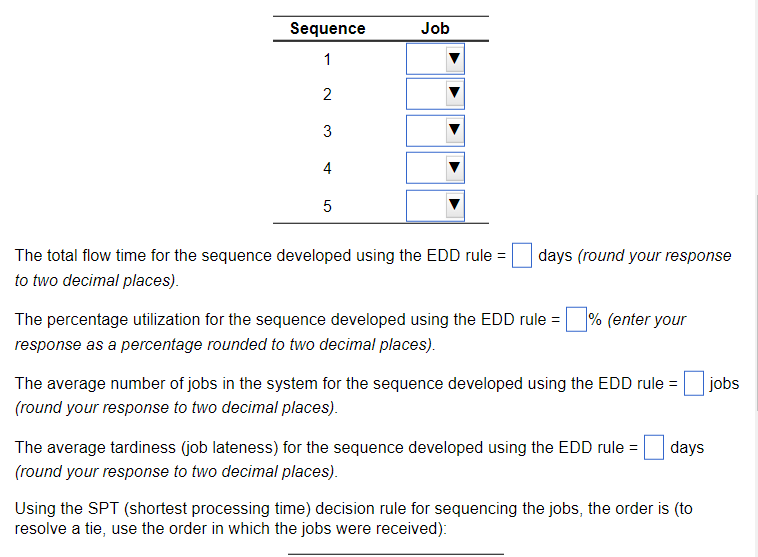
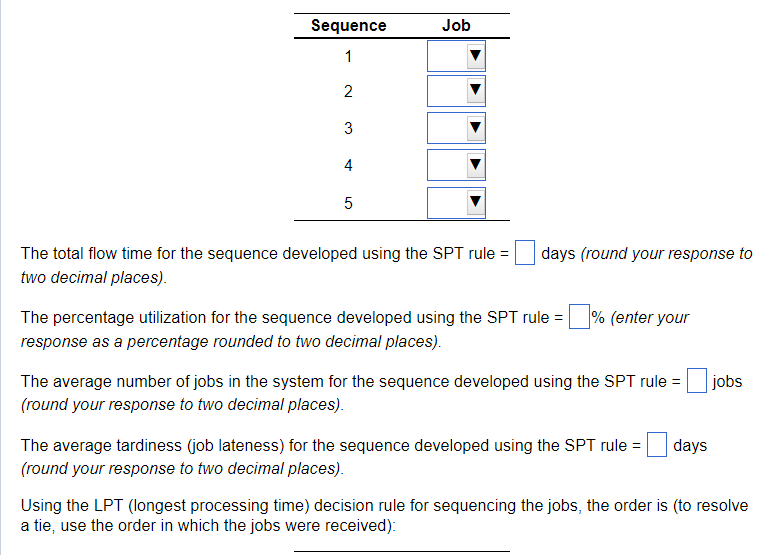
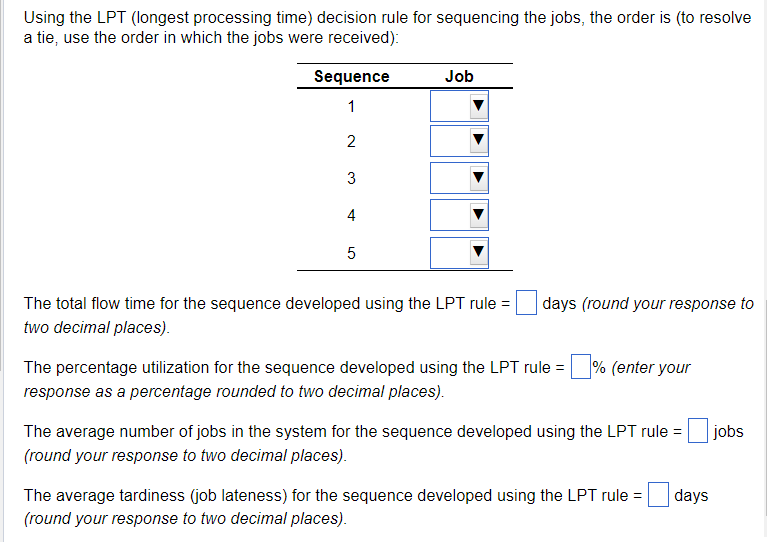
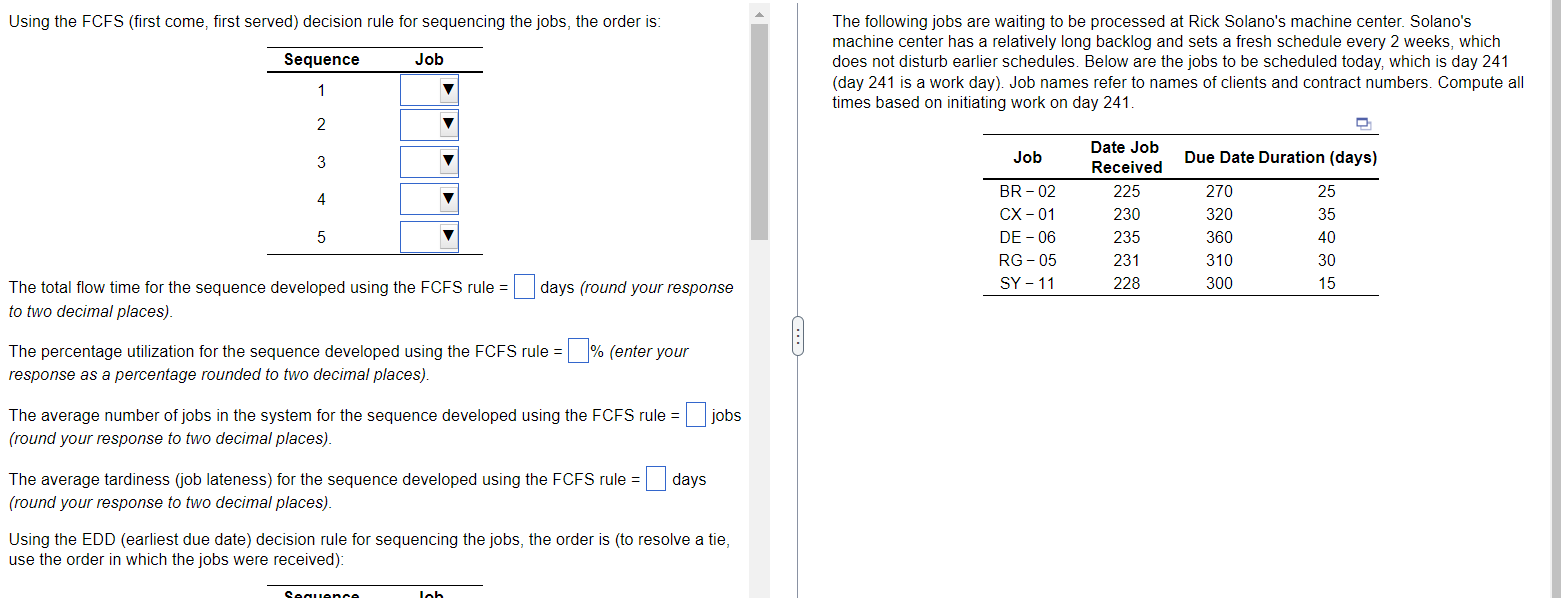
Sequence Job 1 E 2 E 3 E 4 E 5 E "l'e total flow time for the sequence developed using the EDD rule 2 I: days (round your response to two decimal places}. "l'e percentage utilization for the sequence developed using the EDD rule 2 |:|% (enteryour response as a percentage rounded to two decimal places). "l'e average number otjohs in the system for the sequence developed using the EDD rule 2 I: jobs (round your response to two decimal places). "l'e average tardiness (job lateness} for the sequence developed using the EDD rule 2 I: days (round your response to two decimal places). Using the EFT (shortest processing time) decision rule for sequencing the jobs, the order is {to resolve a tie, use the order in which the jobs were received): Sequence Job 2 4 5 The total flow time for the sequence developed using the SPT rule = days (round your response to two decimal places). The percentage utilization for the sequence developed using the SPT rule = % (enter your response as a percentage rounded to two decimal places). The average number of jobs in the system for the sequence developed using the SPT rule = jobs (round your response to two decimal places). The average tardiness (job lateness) for the sequence developed using the SPT rule = days (round your response to two decimal places). Using the LPT (longest processing time) decision rule for sequencing the jobs, the order is (to resolve a tie, use the order in which the jobs were received):Using the LPT (longest processing time) decision rule for sequencing the jobs, the order is (to resolve a tie, use the order in which the jobs were received): Sequence Job N 3 4 5 The total flow time for the sequence developed using the LPT rule = days (round your response to two decimal places). The percentage utilization for the sequence developed using the LPT rule = % (enter your response as a percentage rounded to two decimal places). The average number of jobs in the system for the sequence developed using the LPT rule = jobs (round your response to two decimal places). The average tardiness (job lateness) for the sequence developed using the LPT rule = days (round your response to two decimal places).Using the FCFS (first come, first served) decision rule for sequencing the jobs, the order is: The following jobs are waiting to be processed at Rick Solano's machine center. Solano's machine center has a relatively long backlog and sets a fresh schedule every 2 weeks, which Sequence Job does not disturb earlier schedules. Below are the jobs to be scheduled today, which is day 241 (day 241 is a work day). Job names refer to names of clients and contract numbers. Compute all times based on initiating work on day 241. N Date Job Job Received Due Date Duration (days) BR - 02 225 270 25 CX - 01 230 320 35 5 DE - 06 235 360 40 RG - 05 231 310 30 The total flow time for the sequence developed using the FCFS rule = days (round your response SY - 11 228 300 15 to two decimal places). The percentage utilization for the sequence developed using the FCFS rule = % (enter your response as a percentage rounded to two decimal places). The average number of jobs in the system for the sequence developed using the FCFS rule = jobs (round your response to two decimal places). The average tardiness (job lateness) for the sequence developed using the FCFS rule = days (round your response to two decimal places). Using the EDD (earliest due date) decision rule for sequencing the jobs, the order is (to resolve a tie, use the order in which the jobs were received)
Step by Step Solution
There are 3 Steps involved in it

Get step-by-step solutions from verified subject matter experts
 Study Help