







Question: Several tasks are submitted to a computer system with two processors, P_1 and P_2, working in parallel. The process of submitting tasks can be described
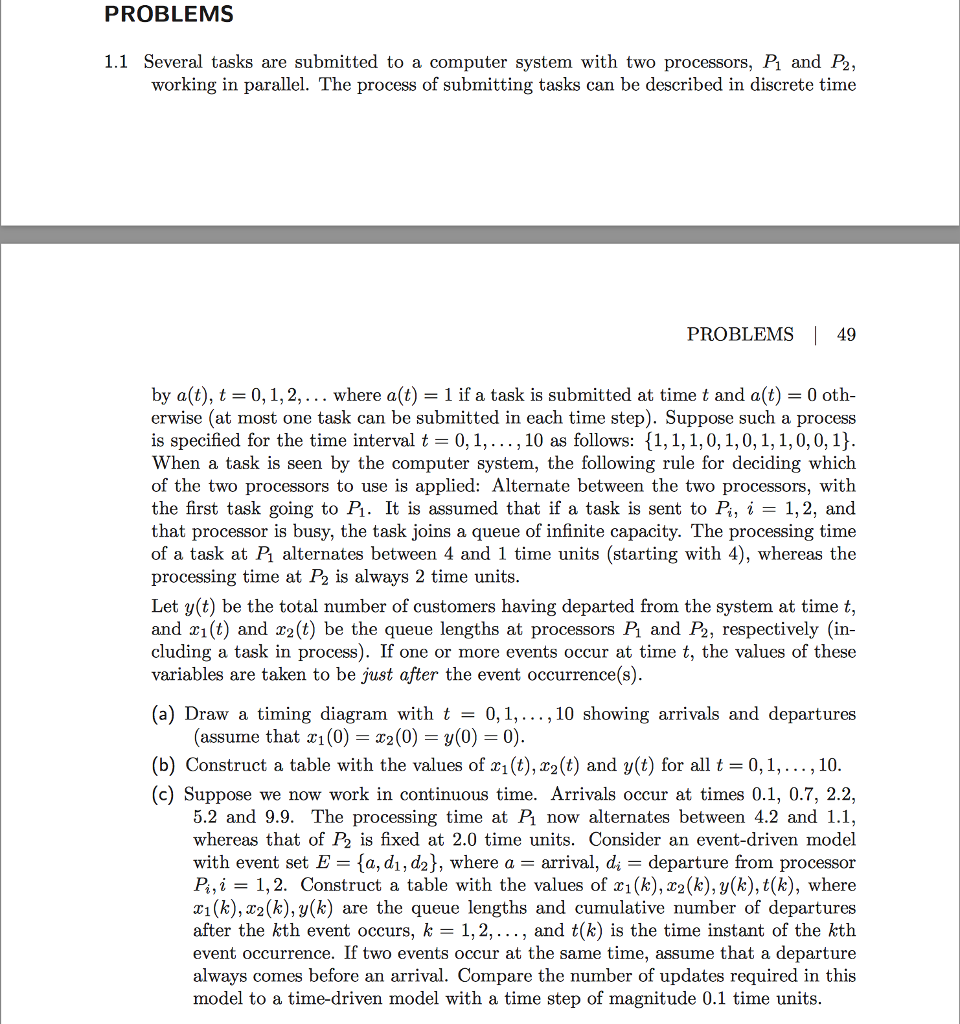
Several tasks are submitted to a computer system with two processors, P_1 and P_2, working in parallel. The process of submitting tasks can be described in discrete time by a(t), t = 0, 1, 2, ... where a(t) = 1 if a task is submitted at time t and a(t) = 0 otherwise (at most one task can be submitted in each time step). Suppose such a process is specified for the time interval t = 0, 1, ..., 10 as follows: {1, 1, 1, 0, 1, 0, 1, 1, 0, 0, 1}. When a task is seen by the computer system, the following rule for deciding which of the two processors to use is applied: Alternate between the two processors, with the first task going to P_1. It is assumed that if a task is sent to P_i, i = 1, 2, and that processor is busy, the task joins a queue of infinite capacity. The processing time of a task at P_1 alternates between 4 and 1 time units (starting with 4), whereas the processing time at P_2 is always 2 time units. Let y(t) be the total number of customers having departed from the system at time t, and x_1 (t) and x_2 (t) be the queue lengths at processors P_1 and P_2, respectively (including a task in process). If one or more events occur at time t, the values of these variables are taken to be just after the event occurrence(s). (a) Draw a timing diagram with t = 0, 1, ..., 10 showing arrivals and departures (assume that x_1(0) = x_2(0) = y(0) = 0). (b) Construct a table with the values of x_1(t), x_2(t) and y(t) for all t = 0, 1, ..., 10. (c) Suppose we now work in continuous time. Arrivals occur at times 0.1, 0.7, 2.2, 5.2 and 9.9. The processing time at P_1 now alternates between 4.2 and 1.1, whereas that of P_2 is fixed at 2.0 time units. Consider an event-driven model with event set E = {a, d_1, d_2}, where a = arrival, d_i = departure from processor P_i, i = 1, 2. Construct a table with the values of x_1(k), x_2(k), y(k), t(k), where x_1(k), x_2(k), y(k) are the queue lengths and cumulative number of departures after the kth event occurs, k = 1, 2, ..., and t(k) is the time instant of the kth event occurrence. If two events occur at the same time, assume that a departure always comes before an arrival. Compare the number of updates required in this model to a time-driven model with a time step of magnitude 0.1 time units
Step by Step Solution
There are 3 Steps involved in it

Get step-by-step solutions from verified subject matter experts
 Study Help